💳 Pay Now |
✍️ Learning Center

A complete, up-to-date breakdown of the GST rate on milk, the correct HSN code, which dairy items are exempt, and how to get your dairy business GST-registered — without the paperwork headache.
All-inclusive professional fee. Government fee, if any, extra.
Trusted by 50,000+ businesses across India
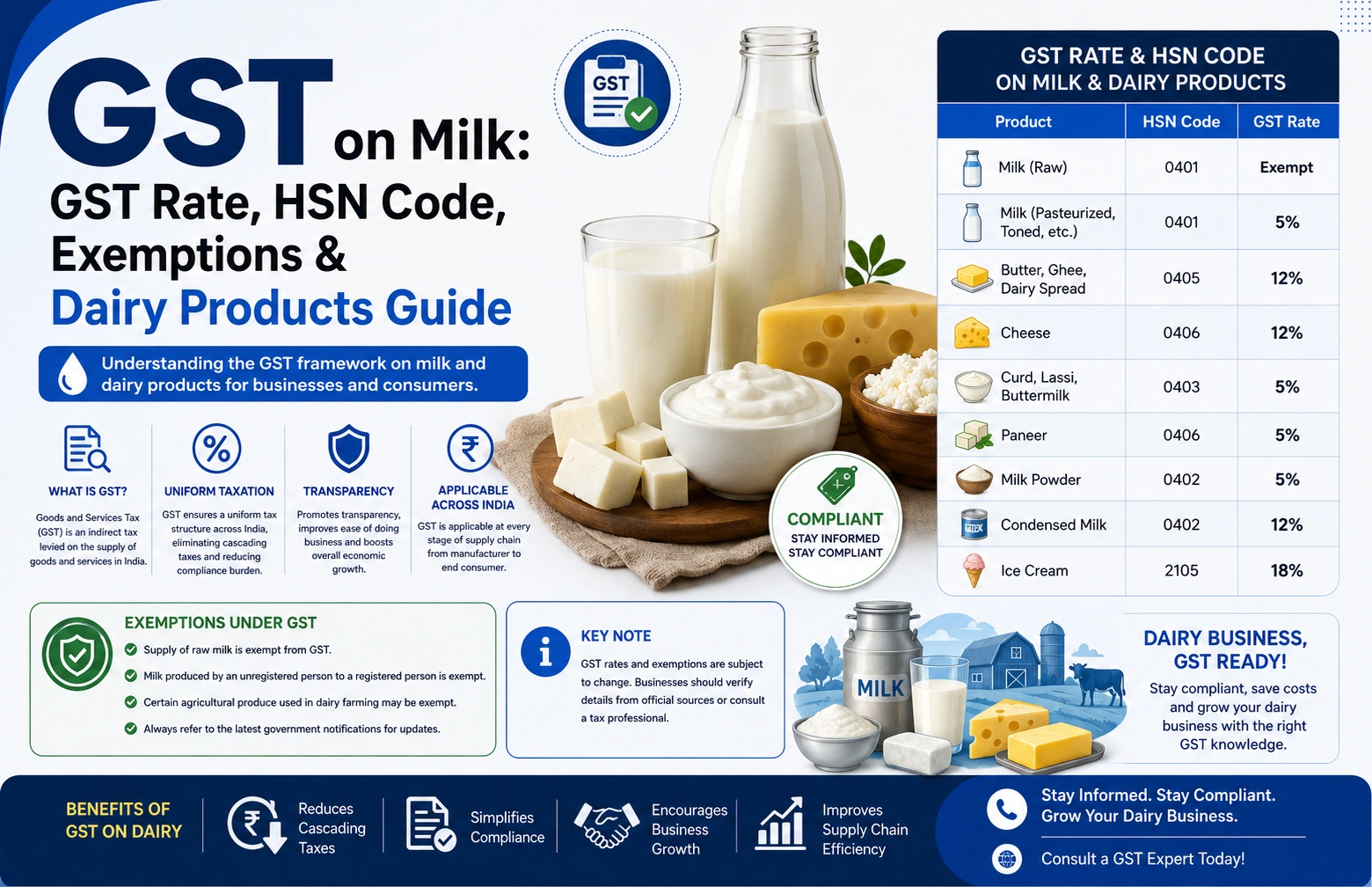
Fresh milk, pasteurised milk and UHT milk fall under HSN code 0401 and are currently exempt from GST (Nil rate). Once milk is turned into a value-added product such as ghee, butter, cheese or milk powder, GST typically applies at 5% under the relevant Chapter 4 HSN code, while loose curd, lassi and paneer remain exempt.
On this page
Milk is treated as a basic food item under India's Goods and Services Tax law, so the government keeps it largely tax-free to protect affordability for households and support the dairy farming sector. GST on milk depends heavily on the form the milk is sold in — loose, pasteurised, UHT-treated, flavoured, or converted into a processed dairy product like ghee or paneer. The moment milk is processed, branded, or blended with other ingredients, it usually moves out of the exempt category and into a taxable slab, most often 5%.
For dairy farmers, milk processing units, kirana stores and online sellers, getting the GST rate and HSN code right is not optional — an incorrect rate on an invoice can trigger notices, blocked input tax credit, and penalties. This guide breaks down the exact GST rate, HSN code and exemption rules for milk and every major dairy product, and shows you how to complete your GST registration in a single sitting.
Under the current GST structure, fresh milk, pasteurised milk and UHT (Ultra-High Temperature) milk are all placed in the Nil-rated category, meaning no GST is charged on them regardless of whether they are sold loose or in a sealed, branded pack. This exemption applies as long as the milk itself is not sweetened, flavoured, or mixed with other additives.
Once milk is flavoured — for example, chocolate or badam milk sold as a ready-to-drink beverage — it is usually reclassified as a beverage under a different HSN heading and attracts GST, commonly at 5%. The same shift happens with condensed milk, milk powder, and cream, all of which are treated as processed dairy products rather than plain milk.
Milk and dairy items fall under Chapter 4 of the GST tariff schedule. The specific HSN code depends on the exact product:
| Product | HSN Code | GST Rate |
|---|---|---|
| Fresh milk (loose or packaged, unsweetened) | 0401 | Nil |
| Pasteurised milk | 0401 | Nil |
| UHT milk | 0401 | Nil |
| Cream (unsweetened) | 0401 / 0402 | 5% |
| Milk powder (skimmed / whole) | 0402 | 5% |
| Condensed milk | 0402 | 5% |
Value-added dairy products are taxed differently from plain milk. Here is the current rate applicable to the most common dairy items:
| Dairy Product | HSN Code | GST Rate |
|---|---|---|
| Curd, lassi & buttermilk (loose or packaged) | 0403 | Nil |
| Paneer / chena (loose or pre-packaged) | 0406 | Nil |
| Cheese | 0406 | 5% |
| Butter | 0405 | 5% |
| Ghee | 0405 | 5% |
| Flavoured milk / milk-based drinks | 2202 | 5% |
| Milk cans | 7310 | 5% |
| Ice cream | 2105 | 18% |
Rates reflect the GST 2.0 rationalisation effective from 22 September 2025. Rates can be revised by GST Council notifications — always confirm the latest rate before invoicing. For the paperwork side of this, see our current GST registration fees in India.
Selling dairy products and need a GST number to invoice correctly?
The following items are currently exempt from GST, provided they meet the stated conditions:
Items that move out of exemption once branded, flavoured, or processed further — such as cheese, butter, ghee, milk powder and flavoured milk — are explained in the dairy products table above. If you want to understand how tax is calculated once an item becomes taxable, our note on reverse charge mechanism (RCM) under GST is a useful next read for dairy traders who buy from unregistered farmers.
Even though fresh milk itself is exempt, most dairy businesses still need GST registration — because they usually sell a mix of exempt items (loose milk, curd) and taxable items (ghee, butter, cheese, packaged paneer), or because their turnover crosses the threshold limit for registration. Being registered also lets you claim Input Tax Credit on packaging, transport, machinery and other taxable purchases, issue GST-compliant invoices to retailers and distributors, and bid for larger B2B and government dairy supply contracts that require a valid GSTIN.
Before you finalise a brand name for your dairy line, it's worth taking a moment to run a free trademark search before naming your dairy brand, so your packaging and marketing spend is protected from day one.
For a longer, category-wise breakdown, see the full checklist of documents required for GST registration.
Send your business name, address and product list (milk, paneer, ghee, etc.) to our team via WhatsApp or the Apply Now link.
Upload PAN, Aadhaar, address proof and a photograph through our secure online form — no office visit needed.
Our team checks your paperwork for errors, classifies your dairy products under the correct HSN codes, and files your application on the GST portal.
If the GST officer raises a clarification, we draft and submit the reply on your behalf within the deadline.
Once approved, you get your GST Registration Certificate along with the User ID and Password of the GST Portal.
Begin billing with the correct GST rate — Nil for exempt items like loose milk, and 5% for taxable dairy products.
Registered dairy businesses need to file periodic GST returns even in months where only exempt goods like fresh milk were sold. If there was genuinely no taxable turnover, you can follow our step-by-step guide to filing a Nil GST return to stay compliant without extra cost. If your business status or turnover changes and you need to confirm where your application stands, you can always check your GST registration status using ARN, and if you ever wind down operations, review the process for cancellation of GST registration to close things out cleanly.
Planning to scale from a small dairy unit into a full processing plant? Start with a solid project report for a dairy farm — lenders and investors will ask for one before releasing funds.
Get your GST number, certificate and portal login handled end-to-end.
No. Fresh, pasteurised and UHT milk are Nil-rated under HSN code 0401, so no GST is charged on plain milk, whether sold loose or in a sealed pack.
Plain milk falls under HSN code 0401. Processed products like milk powder and condensed milk fall under HSN 0402, while butter and ghee fall under HSN 0405.
Paneer and chena are exempt from GST (Nil rate) under HSN code 0406, whether sold loose, branded, or pre-packaged and labelled.
Yes. Ghee and butter are taxed at 5% GST under HSN code 0405.
If you sell only exempt items like loose fresh milk, registration may not be mandatory below the threshold limit. However, most dairy sellers also stock taxable items like ghee, paneer or packaged curd, and cross the turnover threshold, which makes GST registration necessary.
Flavoured or sweetened milk is treated as a beverage under HSN 2202 and attracts 5% GST, unlike plain unflavoured milk which is exempt.
Once your documents are verified and uploaded correctly, GST registration typically takes a few working days, subject to processing time on the GST portal.
You receive your GST Registration Certificate along with the User ID and Password of the GST Portal, which you use to file returns and manage your account.
GST Registration Certificate, and your GST Portal User ID & Password — handled by our team, starting at ₹999. Join 50,000+ businesses who registered with us.
This article is for general informational purposes only and reflects GST rates known at the time of publishing. GST rates and HSN classifications are subject to change by CBIC/GST Council notifications — please verify current rates before filing or invoicing, or speak with our team for the latest guidance.