💳 Pay Now |
✍️ Learning Center
A complete, easy-to-follow guide on RCM applicability, rates, ITC claim and compliance for small businesses and proprietors in India.
Talk to a GST Expert on WhatsApp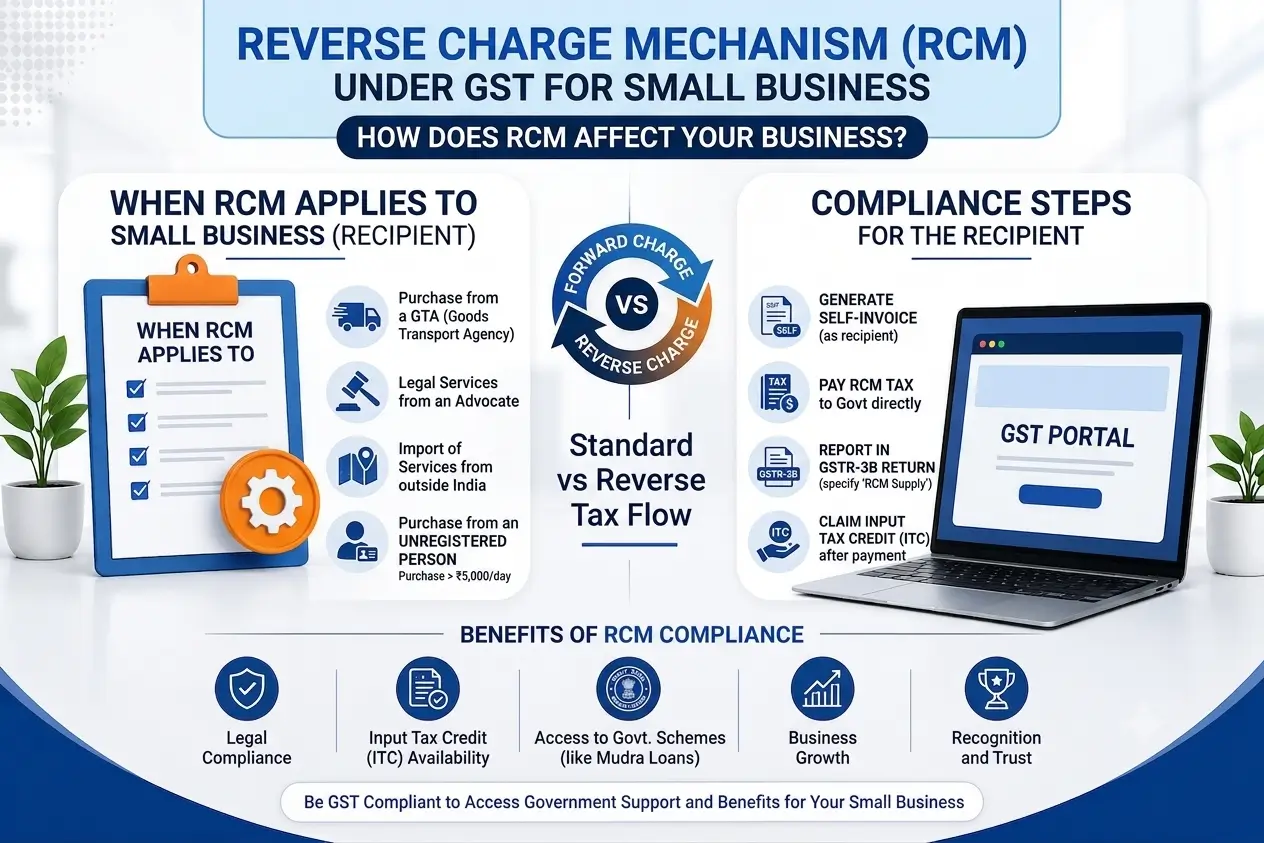
Most small business owners assume GST is only about charging tax to customers. But under the Reverse Charge Mechanism (RCM), it is the buyer, not the seller, who has to pay GST directly to the government in certain situations. If you run a small business, freelance practice, or proprietorship firm, understanding RCM is essential to avoid notices, interest and penalties. This guide explains RCM in plain language, with examples, a compliance checklist and answers to the most common questions small business owners ask.
Under normal GST rules, the supplier of goods or services collects GST from the buyer and deposits it with the government. Reverse Charge Mechanism flips this responsibility. Under RCM, the recipient of goods or services becomes liable to pay GST directly, instead of the supplier. This mechanism was introduced under Section 9(3) and Section 9(4) of the CGST Act to widen the tax base and bring unregistered or specific categories of suppliers into the GST net indirectly.
For a small business, this means that even if you are registered under GST purely to claim input credit or run day-to-day operations, certain purchases will require you to self-assess and pay GST — regardless of whether the supplier has charged it or not.
Small businesses frequently deal with goods transport agencies, legal consultants, imported services, or unregistered suppliers — all common RCM triggers. Since RCM liability is self-assessed, the department does not remind you separately. Missing an RCM entry is one of the most common reasons small businesses receive GST notices during audits and reconciliations. If your turnover already requires GST registration for small business, RCM compliance becomes automatically applicable to you.
Some of the most common categories that apply to small businesses include:
| Category | Example | Who Pays GST |
|---|---|---|
| Goods Transport Agency (GTA) | Freight paid to a transporter without GST charged | Recipient (business) |
| Legal Services | Fees paid to an advocate or law firm | Recipient (business) |
| Import of Services | Software subscription or consultancy from a foreign vendor | Importer (business) |
| Sponsorship Services | Payment for event or brand sponsorship | Sponsoring business |
| Director's Services | Sitting fees or commission to a company director | Company |
| Security Services | Guards supplied by an unregistered/non-body-corporate agency | Recipient (registered business) |
This list is illustrative and the applicable notification list should always be checked before filing. If you are unsure whether a purchase attracts RCM, our team can review your GST registration and compliance documents and guide you.
Under RCM, the buyer calculates GST at the applicable rate for that supply and deposits it in cash — RCM liability cannot be set off using existing Input Tax Credit balance. Payment is made through the electronic cash ledger while filing GSTR-3B for the relevant month. Once paid, the same amount becomes available as Input Tax Credit (subject to eligibility) in the same or a later return period, provided the goods or services are used for business purposes.
A common misconception is that RCM tax is a pure cost. In most cases, once GST is paid under RCM, the business can claim it back as ITC in the same return, provided:
Follow this simple process every month to stay compliant:
Note: RCM applies even if your business is otherwise below the standard GST registration threshold limit, if you are registered voluntarily or under mandatory categories. Always verify the correct HSN/SAC code and rate using our HSN code finder tool before filing.
If RCM liability is not paid on time, the business becomes liable for interest at 18% per annum from the due date, along with possible penalty during scrutiny or audit. Since GTA and legal service payments are common in almost every small business, unpaid RCM is one of the top reasons for GST show cause notices. Timely and accurate GST return filing before the due date is the simplest way to avoid this exposure.
Our GST experts at Setupfiling.in help small businesses identify RCM liability, file returns accurately and avoid penalties.
Chat on WhatsApp: +91 9818209246 Get GST Filing SupportReverse Charge Mechanism is a GST provision where the recipient of goods or services, instead of the supplier, is responsible for paying GST directly to the government. It applies to specific notified goods, services and unregistered supplier transactions.
Yes. Any GST-registered small business, including proprietorships, must pay RCM on notified purchases such as goods transport agency freight, legal services and imported services, regardless of its annual turnover.
No. GST under RCM must be paid only in cash through the electronic cash ledger. It cannot be adjusted against available Input Tax Credit balance.
Yes, in most cases the GST paid under RCM can be claimed back as Input Tax Credit in the same return period, provided the purchase relates to business use and the credit is not restricted under Section 17(5).
Freight paid to Goods Transport Agencies, legal or advocate fees, import of services, sponsorship payments and director's remuneration are among the most common RCM-triggering transactions for small businesses.
Non-payment of RCM liability attracts interest at 18% per annum from the due date and can lead to penalties or a show cause notice during GST audit or scrutiny.
Yes. When the supplier is unregistered, the recipient must issue a self-invoice recording the taxable value and applicable GST rate to correctly report and pay RCM liability.
Managing RCM manually can be error-prone, especially when your business scales. For end-to-end assistance with GST registration, RCM compliance and monthly return filing, connect with our team directly.