💳 Pay Now |
✍️ Learning Center

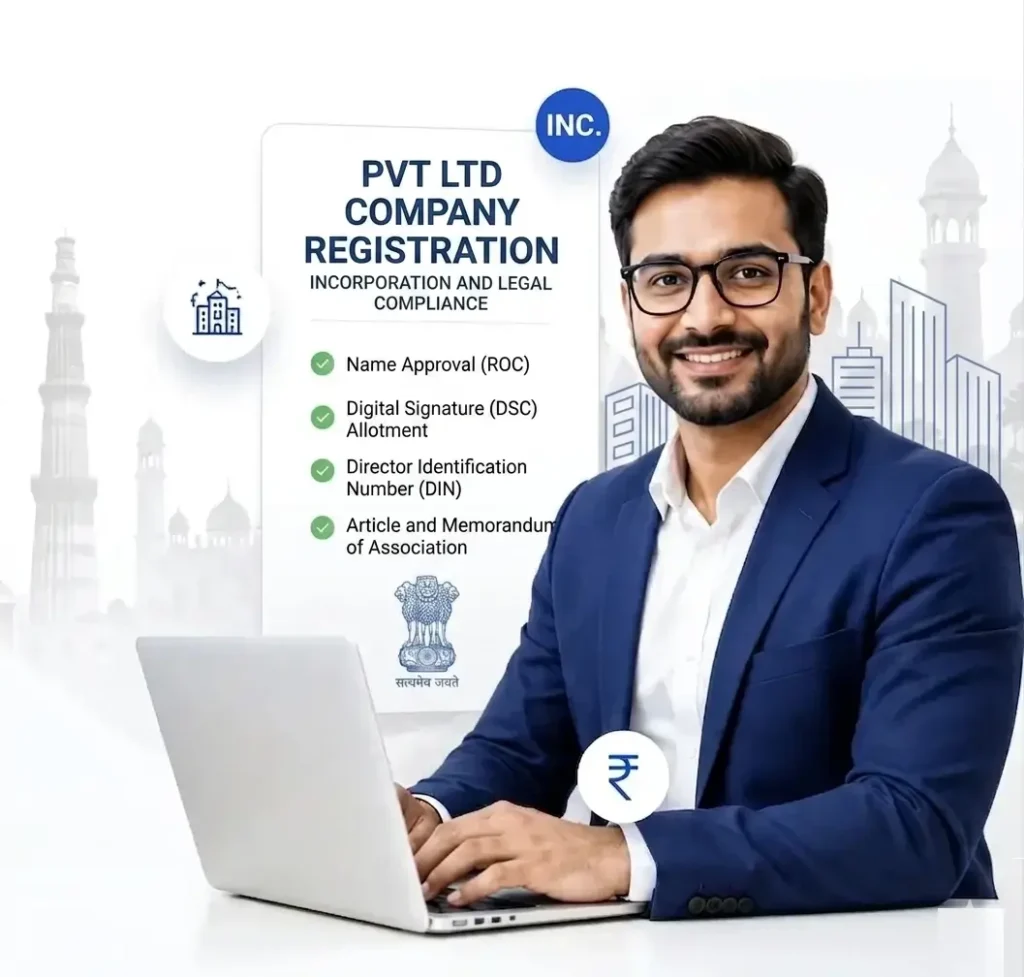
Start your dream business today with easy and hassle-free Private Limited company registration. Get expert support, quick documentation, and smooth approval processes at affordable pricing. Register your company confidently and build a trusted brand with complete legal compliance and professional guidance from start to finish.
Company Registered
Day to Complete
Online Process
Years CA Expertise
A Private Limited Company (Pvt Ltd) is the most preferred business structure for startups and growing businesses in India. Governed by the Companies Act, 2013 and regulated by the Ministry of Corporate Affairs (MCA), it offers a powerful combination of limited liability, separate legal entity status, and the ability to raise funds from investors.
When you register a Private Limited Company, your personal assets are protected from business liabilities. The company can own property, enter into contracts, and sue or be sued in its own name — completely independent of its shareholders and directors.
With the introduction of the SPICe+ (Simplified Proforma for Incorporating Company Electronically Plus) form by MCA, the entire company registration process in India is now seamless, online, and faster than ever before.
The registration process for a Private Limited Company in India requires certain basic documents and criteria to be fulfilled. Here’s what you need:
Choosing the right business structure is one of the most important decisions for any entrepreneur. Here’s why a Pvt Ltd remains the gold standard in India.
Shareholders' personal assets are fully protected. Your liability is limited to the amount invested in the company — nothing more.
The company exists independently of its founders. It can own assets, sign contracts, and continue operations regardless of ownership changes.
Venture capitalists, angel investors, and banks prefer lending to Pvt Ltd companies. Issue equity shares and preference shares to raise capital.
A registered company commands greater trust from customers, vendors, banks, and government bodies compared to sole proprietorships or partnerships
The company continues to exist even if directors or shareholders change, resign, or pass away — ensuring business continuity at all times.
Pvt Ltd companies can register under DPIIT's Startup India scheme and avail tax exemptions, fast-track patent filing, and other government incentives.
Incorporating a company through Simplified Proforma for Incorporating Company electronically (SPICe -INC-32), with eMoA (INC-33), eAOA (INC-34), is the default option and most companies are required to be incorporated through SPICe only. The following are the steps involved in registering a company in India:
To reserve the company name, an application for company name approval is first submitted to the Ministry of Corporate Affairs. 1 or 2 names with business objective might be included in the name approval application. If a name approval is denied, one or two additional names may be presented. All name approval applications are typically approved by the MCA in less than 5 business days.
In India, the Ministry of Corporate Affairs does not allow wet signatures. All signatures for filings with the MCA must be completed with a digital signature that is issued by a Certification Authority in India. Hence, digital signatures are mandatorily required for the Directors before incorporation.
To obtain Digital Signature, the Directors will have to submit a copy of their identity proof and complete a video KYC process. If the Director is a foreign national, the passport and other documents submitted must be apostilled by a local embassy.
Once the digital signatures are obtained, the incorporation application can be filed in SPICe Form to the MCA with all relevant attachments. Along with the incorporation application, the Memorandum of Association (MOA) and Articles of Association (AOA) of the company are filed.
If the MCA finds the incorporation application to be complete and acceptable, the Incorporation Certificate is granted along with PAN of the company. The MCA normally accepts all incorporation applications in less than 5 working days.
The process generally takes 7-10 business days to complete. However, this timeline can vary based on the completeness of your documents and any additional steps that may be required for your business.
Receiving your Certificate of Incorporation is just the beginning. The first 30–90 days after incorporation are critical. Missing these immediate post-incorporation compliances can lead to penalties and legal complications down the line.
Open a dedicated current bank account in the company’s name within 30 days of incorporation. Required documents include COI, MOA, AOA, PAN card, board resolution, and KYC of directors. Avoid mixing personal and business finances from Day 1.
Share certificates must be issued to all shareholders within 60 days of allotment under Section 56(4)(b) of the Companies Act, 2013. These must be properly stamped and signed by two directors (or one director + company secretary).
The company’s name, registered address, and Corporate Identity Number (CIN) must be displayed outside every office/place of business and on all business letterheads, emails, bills, and invoices — this is a legal obligation under Section 12 of the Companies Act.
The first board meeting must be held within 30 days of incorporation (Section 173). Key agenda items include appointment of the first auditor, disclosure of interest by directors (Form MBP-1), opening of bank account, and adoption of common seal if applicable.
Under Section 139(6), a company’s Board of Directors must appoint the first Statutory Auditor within 30 days of incorporation. The appointed auditor holds office until the conclusion of the first Annual General Meeting (AGM). File Form ADT-1 with MCA within 15 days of appointment.
Every company incorporated on or after November 2, 2018 must file Form INC-20A (Declaration of Commencement of Business) within 180 days of incorporation. Failure attracts a penalty of ₹50,000 on the company and ₹1,000 per day on defaulting officers. This is non-negotiable.
Understanding your company’s tax obligations from Day 1 prevents costly penalties and helps you plan cash flows better. Here is a complete overview of taxes applicable to a Pvt Ltd company in India.
A Private Limited Company is taxed as a separate legal entity under the Income Tax Act, 1961. The applicable tax rates depend on the company’s annual turnover and the tax regime chosen.
| Category | Tax Rate | Surcharge | Effective Rate (approx.) |
|---|---|---|---|
Domestic company — Turnover ≤ ₹400 Cr | 25% | 7% / 12% | ~26% |
Domestic company — Turnover > ₹400 Cr | 30% | 7% / 12% | ~33% |
New manufacturing company (Sec. 115BAB) | 15% | 10% | ~17% |
Optional concessional regime (Sec. 115BAA) | 22% | 10% | ~25.17% |
Health & Education Cess of 4% is levied on tax + surcharge in all cases. Companies opting for Sections 115BAA or 115BAB cannot claim most deductions under Chapter VI-A.
If a company’s regular tax liability is less than 15% of its book profits, it must pay Minimum Alternate Tax (MAT) at 15% of book profit (plus surcharge and cess) under Section 115JB of the Income Tax Act. MAT credit can be carried forward for up to 15 years and adjusted against regular tax in future years.
Note: Companies opting for the concessional regime under Section 115BAA are exempt from MAT provisions, making it a preferred choice for new and growing companies.
Post the Finance Act 2020, the classical system of dividend taxation has been restored. Dividends are now taxable in the hands of shareholders at applicable slab rates. The company must deduct TDS at 10% (Section 194) if the dividend paid to a resident shareholder exceeds ₹5,000 in a financial year. For non-resident shareholders, TDS under Section 195 applies at 20% (or lower as per DTAA).
GST registration is mandatory for a Private Limited Company if annual turnover crosses the prescribed threshold or if the company engages in inter-state supply, e-commerce, or specific notified categories. Key GST obligations include:
If a company’s estimated tax liability for the year exceeds ₹10,000, it must pay Advance Tax in four instalments during the financial year itself — rather than a lump sum at year end. Failure to pay advance tax attracts interest under Sections 234B and 234C.
| Instalment | Due Date | Cumulative % of Tax Payable |
|---|---|---|
1st Instalment | 15th June | At least 15% |
2nd Instalment | 15th September | At least 45% |
3rd Instalment | 15th December | At least 75% |
4th Instalment | 15th March | 100% |
After your company is incorporated, staying compliant with ROC and MCA filings is mandatory to avoid heavy penalties. Here’s a snapshot of key annual compliances.
| Compliance | Applicable Form | Frequency | Priority |
|---|---|---|---|
Annual Return Filing | MGT-7 / MGT-7A | Annual | Mandatory |
Financial Statements Filing | AOC-4 | Annual | Mandatory |
Income Tax Return Filing | ITR-6 | Annual | Mandatory |
Board Meetings | Minutes & Resolutions | Min. 4 per year | Mandatory |
Statutory Audit | Auditor’s Report | Annual | Mandatory |
Non-compliance can attract penalties up to ₹1 lakh+ per default and disqualification of directors. SetupFiling’s annual compliance packages ensure your company remains in good standing year-round.
Protect your brand name, logo, and tagline with a registered trademark. Prevents competitors from copying your identity. SetupFiling handles end-to-end trademark filing.
Get MSME recognition for access to government schemes, priority lending, collateral-free loans, and subsidies under the MSMED Act, 2006.
Register with DPIIT's Startup India portal for 3-year tax exemption under Section 80-IAC, fast-track patent filing, and self-certification under labour laws.
Mandatory for food businesses. Obtain FSSAI Basic, State, or Central licence based on your turnover and scale of operations before commencing food-related activities.
Required in states like Maharashtra, Karnataka, West Bengal, Gujarat, and others if you employ staff. Both the company and each director may be liable for professional tax.
Mandatory once employee count crosses 20 (EPF) or 10 (ESIC). These are typically auto-applied through SPICe+ AGILE-PRO-S but must be activated before hiring the threshold employees.
Join 50,000+ entrepreneurs who chose SetupFiling.in for fast, reliable, and affordable Company Registration in India. Get expert guidance from Day 1.
A private limited company (Pvt Ltd) is a legally registered business entity under the Companies Act, 2013 in India. It is a separate legal entity from its owners, meaning the company can own property, enter contracts, and sue or be sued in its own name. Shareholders enjoy limited liability — their personal assets are fully protected and their financial risk is restricted to the amount invested in the company. A Pvt Ltd company cannot offer its shares to the general public and restricts the transfer of shares among members. It must have a minimum of 2 and a maximum of 200 shareholders.
Any individual who is at least 18 years of age and of sound mind is eligible to become a director or shareholder of a Private Limited Company in India. There is no citizenship requirement — Indian residents, NRIs, and foreign nationals can all be directors and shareholders. The company must have a minimum of 2 directors and 2 shareholders (both roles can be filled by the same 2 individuals). At least one director must be an Indian resident, meaning they must have stayed in India for at least 182 days in the preceding calendar year. Each director must obtain a valid Director Identification Number (DIN) from the MCA.
GST registration is not mandatory for a Private Limited Company at the time of incorporation. It becomes compulsory when annual turnover crosses ₹40 lakhs for goods-based businesses or ₹20 lakhs for service-based businesses (₹10 lakhs in special category states). However, GST registration is mandatory from day one if the company is engaged in inter-state supply of goods or services, e-commerce operations, or any category notified by the government regardless of turnover. Voluntary GST registration is also available and advisable to claim input tax credits and maintain credibility with corporate clients.
A Private Limited Company is better suited for startups and businesses planning to raise venture capital, angel investment, or issue ESOPs to employees. It offers stronger investor confidence, better brand credibility, and a structured governance framework. An LLP (Limited Liability Partnership) is better for professionals, consultants, and service businesses that want limited liability with lower compliance costs and no mandatory audit below a certain threshold. If your goal is growth, fundraising, and scalability, a Pvt Ltd is the right choice. If you are a small professional firm with no plans to raise equity funding, an LLP is more cost-effective.
A Private Limited Company must have a minimum of 2 directors and can have a maximum of 15 directors. At least one of the directors must be a resident of India — defined as a person who has stayed in India for not less than 182 days during the immediately preceding financial year. Every director must hold a valid Director Identification Number (DIN) issued by the Ministry of Corporate Affairs (MCA). Directors and shareholders can be the same individuals, so a 2-person founding team can meet all minimum requirements.
A Private Limited Company (Pvt Ltd) restricts the transfer of shares, limits the number of shareholders to a maximum of 200, and cannot invite the public to subscribe to its shares or list on a stock exchange. A Public Limited Company (Ltd) can offer shares to the general public, has no upper limit on the number of shareholders, can be listed on a stock exchange, and is subject to more stringent compliance under SEBI and the Companies Act. Public Limited Companies require a minimum of 3 directors and 7 shareholders. Pvt Ltd companies are preferred for closely-held businesses, while Public Limited Companies are used for large-scale enterprises seeking public capital.
No, a single person cannot start a Private Limited Company. A Pvt Ltd requires a minimum of 2 directors and 2 shareholders. If you are a solo founder and want a company structure with limited liability, you can register a One Person Company (OPC) under the Companies Act, 2013, which allows a single promoter to own and run the company with full limited liability protection. However, OPCs must mandatorily convert to a Pvt Ltd once paid-up capital exceeds ₹50 lakhs or turnover exceeds ₹2 crore in three consecutive years.
The main disadvantages of a Private Limited Company include: (1) Higher compliance burden — mandatory statutory audit, annual ROC filings (MGT-7 and AOC-4), board meetings, and income tax returns; (2) Higher cost of maintenance compared to a sole proprietorship or LLP; (3) Shares cannot be listed on a stock exchange, limiting access to public capital; (4) Transfer of shares is restricted and requires board approval as per the Articles of Association; (5) Greater regulatory scrutiny from the Registrar of Companies (RoC) and MCA. Despite these, the benefits of limited liability, separate legal entity, and investment-readiness outweigh the drawbacks for most businesses.
A Private Limited Company can have a minimum of 2 shareholders and a maximum of 200 shareholders at any given point in time. Shareholders who hold shares under an Employee Stock Option Plan (ESOP) are excluded from this 200-member limit. Shareholders can be individual persons or corporate entities and can include Indian residents, NRIs, or foreign nationals subject to applicable FDI (Foreign Direct Investment) regulations under the FEMA framework.
A One Person Company (OPC) is ideal for a solo entrepreneur who wants limited liability and a corporate identity without needing a co-founder. An OPC can be run and owned entirely by a single person. A Private Limited Company is better suited for two or more founders, businesses that plan to raise equity funding from investors, issue ESOPs, or scale rapidly. OPCs cannot raise funds from angel investors or venture capitalists easily and must convert to a Pvt Ltd once they cross ₹2 crore turnover or ₹50 lakh paid-up capital thresholds. For long-term business growth and investment-readiness, a Private Limited Company is the stronger structure.
Yes, you can attempt to register a Private Limited Company yourself through the MCA21 portal using the SPICe+ (Simplified Proforma for Incorporating Company Electronically Plus) form. However, the process involves multiple technical steps: obtaining Digital Signature Certificates (DSC), applying for Director Identification Numbers (DIN), reserving the company name via RUN, drafting the Memorandum of Association (MOA) and Articles of Association (AOA), and correctly filing all documents with the Registrar of Companies. Any error can lead to rejection and delays. Most founders prefer to use a professional service like SetupFiling.in to ensure accurate and timely registration.
The minimum number of persons required to incorporate and operate a Private Limited Company in India is 2. The company must have at least 2 directors and 2 shareholders, and both roles can be held by the same 2 individuals. This means a 2-person founding team is sufficient to fulfil all minimum requirements. At least one of the 2 directors must be an Indian resident as per Section 149 of the Companies Act, 2013.
Technically yes — the MCA21 portal allows any individual to file the SPICe+ incorporation form directly. However, the process is complex and involves legal drafting of MOA and AOA, correct classification of business activities using NIC codes, DSC and DIN procurement, name reservation, and accurate document preparation. Even a minor error in the form or documents can result in rejection by the Registrar of Companies, causing costly delays. Using a professional service like SetupFiling.in ensures your application is filed correctly the first time and significantly reduces the registration timeline.
An LLC (Limited Liability Company) is a business structure available in the United States, United Kingdom, and certain other countries. A Private Limited Company (Pvt Ltd) is the equivalent structure in India under the Companies Act, 2013. Both provide limited liability protection to their owners. If you are incorporating a business in India, a Private Limited Company is the correct and only equivalent structure — there is no LLC entity type under Indian law. Indian Pvt Ltd companies are internationally recognised and commonly used by foreign investors and cross-border businesses operating in India.
For businesses operating in India, a Private Limited Company (Pvt Ltd) is the correct legal structure — LLC as a business form does not exist under Indian law. The Pvt Ltd structure under the Companies Act, 2013 provides the same core benefits as an LLC: limited liability for owners, separate legal entity status, and operational flexibility. If you are a foreign entrepreneur or a US-based NRI looking to start a business in India, registering a Pvt Ltd is the standard and legally recognised route. Foreign nationals can be directors and shareholders in an Indian Pvt Ltd company subject to FDI guidelines.
To start a Private Limited Company in India, follow these steps: (1) Obtain a Digital Signature Certificate (DSC) for all proposed directors; (2) Apply for Director Identification Numbers (DIN) for each director; (3) Reserve the company name through RUN (Reserve Unique Name) on the MCA portal; (4) Draft the Memorandum of Association (MOA) and Articles of Association (AOA); (5) File the SPICe+ form with the Registrar of Companies (RoC) along with all required documents and government fees; (6) Receive the Certificate of Incorporation, along with the company's PAN, TAN, and CIN. SetupFiling.in handles this entire process end-to-end.
The total cost to register a Private Limited Company in India typically ranges between ₹6,000 and ₹15,000, depending on the state of incorporation and the authorised share capital chosen. This includes: MCA government filing fees, state stamp duty on MOA and AOA, Digital Signature Certificate (DSC) charges, and professional drafting fees. SetupFiling.in offers transparent all-inclusive registration packages covering all government fees, DSC, DIN, MOA and AOA drafting, SPICe+ filing, and delivery of the Certificate of Incorporation — with no hidden charges.
There is no minimum paid-up capital requirement for a Private Limited Company in India after the Companies (Amendment) Act, 2015. You can legally incorporate with as little as ₹1 as paid-up capital. However, you must declare an authorised share capital in your Memorandum of Association, which determines the government fee at registration. Most new companies choose an authorised capital of ₹1 lakh to ₹10 lakhs to keep registration fees low while maintaining flexibility for future fundraising. The actual cash needed to start depends on your business model and operational requirements, not on any legal minimum capital.
No. Company registration in India is never completely free. Mandatory costs include MCA government filing fees, state stamp duty on MOA and AOA, and Digital Signature Certificate (DSC) charges — none of which are waived. Offers of "free company registration" typically mean zero professional service fees but still pass all government and stamp duty charges to you, and may come with hidden conditions or incomplete services. SetupFiling.in provides fully transparent pricing with a detailed breakdown of every charge before you proceed — so you know exactly what you are paying for.
Opening a Private Limited Company in India involves the following steps: obtain DSCs for all proposed directors; apply for DINs; reserve your desired company name on the MCA portal using the RUN application; prepare e-MOA and e-AOA; file the SPICe+ incorporation form with the Registrar of Companies along with identity and address proofs of directors and the registered office address proof; pay the applicable government fees and stamp duty online; and receive the Certificate of Incorporation with CIN, PAN, and TAN. The entire process is online and typically takes 7 to 15 working days.
The annual compliance and operating cost of a Private Limited Company in India typically ranges from ₹15,000 to ₹50,000 or more, depending on the size, activity level, and turnover of the company. Key annual costs include: statutory audit fees, filing of annual returns with the MCA (Forms MGT-7 and AOC-4), income tax return filing, ROC annual fees, and professional accounting and compliance charges. Companies registered for GST, TDS, or payroll will have additional ongoing compliance costs. While a Pvt Ltd costs more to maintain than a proprietorship or LLP, the legal protections and business credibility it provides are substantially higher.
With all documents in order, a Private Limited Company can be registered in 7 to 15 working days in India. The timeline includes: DSC issuance (1–3 working days), name reservation via RUN (1–2 working days), and SPICe+ form processing by the Registrar of Companies (5–10 working days). Delays typically occur when documents are incomplete, the proposed name is objected to, or the RoC has a high processing volume. Working with an experienced registration service like SetupFiling.in, which pre-checks all documents before filing, can significantly reduce the turnaround time.
Stamp duty for a Private Limited Company registration is levied on the Memorandum of Association (MOA) and Articles of Association (AOA) and varies from state to state based on the authorised share capital of the company. For example, stamp duty in Maharashtra differs from that in Delhi, Karnataka, or Rajasthan. The stamp duty is calculated and paid electronically as part of the SPICe+ filing process through the MCA portal, and is automatically determined based on the state where the company's registered office is located. SetupFiling.in includes all applicable stamp duty in its transparent registration pricing.
To register a small business in India: (1) Choose the right business structure — sole proprietorship, partnership, LLP, OPC, or Private Limited Company depending on your needs; (2) Register with the relevant authority — MCA portal for Pvt Ltd, LLP, or OPC; (3) Obtain a PAN and TAN for the business; (4) Register for GST if your turnover qualifies or if you are engaged in inter-state or e-commerce business; (5) Open a business current account with a bank; (6) Consider Udyam (MSME) Registration to access government schemes, subsidies, and credit facilities. For most small businesses with growth plans, a Private Limited Company or LLP is recommended for its limited liability and formal structure.
The government fee for name reservation through the RUN (Reserve Unique Name) application on the MCA portal is ₹1,000 per application. This allows you to apply for one company name at a time. If approved, the name reservation is valid for 20 days, within which you must file the SPICe+ incorporation form. If the name is rejected, you can reapply with a different name. Company names must be unique, must not resemble existing registered names or trademarks, and must comply with the Companies (Incorporation) Rules, 2014. Alternatively, name reservation can also be done directly within the SPICe+ form without a separate RUN application.
The minimum number of persons required to form a Private Limited Company in India is 2. The law under the Companies Act, 2013 mandates at least 2 directors and 2 shareholders. In practice, the same 2 individuals can serve as both directors and shareholders simultaneously. At least one of the directors must be a resident of India. There is no requirement for the directors or shareholders to be full-time employees of the company.
Under the Companies Act, 2013, the four primary types of companies registered in India are: (1) Private Limited Company (Pvt Ltd) — has 2 to 200 shareholders, restricts share transfer, and cannot offer shares to the public; (2) Public Limited Company (Ltd) — can have unlimited shareholders, can list on a stock exchange, and must comply with SEBI regulations; (3) One Person Company (OPC) — a single-member company that provides limited liability to a solo founder; and (4) Section 8 Company — a not-for-profit company formed for charitable, educational, religious, or social objectives. LLPs are incorporated under a separate LLP Act, 2008 and are a distinct category.
The four foundational pillars of a company under company law are: (1) Separate Legal Entity — the company is legally distinct from its owners and can own assets, take on liabilities, and enter contracts in its own name; (2) Limited Liability — shareholders are financially liable only up to the amount of their unpaid share capital, protecting personal assets; (3) Perpetual Succession — the company continues to exist irrespective of changes in ownership, death of directors, or resignation of shareholders; and (4) Transferability of Shares — ownership can be transferred (subject to restrictions in Pvt Ltd companies) without dissolving the company. These pillars distinguish companies from partnerships and sole proprietorships.
For most small businesses in India, a Private Limited Company or an LLP is the best structure. A Private Limited Company is ideal if you plan to raise funds from investors, hire employees with ESOPs, build a brand, or scale the business significantly. An LLP is better suited for small professional firms, consultancies, and service businesses that want limited liability with lower annual compliance costs. A sole proprietorship is the simplest but offers no liability protection. The best choice depends on the number of founders, your industry, growth plans, and whether you intend to seek external investment.
The best type of business structure in India depends entirely on your goals, team size, and growth plans. A Private Limited Company is best for startups, technology businesses, e-commerce ventures, and companies planning to raise institutional investment. An LLP is best for law firms, accounting practices, and professional partnerships wanting low compliance with limited liability. A sole proprietorship is simplest for individual traders, freelancers, and micro-businesses but lacks liability protection. A Section 8 Company is ideal for NGOs and non-profit organisations. For most entrepreneurs with serious growth ambitions, a Private Limited Company remains the gold standard in India.
In India, limited companies are classified into two broad types based on how liability is limited: (1) Company Limited by Shares — the most common type, where members' liability is restricted to the amount unpaid on their shares. This includes both Private Limited Companies and Public Limited Companies; and (2) Company Limited by Guarantee — where members' liability is limited to a pre-agreed amount they undertake to contribute upon winding up. This type is used primarily for non-profit organisations, clubs, associations, and chambers of commerce. Most commercial and business entities in India operate as companies limited by shares.
A sole proprietorship is the easiest business to set up in India as it requires no formal registration with any central authority (though a Shop and Establishment Registration or Udyam Registration is advisable). Among formally registered company structures, a One Person Company (OPC) or Private Limited Company through the SPICe+ process on the MCA portal is relatively straightforward, especially with professional assistance. With services like SetupFiling.in, a Private Limited Company can be fully incorporated in 7 to 15 working days — 100% online, without the founders needing to visit any government office.
The three broad categories of business structures in India are: (1) Unincorporated businesses — including sole proprietorships and traditional partnerships, which are easy to set up but offer no limited liability protection to owners; (2) Incorporated companies — including Private Limited Companies, Public Limited Companies, One Person Companies (OPCs), and Section 8 Companies, which are registered under the Companies Act, 2013 and have a separate legal identity; and (3) Hybrid structures — including Limited Liability Partnerships (LLPs) registered under the LLP Act, 2008, which combine the operational flexibility of a partnership with the limited liability protection of a company. Each structure has different legal, tax, and compliance implications.