GST Cancellation — Cancel Your Registration the Right Way

Closed your business or fallen below the GST threshold? Cancel your GST registration online with expert CA/CS assistance — penalty-free and fully compliant.

All-Inclusive GST Cancellation Package

3499 2499/-
  • Free Consultation
  • Form REG-16 Filing
  • GSTR-10 Final Return Included

GST Cancellation: Overview

Under India’s GST law, every supplier crossing the prescribed turnover threshold must register under the Goods and Services Tax. However, when a business closes, restructures, or falls below that threshold, the registration is no longer needed — or may even attract unnecessary compliance obligations and penalties for non-filing.

GST Cancellation (also called GST Surrender) is the formal process of terminating that registration. It can be initiated voluntarily by the taxpayer or suo motu by a GST officer. The outcome is the same: your GSTIN is marked inactive, ending your obligations as a registered person going forward.

What is GST Cancellation?

GST Cancellation” means that your GST registration is terminated or surrendered. After cancellation:

  • You are no longer considered a GST-registered taxpayer.
  • You cannot collect GST on your sales.
  • You cannot claim Input Tax Credit (ITC) on purchases made after cancellation.
  • You are not required to file regular GST returns (for periods after cancellation).

However, cancellation does not automatically relieve you of all past liabilities. You may still have to settle taxes, reverse credits, file a final return, etc.

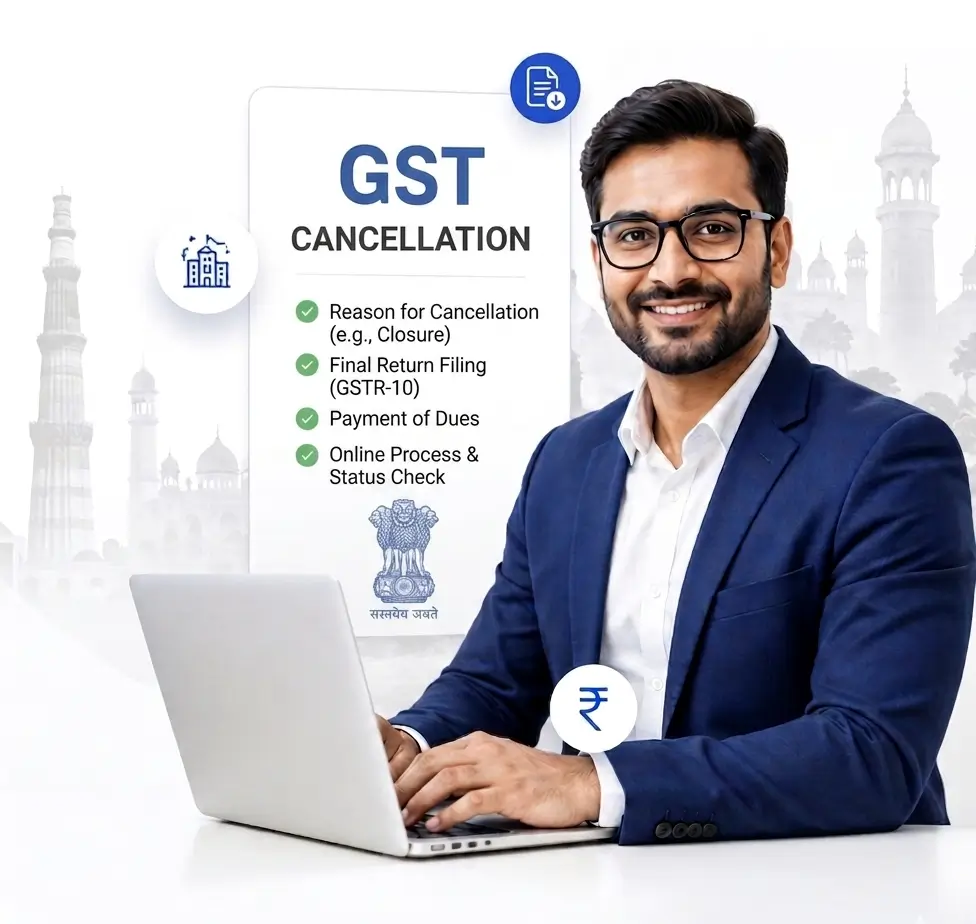
Man working on a laptop discussing GST cancellation processes.

Who Should Apply for GST Cancellation?

Business Closure

Your business has permanently shut down or been wound up and no further taxable supplies will be made.

Transfer or Merger

The business was sold, transferred, or merged with another entity that will obtain a fresh registration.

Below Threshold Turnover

Annual turnover has dropped below ₹40 lakh (goods) or ₹20 lakh (services), making registration optional.

Voluntary Registration Surrendered

You had registered voluntarily despite being below the threshold and no longer wish to remain registered.

Constitution or PAN Change

A change in business constitution (e.g. sole proprietor to company) or PAN requires cancellation and fresh registration.

Officer-Initiated Cancellation

GST authorities can cancel registration for non-filing of returns, fake invoicing, or fraud — you'll receive a show-cause notice (Form REG-17) first.

Reasons for GST Registration Cancellation

1. Voluntary GST cancellation by taxpayer

You might Apply for GST Cancellation voluntarily if:

  • Your business has permanently closed or is discontinued.
  • The business is transferred, merged, or otherwise disposed of, and the new entity will register afresh.
  • Your constitution or PAN has changed in a way that the existing registration is no longer valid.
  • You registered voluntarily (for example, though your turnover was below threshold) and now want to surrender registration.

2. GST Cancellation by tax authorities

The tax officer may cancel GST registration (initiate GST Cancellation) under certain conditions, such as:

  • You fail to carry on business from the declared place.
  • You issue invoices without supplying goods/services (i.e. wrongful or fictitious invoices).
  • You repeatedly fail to file GST returns (e.g. six continuous periods for regular taxpayers).
  • You misuse input tax credit or contravene GST provisions.
  • The registration was obtained fraudulently or via misstatement.

When the officer proposes to cancel, you will be issued a show-cause notice giving you chance to respond.

GST Registration Cancellation Fees

3499 2499/-
  • Free Consultation
  • Form REG-16 Filing
  • GSTR-10 Final Return Included

Documents Required For GST Registration Cancellation

The following documents are required for GST Registration Cancellation:

  • User ID and Password of GST Registration 
  • A copy of the GST Registration Certificate.
  • A copy of the PAN card of the registered person.
  • Details of the tax paid on such inputs, semi-finished, finished goods held in stock on the date of cancellation.
  • Application for Cancellation of Registration in Form GST REG-16.
  • Detail of Last Return filled by Taxpayer

GST Cancellation Process — Step by Step

1. Clear All Pending Returns & Tax Dues

File all overdue GSTR-1 and GSTR-3B returns. Pay any outstanding tax, interest, or penalty. No cancellation is processed with a pending compliance backlog.

2. Compute Stock Liability & ITC Reversal

List all stock (inputs, WIP, finished goods) and capital goods as of the day before cancellation. Calculate the ITC reversal amount or tax payable — whichever is higher must be paid via DRC-03 challans.

3. File Form GST REG-16 on the Portal

Log in to gst.gov.in → Services → Registration → Application for Cancellation of Registration. Complete Form REG-16 with the reason for cancellation, desired effective date, stock details, and liability computation. Submit with DSC or EVC.

4. GST Officer Review (within 30 days)

The assigned GST officer examines the application. They may seek clarification or additional documents. If satisfied, the officer issues the cancellation order in Form GST REG-19 specifying the effective cancellation date.

5. File Final Return GSTR-10

Within 3 months of the cancellation order (or date of cancellation, whichever is later), file the Final Return in Form GSTR-10. This return discloses closing stock and ensures all liabilities are settled. Failure to file attracts a penalty of ₹200/day (up to ₹10,000).

What Happens After GST Cancellation?

Cancellation is not a clean slate for all past obligations. Here is what you must know:

Obligation Deadline / Details

File GSTR-10 (Final Return)

Within 3 months of cancellation order date. Penalty: ₹200/day up to ₹10,000 for late filing.

Reverse ITC on Stocks

ITC on inputs, semi-finished goods, finished goods and capital goods must be reversed or tax paid on stock — whichever is higher.

Maintain Records

All books, invoices, and accounts must be retained for at least 6 years from the end of the financial year of cancellation.

No GST Collection

You cannot charge or collect GST on any sales after the cancellation effective date.

No ITC Claims

Input Tax Credit cannot be claimed on purchases made after cancellation.

Re-registration

If you restart business and cross the threshold, apply for fresh GST Registration.

GST Cancellation by Tax Authorities

GST officers can initiate cancellation independently (without the taxpayer’s request) in cases such as:

  • Failure to file GST returns for six consecutive tax periods
  • Business not being carried on from the declared principal place of business
  • Issuing invoices without actual supply of goods or services
  • Fraudulent registration or misrepresentation of facts
  • Misuse or fraudulent claim of Input Tax Credit

In such cases, the officer issues a Show Cause Notice in Form GST REG-17. You must respond within 7 days using Form GST REG-18. If your reply is satisfactory, the officer drops proceedings via REG-20. Otherwise, cancellation proceeds via REG-19.

If your registration has been cancelled by an officer and you wish to undo it, you can apply for revocation of cancellation within 30 days of the cancellation order.

Ready to Cancel Your GST Registration?

Avoid late fees and penalties. Our CA/CS team handles everything — application, follow-ups, and your final return GSTR-10 — for a one-time fee of ₹2,499.

Frequently Asked Questions (FAQs)

GST Cancellation is the formal termination of your GST registration. Once cancelled, your GSTIN is marked inactive — you are no longer a registered taxpayer under the Goods and Services Tax law. You cannot collect GST on your sales, claim Input Tax Credit (ITC) on purchases, or file routine GST returns. However, cancellation does not erase past liabilities: you must still file a Final Return in Form GSTR-10 within 3 months and settle any outstanding tax dues or reverse ITC on stock held at the time of cancellation.

You should apply for GST Cancellation if: your business has permanently closed or been wound up; the business was sold, transferred, or merged into another entity; your annual turnover has fallen below ₹40 lakh (goods) or ₹20 lakh (services); you had registered voluntarily despite being below the threshold and no longer wish to remain registered; or your business constitution or PAN has changed, requiring a fresh registration. GST officers can also cancel your registration without your request in cases of prolonged non-filing, fake invoicing, or fraud.

GST Suspension is a temporary state where your registration is inactive while proceedings or verification are ongoing. You cannot trade under a suspended GSTIN but the registration itself still exists. GST Cancellation is permanent — your GSTIN is terminated and marked as cancelled in the public GST records. Suspension is a holding state; cancellation is the final outcome. During the period between filing a cancellation application and the issuance of an order, your GSTIN is automatically placed in "Suspended" status.

The documents required to apply for GST Cancellation are: GST portal login credentials (User ID and Password), copy of the GST Registration Certificate, PAN card of the registered person, details of the last GST return filed, and a stock statement showing inputs, semi-finished goods, finished goods, and capital goods held as of the cancellation date with ITC amounts claimed on them. If all pending returns are filed and no taxable supplies were made, an undertaking to that effect can substitute for certain return filings. setupfiling.in will prepare and verify all documents before submission.

No. The GST portal blocks submission of Form REG-16 if any GSTR-1 or GSTR-3B returns are pending. All outstanding returns must be filed and all tax dues, interest, and late fees must be cleared before the cancellation application can be submitted. If no taxable supplies were made during any period, you can file nil returns or submit a self-declaration undertaking as permitted under the updated GST portal instructions. Attempting to cancel with pending compliance will result in the application being rejected.

Form GST REG-16 is the official application form for voluntary cancellation of GST registration. To file it: log in to gst.gov.in, go to Services → Registration → Application for Cancellation of Registration, select the reason for cancellation, enter the desired effective date, provide stock details and ITC reversal calculations, and submit using a Digital Signature Certificate (DSC) or Electronic Verification Code (EVC). The GST officer then has up to 30 days to review and issue the cancellation order in Form GST REG-19. SetupFiling.in prepares and submits REG-16 on your behalf, typically within 1–2 business days of receiving your documents.

GSTR-10 is the Final Return that every cancelled GST taxpayer must file. It discloses closing stock, confirms ITC reversal liabilities, and ensures all outstanding dues are settled. It must be filed within 3 months from the date of the cancellation order (or the effective date of cancellation, whichever is later). Late filing attracts a penalty of ₹200 per day (₹100 CGST + ₹100 SGST), capped at ₹10,000. Failure to file GSTR-10 can also lead to a best-judgment assessment by the GST officer. SetupFiling.in's GST Cancellation package includes GSTR-10 filing at no extra cost.

On the date of cancellation, you must prepare a stock statement listing all inputs, semi-finished goods, finished goods, and capital goods. For inputs and finished goods: compare the ITC originally claimed with the GST payable on the current market value of the stock — you must pay whichever is higher. For capital goods: compare the ITC claimed minus 5% per quarter of use with the GST on the current transaction value — again, whichever is higher must be paid. The amount is discharged via Form DRC-03 challan. This calculation is a critical step and errors here can trigger notices later — our CA team handles it precisely.

Yes, but not without notice. A GST officer can initiate suo motu (on their own) cancellation in cases such as: failure to file returns for six consecutive tax periods, not carrying on business from the declared principal place, issuing invoices without actual supply of goods or services, fraudulent registration, or misuse of Input Tax Credit. Before cancelling, the officer must issue a Show Cause Notice in Form GST REG-17, giving you 7 days to respond using Form GST REG-18. If your reply is satisfactory, the proceedings are dropped via Form GST REG-20. Otherwise, the cancellation order is issued in Form GST REG-19.

Revocation is the process of undoing a GST cancellation that was initiated by a tax officer (suo motu). If your GSTIN was cancelled by the department and you wish to restore it, you can apply using Form GST REG-21 through the GST portal under Services → Registration → Application for Revocation. You generally have 90 days from the cancellation order to apply, extendable up to 270 days with approval. All pending returns must be filed and dues cleared before the portal allows submission. Importantly, voluntary cancellations (initiated by you via REG-16) cannot be revoked — only officer-initiated cancellations are eligible for revocation.

If your business closed but your GST registration was never cancelled, you are likely accumulating late fees for non-filing of returns for every period since closure. The first step is to file all pending nil returns (or make use of an undertaking if no supplies were made), then clear any outstanding dues, and finally apply for cancellation via REG-16. The CBIC periodically issues Amnesty Schemes that offer waivers or caps on late fees — these can significantly reduce your backlog liability. Our CA team can assess your specific situation, calculate the minimum payable amount, and get your GSTIN cancelled cleanly.

After filing the cancellation application, any remaining balance in your Electronic Credit Ledger can only be used to discharge existing GST liabilities up to the date of filing GSTR-10. It cannot be refunded or carried forward. Any ITC on stock, semi-finished goods, finished goods, and capital goods as of the cancellation date must be reversed (or tax paid on the current value, whichever is higher). Unused credit after all liabilities are settled will lapse permanently. This is why it is important to plan your cancellation date carefully and utilise available ITC before applying.

Yes. If you resume business operations and your turnover crosses the mandatory threshold — ₹40 lakh for goods or ₹20 lakh for services — you must apply for fresh GST Registration. You can also choose to register voluntarily even below the threshold. There is no mandatory cooling-off period after a voluntary cancellation. The fresh registration will assign you a new GSTIN. Existing business records and liabilities from the old GSTIN remain separate and must have been fully settled at the time of the original cancellation.

Once Form REG-16 is successfully submitted on the GST portal, the GST officer has up to 30 days to review the application and issue the cancellation order in Form GST REG-19. In straightforward cases with all returns filed and dues cleared, orders are often issued earlier. SetupFiling.in prepares and submits your REG-16 application within 1–2 business days of receiving complete documents, and follows up proactively with the GST portal until the order is issued. After the order, you have 3 months to file GSTR-10 and close all liabilities.

SetupFiling.in handles the entire GST Cancellation process for you at an all-inclusive fee of ₹2,499 — with no hidden charges. Our CA/CS team provides a free consultation, verifies your compliance status, files all pending returns if required, prepares the stock statement and ITC reversal calculation, submits Form REG-16 on the GST portal, follows up with the department until the cancellation order (REG-19) is issued, and files your mandatory Final Return in GSTR-10. You do not need to visit any government office. The entire process is 100% online.