💳 Pay Now |
✍️ Learning Center
Apply for Startup India Registration (DPIIT Recognition) and give your business a strong start. Eligible startups can enjoy tax benefits, easier compliance, and faster IPR support. Check if you qualify and apply today to access government support and grow your business with confidence and better opportunities ahead.

Startups Served
Approval Rate
Online Process
CA Expertise
Everything founders need to know about getting recognised as a startup by the Department for Promotion of Industry and Internal Trade — eligibility, benefits, step-by-step process, and the landmark 2026 policy changes.
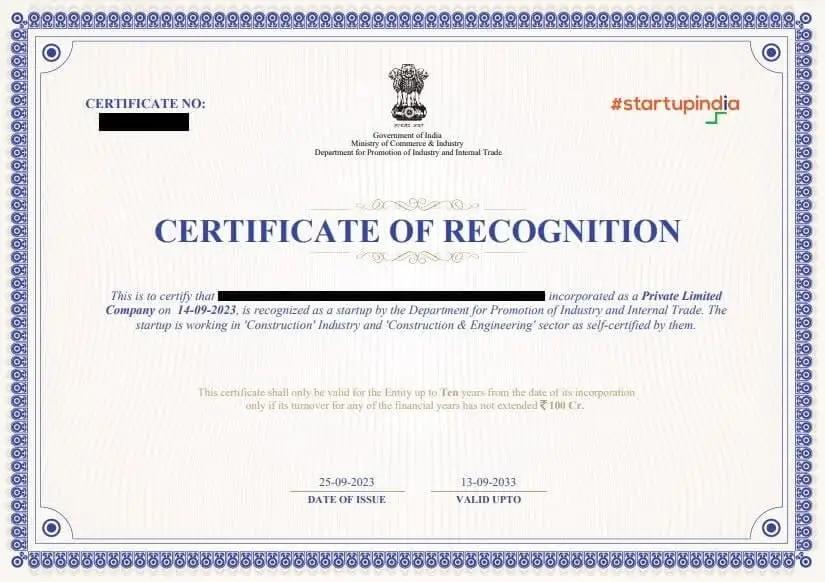
DPIIT Recognition is an official certification issued by the Department for Promotion of Industry and Internal Trade (DPIIT), under the Ministry of Commerce and Industry, Government of India. It formally recognises a business as a “startup” under the Startup India initiative, unlocking a range of benefits that are not available to regular businesses.
Launched on January 16, 2016, the Startup India initiative was designed to build a strong, innovation-driven ecosystem that promotes growth and generates large-scale employment. The DPIIT Certificate of Recognition is the gateway credential to this ecosystem.
Once you hold a DPIIT Certificate of Recognition, you can then apply separately for additional benefits such as the Section 80-IAC income tax exemption, IPR fee rebates, and seed funding schemes.
A startup must meet all of the following criteria under the revised 2026 DPIIT framework (Gazette Notification G.S.R. 108(E)).
Must be incorporated as a Private Limited Company, LLP, Registered Partnership Firm, or (from 2026) Cooperative Society. Sole proprietorships and public limited companies are not eligible.
Must not have been incorporated for more than 10 years from the date of registration. (Deep Tech Startups get 20 years.)
Must not exceed ₹200 crore in any financial year since incorporation (up from ₹100 Cr under the old 2019 rules).
Must work towards development, improvement, or innovation of a product, process, or service — OR have a scalable business model with high potential for wealth and employment creation.
Must be incorporated in India. Indian promoters must hold at least 51% shareholding as per Companies Act 2013 and SEBI (ICDR) Regulations.
Must not have been formed by splitting up or reconstructing an already existing business. Joint Ventures, holding/subsidiary structures are also excluded.
We help plan and prepare for Startup India Registration, draft documents, and file with the Department for Promotion of Industry and Internal Trade (DPIIT) under the government of India Startup India Initiatives.
Updated financial statements (Balance Sheet, Profit & Loss statement, Income Tax Returns) for the past three years or from the year of incorporation
Note 1 – The Balance Sheet and the Profit and Loss Statement must be CA Certified
Note 2 – If your startup was incorporated on 1st April 2021 or later, Income Tax Returns (ITR) is not mandatory. For startups incorporated earlier, ITR is mandatory
DPIIT Recognition is one certificate that opens multiple doors. Here are the key benefits available to recognised startups.
Eligible startups can claim a 100% deduction on profits for any 3 consecutive assessment years within the first 10 years from incorporation, after separate IMB approval. Extended to startups incorporated up to March 31, 2030.
DPIIT-recognised startups get fast-tracked patent examination and pay only 20% of standard patent filing fees. Government bears all facilitator fees — you only pay the statutory fee.
Recognised startups can apply for government tenders without the “prior experience or turnover” criteria that applies to regular companies. GeM onboarding initiatives also expanded in 2025-26.
Access to seed funding for proof-of-concept, prototype development, product trials, and market entry. Only DPIIT-recognised startups can apply through empanelled incubators.
Self-certify compliance with 9 labour laws and 3 environmental laws through the Startup India app, saving time and legal costs in the early years.
If a startup fails, it can wind up operations through a simplified fast-track insolvency process under the IBC — often within approximately 90 days, creating a healthier risk-taking environment.
Section 56(2)(viib) angel tax — a major pain point for fundraising startups — has been permanently eliminated for all classes of investors effective FY 2025-26. Formally omitted from the 2026 DPIIT notification.
Access to DPIIT-empanelled incubators, national and international startup fests, investor networks, and government mentorship programmes through the Startup India ecosystem.
Visit nsws.gov.in and create a business account. If you have an existing investor or business account, log in directly.
Click Add Approvals → Central Approvals and search for “Registration as a Startup” to add it to your dashboard.
Enter company details: entity type, industry, sector, incorporation date, PAN, registration number, and a detailed write-up on your innovation and business model.
Submit your Certificate of Incorporation, Organisation DSC, pitch deck, demo video link, director KYC, financial statements, and revenue model.
Upon successful submission, you receive an immediate recognition number. The formal Certificate of Recognition is issued within 2–30 working days after document review.
With your DPIIT Certificate, apply separately for Section 80-IAC tax exemption via the Inter-Ministerial Board (IMB). IMB approval typically takes 3–12 months. This is a completely separate process from DPIIT recognition.
The Section 80-IAC tax holiday is perhaps the most financially significant benefit of the Startup India ecosystem. It allows eligible startups to claim a 100% deduction on profits for any 3 consecutive assessment years within the first 10 years since incorporation.
Key update from Union Budget 2025-26: The incorporation cut-off date for 80-IAC eligibility has been extended to March 31, 2030. Startups incorporated up to that date — and which subsequently get DPIIT recognition — can access this benefit.
Only Private Limited Companies and Limited Liability Partnerships (LLPs) are eligible for the 80-IAC tax holiday. Registered Partnership Firms and Cooperative Societies are not currently eligible for this specific benefit, though they can still access all other DPIIT recognition benefits.
After receiving your DPIIT Certificate of Recognition, apply for the Certificate of Eligibility via the Startup India portal at startupindia.gov.in. This triggers a review by the Inter-Ministerial Board (IMB), which evaluates whether your startup genuinely qualifies. IMB approval typically takes 3–12 months. Once approved, you can claim the three-year tax holiday in any consecutive years of your choosing within the first 10 years.
Join 50,000+ entrepreneurs who’ve trusted SetupFiling.in’s expert CA and CS team. Get your DPIIT certificate filed today — online, transparent, and affordable.
As per the DPIIT Gazette Notification G.S.R. 108(E) dated February 4, 2026, the annual turnover limit for a regular startup has been raised to ₹200 crore in any financial year since incorporation (previously ₹100 crore). Deep Tech Startups have a higher ceiling of ₹300 crore.
The February 2026 DPIIT notification formally introduced a “Deep Tech Startup” sub-category for entities with high R&D intensity, significant IP creation, scientific/technical uncertainty, and long gestation periods (10–15 years). Deep Tech Startups receive an extended eligibility window of up to 20 years from incorporation and a higher turnover threshold of ₹300 crore.
Yes — for the first time. The 2026 notification expanded eligible entity types to include state cooperative societies and multi-state cooperative societies, in addition to the existing categories of Private Limited Companies, LLPs, and Registered Partnership Firms.
You receive an immediate recognition number upon successful submission of the application on NSWS. The formal Certificate of Recognition is typically issued within 2–30 working days after document review. Separately, the Section 80-IAC tax exemption approval by the IMB takes 3–12 months and is a completely different process.
Sole proprietorships are not eligible for DPIIT recognition. However, a One Person Company (OPC), being a form of Private Limited Company, is eligible for all Startup India benefits. Unregistered partnership firms are also not eligible.
Key documents include: Certificate of Incorporation and PAN, director/partner KYC documents, Organisation Class 3 DSC (mandatory since November 2023), innovation write-up, pitch deck (PDF), demo video link (YouTube/Vimeo, 2–5 minutes), revenue model, and CA-certified financial statements (Balance Sheet and P&L) for the past years or since incorporation. ITR is mandatory only for startups incorporated before April 1, 2021.
DPIIT Recognition is the foundational certificate that formally identifies your entity as a startup. It is processed through the NSWS portal and is a prerequisite for all other Startup India benefits. Section 80-IAC tax exemption is a separate benefit requiring a separate application to the Inter-Ministerial Board (IMB) via the Startup India portal. Getting DPIIT recognition does not automatically grant the 3-year income tax holiday — you must apply separately and wait for IMB approval (typically 3–12 months).
No. Only entities incorporated in India are eligible. Additionally, Indian promoters must hold at least 51% shareholding. Foreign investors and VC funds can invest in and support Indian startups, but the startup entity itself must be incorporated in India with majority Indian promoter ownership.