💳 Pay Now |
✍️ Learning Center

Get your GST registration online quickly and easily with expert assistance. We handle documentation, application filing, and compliance support for businesses across India. Start your GST registration online today and grow your business without delays. Contact us now for fast, reliable, and hassle-free GST services.
Happy Clients
Expert Advisors
Online Process
Customer Rating
All packages include CA-assisted filing, GSTIN delivery, and portal credentials. No hidden charges.
Just the GST registration — fast and affordable
GST Registration + 6 months of returns
 Premium Package
GST Registration + 12 Month GST Return
🔒 Payments secured by Razorpay · 100% CA-assisted · Full refund if application fails due to our error. Refund Policy.
Fast GST registration online with expert support, easy documentation, and quick approval for your business.
Whether you are launching a new startup, running a small business, or expanding your operations across states, GST registration online is one of the first compliance steps you cannot skip. This guide explains everything — who needs it, what documents to keep ready, how the process works and what happens if you miss it.
GST stands for Goods and Services Tax. It is a single tax that is applied to the supply of goods and services across India.
It is collected at every step of the supply chain, but businesses can claim credit for the tax they paid on purchases. This makes GST a tax only on the value added at each stage.
In simple terms, GST means:
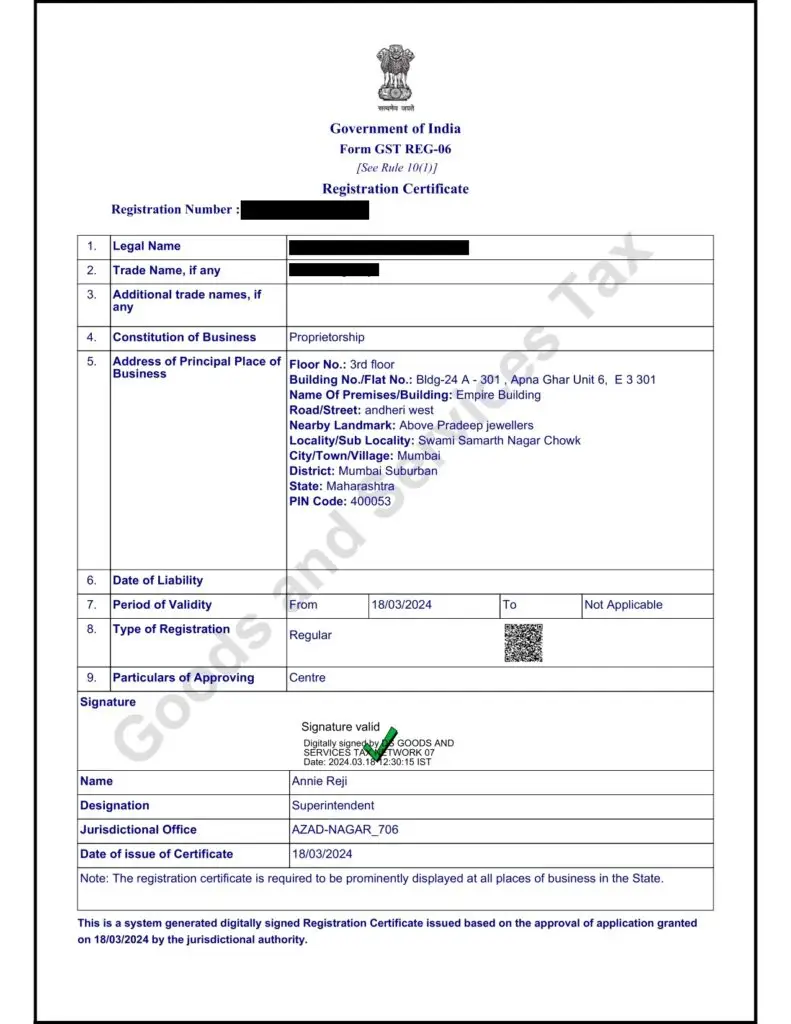
Not every business needs GST registration immediately. It depends on your annual turnover and the nature of your business.
GST registration is mandatory if:
GST registration is voluntary but beneficial if:
If you are an e-commerce seller, there is no exemption — GST registration is compulsory from day one, irrespective of how much you earn.
Getting registered under GST is not just a legal formality. It opens real business advantages:
Keeping your documents ready before you start the application saves time and avoids rejection. Here is what you need based on your business type:
| Business Type | Extra Documents Needed |
|---|---|
Sole Proprietorship | PAN + Aadhaar of proprietor |
Partnership Firm | Partnership deed, PAN of firm, PAN/Aadhaar of partners |
Private Limited Company | Certificate of Incorporation, MOA/AOA, Board resolution |
LLP | LLP Agreement, Certificate of Incorporation |
HUF | HUF deed, PAN of HUF |
Important 2026 update: From January 2026, GST registration can be automatically suspended if your bank account details are missing from your GST profile. Make sure you update bank details immediately after registration.
If you are a small business with turnover below ₹1.5 crore (₹75 lakhs for some states), you may be eligible for the GST Composition Scheme. Under this scheme:
The Composition Scheme is ideal for small retailers, manufacturers, and restaurant owners who mainly deal with end consumers. However, if most of your clients are GST-registered businesses needing valid tax invoices, the regular scheme is better for them and for you.
Getting your GSTIN is just the start. Here is what comes next:
Failing to register when you are liable is a serious offence. Here is what you risk:
The tax department increasingly uses AIS (Annual Information Statement), bank data, and third-party sources to identify unregistered businesses. It is far safer — and more profitable — to register proactively.
At SetupFiling.in, our team of qualified Chartered Accountants and GST practitioners has helped thousands of businesses across India get their GST registration done smoothly — without the confusion, portal errors, or wasted time. We handle everything: document preparation, application filing, tracking, and post-registration compliance support.
GST registration is the process of enrolling a business on the GST portal to obtain a 15-digit GST Identification Number (GSTIN), linked to the business PAN. Once registered, a business can legally charge GST on sales, issue GST-compliant invoices, and claim input tax credit on purchases.
Any business supplying goods or services beyond the prescribed turnover threshold, anyone making inter-state supplies, e-commerce sellers, and casual or non-resident taxable persons must apply, regardless of turnover. Many traders also apply for an import export code alongside GST once they start cross-border transactions.
For suppliers of goods, GST registration becomes mandatory once aggregate turnover crosses ₹40 lakh in a financial year, and for suppliers of services, the limit is ₹20 lakh. In special category states, these limits are lower — ₹20 lakh for goods and ₹10 lakh for services.
These limits apply only to regular intra-state suppliers. Certain categories, such as inter-state suppliers and e-commerce operators, must register irrespective of turnover, since threshold exemption does not apply to them.
No, the GST department does not charge any government fee for obtaining GST registration. The entire application on the GST portal is free of cost, whether you are a proprietorship, partnership, LLP or company.
If you take professional help for document preparation, error-free filing and query resolution, a separate service charge may apply, but this is distinct from the government process, which itself carries zero fee.
If the application and documents are in order, GST registration is typically approved within 7 working days of submission. The GST officer may raise a clarification query within this window, which can extend the timeline if additional documents or explanations are needed.
Applications flagged for physical verification of the business premises can take longer. Uploading clear, correctly named documents at the first attempt is the biggest factor in getting approval without delay.
You will generally need the following documents to apply:
Identity & PAN: PAN card and Aadhaar of the proprietor, partners or directors.
Business Proof: Certificate of incorporation, partnership deed, or LLP agreement, depending on structure. If your entity isn't formed yet, you may need company registration services or single-promoter company incorporation first.
Address Proof: Electricity bill, rent agreement or property tax receipt of the principal place of business, with an NOC if rented.
Bank Proof: A cancelled cheque or the first page of the bank passbook showing account details.
Photograph & Signature: Passport-size photo of the applicant and digital signature for companies/LLPs, using a valid signing certificate.
Yes. Any business or individual can opt for voluntary GST registration even if their turnover is below the mandatory threshold. This is common among startups, freelancers and small sellers who want to appear on marketplaces or claim input tax credit early.
Once voluntarily registered, the same compliance obligations apply as for a regular taxpayer, including timely return filing, so it should be a considered decision rather than a default choice.
A Digital Signature Certificate (DSC) is mandatory for companies and LLPs while submitting their GST registration application, since it authenticates the authorised signatory. Proprietorships and most other applicants can instead verify the application using an Electronic Verification Code (EVC) sent as an OTP to their registered mobile and email.
If your entity requires a DSC, it must be a valid Class 3 certificate registered on the GST portal before final submission.
Operating a business that is legally required to Register for GST without doing so is treated as an offence under GST law. It can attract a penalty equal to 10% of the tax due (subject to a minimum amount), or 100% of the tax due in cases of deliberate evasion.
Beyond penalties, an unregistered but liable business also cannot legally collect GST from customers or claim input tax credit, which puts it at a direct commercial disadvantage compared to registered competitors.
Yes. Businesses and individuals selling goods or services through e-commerce platforms such as Amazon, Flipkart or their own website are required to obtain GST registration regardless of their turnover. The usual threshold exemption of ₹40 lakh or ₹20 lakh does not apply to e-commerce suppliers.
E-commerce operators and aggregators themselves must also register for GST irrespective of turnover, since they are responsible for collecting tax at source on behalf of sellers on their platform.
The main categories are Normal Taxpayer, applicable to most businesses with no expiry date and no deposit requirement; Composition Taxpayer, for small businesses opting for a flat, lower tax rate but without input tax credit; Casual Taxable Person, for those running a temporary or seasonal business such as an exhibition stall; and Non-Resident Taxable Person, for entities based outside India that supply taxable goods or services within the country.
Choosing the correct category at the time of application is important, since it determines your compliance obligations, applicable tax rate, and the deposits required in certain cases.
A fixed principal place of business is normally required for GST registration, supported by an ownership document, rent agreement, or a consent letter with an NOC if the premises belong to someone else. Even a portion of a residential address can be used as the registered office in most cases.
Casual taxable persons who don't have a fixed place of business, such as those running a temporary stall or exhibition, can register under a separate category meant specifically for short-term, non-permanent business activity.
Once your GSTIN is issued, you must start issuing GST-compliant invoices showing your GSTIN, HSN/SAC codes, and a clear tax breakup, and file monthly or quarterly returns such as GSTR-1 and GSTR-3B along with an annual return, based on your registration type and turnover.
Many newly registered businesses also protect their brand name at this stage through brand name protection filing, and MSMEs benefit from applying for Udyam recognition for small enterprises to access priority lending and other government scheme benefits.