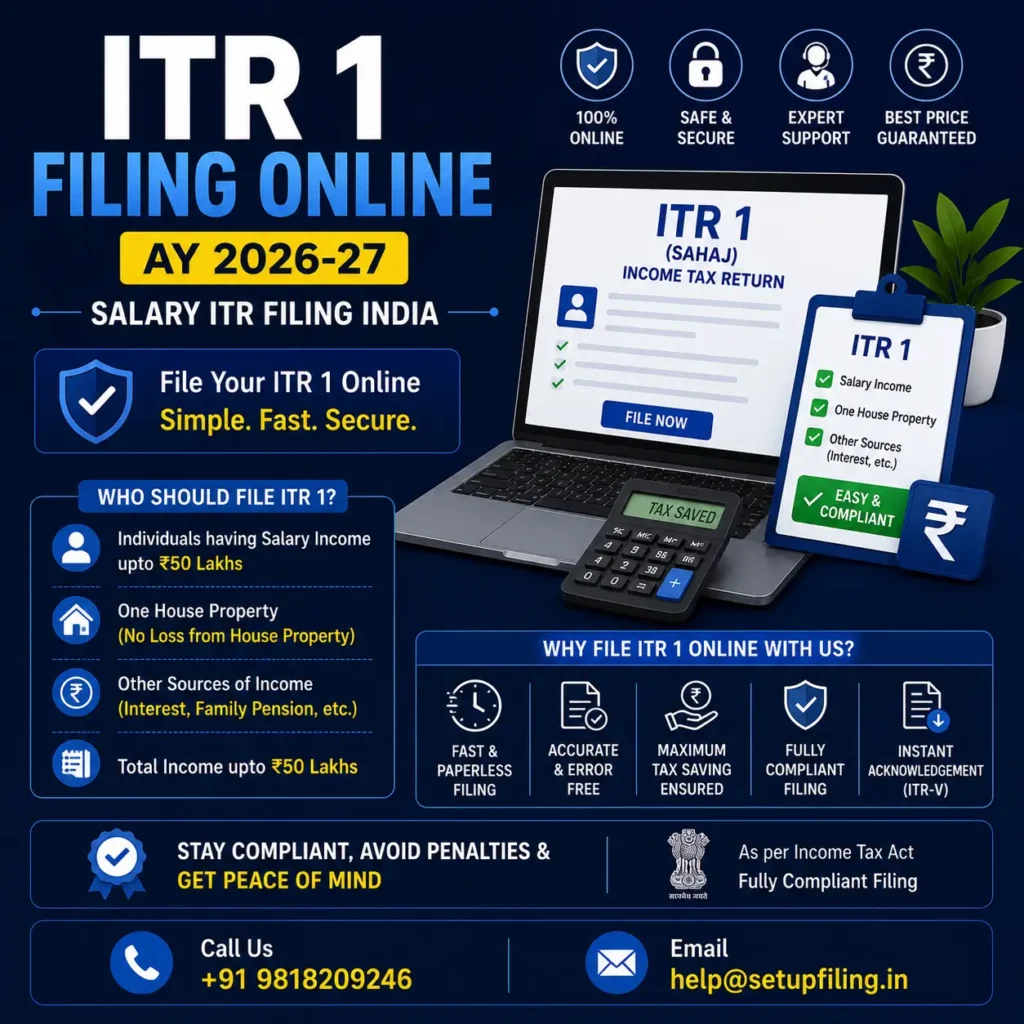
File your Income Tax Return (ITR 1 Filing Enabled) for Assessment Year 2026–27 easily and accurately. Expert-assisted salary ITR filing by Chartered Accountants — affordable, fast, and 100% online.
Filing Income Tax Returns (ITR) is an essential annual compliance for salaried individuals in India. For Assessment Year (A.Y.) 2026-27, taxpayers earning salary income and having simple income sources can generally file their return using ITR-1 (Sahaj). Understanding eligibility, required documents, deductions, and filing procedures helps ensure accurate and timely compliance with the Income Tax Act.
ITR 1, popularly known as Sahaj, is a simplified income tax return form notified by the Income Tax Department of India. It is designed for resident salaried individuals with straightforward income sources and total income not exceeding ₹50 lakh for Financial Year 2025–26 (Assessment Year 2026–27).
🗓️ Applicable: For AY 2026–27, covering income earned between 1st April 2025 and 31st March 2026 (Financial Year 2025–26).
💰 Income Limit: Total income must not exceed ₹50 lakh. Includes salary, pension, one house property, and other sources like bank interest.
📅 Due Date: 31st July 2026 for salaried individuals (non-audit cases) filing ITR 1 for AY 2026–27.

ITR 1 (Sahaj) is applicable to resident individuals whose income falls under the following categories:
Private sector employees, government servants, and pensioners with salary income can file ITR 1. Your Form 16 from the employer is the primary document required for salary ITR filing.
Individuals having income from a single house property — whether self-occupied or let-out — are eligible. Those with two or more house properties must use ITR 2.
Income from savings account interest, fixed deposits (FDs), recurring deposits, family pension, or agricultural income up to ₹5,000 is covered under ITR 1.
For AY 2026–27, salaried individuals with exempt LTCG under Section 112A up to ₹1.25 lakh can still file ITR 1. LTCG exceeding this limit requires ITR 2.
Provide your name, PAN, Aadhaar, and contact information. Our experts will get in touch within 30 minutes to guide you through the ITR 1 filing process.
Share Form 16 from your employer, Form 26AS, bank statements, and investment proof. Our CA team will review your salary details and income sources accurately.
Our Chartered Accountants compute your total income, applicable deductions under 80C/80D, choose the best tax regime (old vs new), and calculate your tax liability or refund.
We prepare your ITR 1 Sahaj form with complete accuracy and file it on the Income Tax e-filing portal. You will receive a confirmation acknowledgement (ITR-V).
Complete e-verification of your return using Aadhaar OTP, net banking, or by sending a signed physical ITR-V to CPC Bengaluru within 30 days of filing.
Missing the ITR 1 filing due date of 31st July 2026 can result in penalties and loss of certain benefits. Here is what you risk:
⚠️ Penalty under Section 234F
Don’t wait till the last date. File your salary ITR online now with expert CA assistance. Avoid penalties and get your refund faster.
Resident individuals with total income up to ₹50 lakh from salary, pension, one house property, and other sources such as bank interest or family pension can file ITR 1 (Sahaj) for AY 2026–27.
The due date for ITR 1 filing for AY 2026–27 (income of FY 2025–26) is 31st July 2026 for salaried individuals and non-audit cases. A belated return can be filed up to 31st December 2026 with a penalty.
ITR 1, known as Sahaj (meaning ‘easy’), is a simplified income tax return form for resident salaried individuals in India. It covers salary income, one house property, other sources, and now includes exempt LTCG up to ₹1.25 lakh under Section 112A.
Yes, a salaried person can file ITR 1 without a CA. However, to avoid errors, missed deductions, or wrong tax regime choice, using an expert service like SetupFiling.in ensures accurate filing and maximum refund at affordable charges.
Key documents include: Form 16 from employer, PAN card, Aadhaar card, Form 26AS, Annual Information Statement (AIS), bank account details, investment proofs (80C/80D), HRA rent receipts, and home loan certificate if applicable.
Yes, ITR 1 can be filed under both old and new tax regimes for AY 2026–27. Under the new regime, the basic exemption limit is ₹4 lakh and tax rebate under Section 87A is available for income up to ₹12 lakh, making it attractive for many salaried employees.
Yes, salaried employees receiving HRA from their employer can claim HRA exemption in ITR 1. For AY 2026–27, you are required to provide rent receipts with landlord details. HRA cannot be claimed if you opt for the new tax regime.
ITR 1 is for salaried individuals with income up to ₹50 lakh and simple income sources. ITR 2 is for those with capital gains, more than one house property, foreign income, or higher income. Salaried individuals with stock market gains exceeding ₹1.25 lakh LTCG must file ITR 2.
SetupFiling.in provides practical services solutions designed around customer needs. Our team focuses on clear communication, reliable support, and outcomes that help people make informed decisions quickly.
Customers can contact our team directly for fast support, clear next steps, and timely follow-up. We prioritize responsiveness so questions are answered quickly and issues are resolved without unnecessary delays.
Customers choose us for trusted expertise, transparent guidance, and consistent results. We focus on practical recommendations, personalized service, and long-term relationships built on reliability and accountability.
WhatsApp us