Section 44ADA of the Income Tax Act – A Complete Guide and Calculation
A plain-English guide to the presumptive taxation scheme for doctors, lawyers, CAs, engineers, freelancers and other specified professionals – eligibility, the ₹75 lakh limit, the 50% income rule, worked examples, and step-by-step tax calculation.
Section 44ADA at a Glance
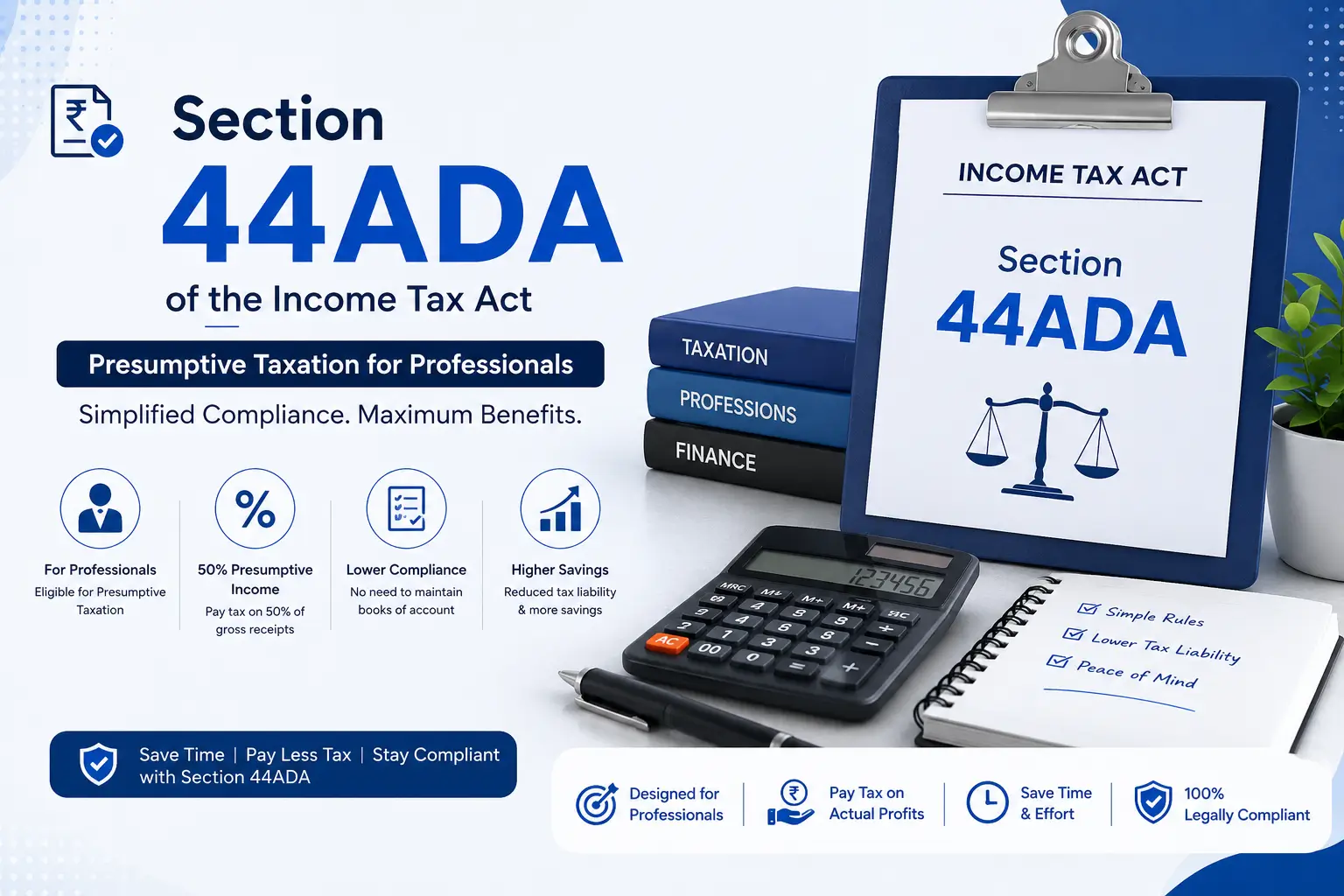
- What it is: A presumptive taxation scheme that lets specified professionals declare 50% of gross receipts as taxable income without maintaining full books of account.
- Who can use it: Resident individuals, HUFs and partnership firms (not LLPs) in notified professions such as medicine, law, engineering, architecture, accountancy and technical consultancy.
- Turnover limit: ₹50 lakh in general, extended to ₹75 lakh if at least 95% of receipts come through banking or digital channels.
- Tax benefit: No tax audit, no detailed bookkeeping, and simplified ITR-4 filing for most professionals.
- Advance tax: Payable in a single instalment on or before 15 March of the financial year.
What is Section 44ADA of the Income Tax Act?
Section 44ADA of the Income Tax Act, 1961 is a presumptive taxation provision designed for small and mid-sized professionals. Instead of maintaining detailed books of account and computing profit by deducting every business expense, an eligible professional can simply declare 50% (or more) of their gross annual receipts as taxable income.
The provision was introduced to reduce the compliance burden on professionals such as doctors, chartered accountants, lawyers, architects and engineers who often find it difficult to maintain elaborate accounting records. Once a professional opts for this scheme, the income computed at 50% of gross receipts is treated as the final "profits and gains of profession" and is taxed as per the applicable slab rates, without requiring a separate tax audit in most cases.
If you also earn salary, rental, or capital gains income, that income is computed separately and added to your presumptive professional income before applying the slab rates. You can read our detailed ITR filing guide for AY 2026-27 to understand how different income heads are combined.
Who is Eligible Under Section 44ADA?
Section 44ADA applies only to resident individuals, Hindu Undivided Families (HUFs), and partnership firms (excluding LLPs) who are engaged in a profession specified under Section 44AA(1) of the Income Tax Act.
Specified Professions Covered
- Legal profession (advocates, legal consultants)
- Medical profession (doctors, dentists, physiotherapists)
- Engineering
- Architecture
- Accountancy (Chartered Accountants)
- Technical consultancy
- Interior decoration
- Company secretaries and film artists
- Authorised representatives and authors
- Notified IT and technology-related professionals, and other professions notified by the CBDT
Who Cannot Use This Scheme
- Non-resident individuals
- Companies and LLPs
- Professionals whose gross receipts exceed the prescribed limit
- Persons carrying on a business (not a profession) – they may instead check Section 44AD for businesses
- Professionals who wish to claim actual expenses higher than what the presumptive scheme allows and are prepared to maintain full books and undergo audit where applicable
Turnover / Gross Receipts Limit Under Section 44ADA
The gross receipts limit under Section 44ADA was enhanced through an amendment to the Finance Act, and the enhanced limit continues to apply under the current provisions.
| Condition | Gross Receipts Limit |
|---|---|
| Standard limit (any mode of receipt) | Up to ₹50 lakh |
| Enhanced limit – if cash receipts do not exceed 5% of total receipts (95%+ digital/banking) | Up to ₹75 lakh |
Gross receipts include professional fees, consultation charges, retainer fees and project payments received during the year. Reimbursements billed separately and capital receipts are generally excluded. If total receipts cross ₹75 lakh, or cash receipts exceed 5% while receipts are between ₹50 lakh and ₹75 lakh, the professional falls outside Section 44ADA for that year and must maintain regular books of account.
How to Calculate Income Under Section 44ADA
The calculation under Section 44ADA is straightforward once you know your total gross professional receipts for the financial year. Follow these steps:
- Add up total gross receipts from your profession for the financial year, including all fees, retainers and project payments received or receivable.
- Check the ₹75 lakh / ₹50 lakh eligibility limit based on how much of your income came through banking or digital channels versus cash.
- Apply the 50% presumptive rate to your gross receipts to arrive at the deemed taxable professional income. You may voluntarily declare a higher percentage if your actual profit margin is higher.
- Add other income such as salary, house property income, capital gains, or interest income to the presumptive professional income to arrive at Gross Total Income.
- Deduct eligible deductions under Chapter VI-A (only available under the old tax regime; the new regime allows very limited deductions) to compute Total Taxable Income.
- Apply the applicable slab rate for the financial year and claim the Section 87A rebate if your taxable income qualifies, to arrive at final tax payable.
Formula: Presumptive Taxable Income = 50% (or higher) × Total Gross Receipts
Note that no separate deduction is allowed for business expenses such as rent, staff salary or depreciation once you opt for Section 44ADA – the 50% figure is deemed to already account for all such expenses under Sections 30 to 38.
Worked Examples of Section 44ADA Calculation
| Professional | Gross Receipts | Cash Receipts | Applicable Limit | Presumptive Income (50%) |
|---|---|---|---|---|
| Dr. Mehta, Physiotherapist | ₹22,00,000 | Nil (fully digital) | ₹75 lakh | ₹11,00,000 |
| Adv. Sharma, Practicing Lawyer | ₹48,00,000 | ₹1,20,000 (2.5%) | ₹75 lakh | ₹24,00,000 |
| CA Firm (Partnership) | ₹68,00,000 | ₹4,50,000 (6.6%) | ₹50 lakh – exceeds limit, 44ADA not available | Regular books required |
As the third example shows, once cash receipts cross 5% of total receipts and gross receipts also exceed ₹50 lakh, the professional cannot use the enhanced ₹75 lakh limit and must switch to regular books of account with tax audit applicability checked separately.
Tax Calculation on Presumptive Income (New Tax Regime)
Once presumptive income under Section 44ADA is computed, tax is charged as per the regular slab rates applicable to individuals. Under the new tax regime, which is the default regime for individual taxpayers, the slabs are as follows:
| Taxable Income Slab | Tax Rate |
|---|---|
| Up to ₹4,00,000 | Nil |
| ₹4,00,001 – ₹8,00,000 | 5% |
| ₹8,00,001 – ₹12,00,000 | 10% |
| ₹12,00,001 – ₹16,00,000 | 15% |
| ₹16,00,001 – ₹20,00,000 | 20% |
| ₹20,00,001 – ₹24,00,000 | 25% |
| Above ₹24,00,000 | 30% |
A resident individual whose total taxable income does not exceed ₹12,00,000 in a year can claim a rebate under Section 87A of up to ₹60,000, which brings the net tax liability to nil. This makes Section 44ADA especially useful for early-career professionals and part-time consultants whose presumptive income falls within this bracket.
Example: A freelance IT consultant with gross receipts of ₹20 lakh (fully digital) declares presumptive income of ₹10,00,000. Since this is below ₹12,00,000, the Section 87A rebate brings the final tax liability to nil, subject to no other special-rate income such as capital gains.
Section 44ADA vs Section 44AD – Key Differences
| Particulars | Section 44AD | Section 44ADA |
|---|---|---|
| Applicable to | Eligible businesses | Specified professionals |
| Turnover limit | ₹2 crore (₹3 crore if 95%+ digital) | ₹50 lakh (₹75 lakh if 95%+ digital) |
| Presumptive income rate | 8% (cash) / 6% (digital) | 50% |
| LLP eligibility | Not eligible | Not eligible |
| Lock-in on opting out | 5-year restriction applies | No statutory lock-in, but consistency is advisable |
Advance Tax Rules Under Section 44ADA
Professionals opting for Section 44ADA get a compliance relief on advance tax as well. Instead of paying advance tax in four instalments like regular taxpayers, they are required to pay 100% of the estimated advance tax in a single instalment on or before 15 March of the relevant financial year under Section 211(1)(b). Missing this deadline attracts interest under Sections 234B and 234C.
Books of Account and Tax Audit Applicability
One of the biggest advantages of Section 44ADA is that professionals do not need to maintain books of account under Section 44AA, nor get their accounts audited under Section 44AB, as long as they:
- Declare income at 50% or more of gross receipts, and
- Stay within the applicable ₹50 lakh / ₹75 lakh limit.
A tax audit becomes mandatory if a professional declares income lower than the 50% presumptive rate and their total income exceeds the basic exemption limit, or if gross receipts exceed the prescribed threshold. If you have received a scrutiny or demand communication despite filing correctly, see our guide on the income tax demand notice under Section 143(1).
Which ITR Form to File Under Section 44ADA
Most professionals opting for the presumptive scheme under Section 44ADA file ITR-4 (Sugam). However, if you have capital gains, foreign assets/income, income from more than one house property, or are a director in a company, you must file ITR-3 and report presumptive income under the relevant schedule. For the complete process and due dates, refer to our online ITR filing guide and our e-filing of income tax return resource.
If you have TDS deducted on your professional fees under Section 194J, make sure it is reconciled with Form 26AS before filing – our guide on TDS payment and TDS return filing explains this in detail.
Benefits and Limitations of Section 44ADA
Benefits
- No requirement to maintain detailed books of account
- No mandatory tax audit within the prescribed limits
- Simplified single-form ITR-4 filing
- Reduced compliance cost and paperwork
- Higher ₹75 lakh limit rewards digital, banking-channel income
Limitations
- No separate deduction for actual business expenses
- Not available to LLPs, companies or non-residents
- 100% advance tax due in a single instalment by 15 March
- If actual profit is genuinely lower than 50%, opting out may trigger audit requirements
- Not beneficial for professionals with very high actual expense ratios
Need Help With Section 44ADA Calculation or ITR Filing?
Our tax experts have helped over 50,000 customers with presumptive taxation, ITR filing and tax planning. Get accurate calculation and timely filing, done right the first time.
Chat on WhatsApp: +91 98182 09246Frequently Asked Questions on Section 44ADA
What is the current turnover limit under Section 44ADA?
The turnover limit is ₹50 lakh in general, extended to ₹75 lakh if at least 95% of gross receipts are received through banking or digital channels, as per the current provisions of the Income Tax Act.
Who can opt for the presumptive scheme under Section 44ADA?
Resident individuals, HUFs and partnership firms (excluding LLPs) carrying on a specified profession such as medicine, law, engineering, architecture, accountancy or technical consultancy can opt for this scheme.
Can a freelancer use Section 44ADA?
Yes, freelancers engaged in a profession notified under Section 44AA(1), such as IT consultants, designers and technical consultants, can use Section 44ADA if their gross receipts stay within the applicable limit.
Is tax audit required under Section 44ADA?
No, tax audit is generally not required if you declare income at 50% or more of gross receipts and remain within the ₹50 lakh or ₹75 lakh limit. Audit becomes applicable if you declare lower income and your total income exceeds the exemption limit.
Which ITR form should professionals under Section 44ADA file?
Most professionals file ITR-4 (Sugam). Those with capital gains, foreign income or multiple house properties should file ITR-3 and report presumptive income under the relevant schedule.
Can I claim business expenses separately under Section 44ADA?
No, once you opt for Section 44ADA, the 50% presumptive income is deemed to already account for all business expenses under Sections 30 to 38, so no separate deduction is allowed.
What happens if my actual profit is less than 50% of receipts?
You may declare a lower percentage than 50%, but if your total income exceeds the basic exemption limit, you will be required to maintain regular books of account and get them audited under Section 44AB.
When is advance tax due for professionals under Section 44ADA?
Professionals under Section 44ADA must pay 100% of their estimated advance tax liability in a single instalment on or before 15 March of the relevant financial year.
Is income up to ₹12 lakh tax-free under Section 44ADA?
If your total taxable income, including presumptive professional income, does not exceed ₹12,00,000 and you opt for the new tax regime, the Section 87A rebate of up to ₹60,000 can bring your net tax liability to nil.
Related Income Tax Resources
Disclaimer: This article is for general informational purposes only and does not constitute tax or legal advice. Tax laws, limits and rates are subject to change through Finance Acts and CBDT notifications. Please consult a qualified Chartered Accountant or tax professional, such as our team at SetupFiling, before making any filing decisions.