
- A.Y. 2026–27 Filing Open
IT Returns Filing in India: Everything You Need to Know
Understand what IT returns are, who must file them, key deadlines, documents required, and how SetupFiling.in makes the entire process effortless — online, fast, and 100% compliant.
50,000+
Clients Served
15+ Years
CA Expertise
Same Day
Filing Available
100%
Online Process
Simple, Affordable Plans for ITR A.Y. 2026-27 Filing
File Your ITR for A.Y. 2026-27
Join 50,000+ entrepreneurs and professionals who trust SetupFiling.in for accurate, expert-led income tax return filing. Backed by CAs, CSs, and Tax Attorneys with 15+ years of experience.
What Are IT Returns (Income Tax Returns)?
IT Returns (ITR) are official documents filed with the Income Tax Department of India that declare your total income, applicable deductions, and tax liability for a given financial year. Filing your IT return is not just a legal obligation — it is also proof of income for loans, visas, government tenders, and financial credibility.
The term “IT returns” refers to the annual Income Tax Return (ITR) that every eligible taxpayer — individual, HUF, firm, company, LLP, or trust — must file under the Income Tax Act, 1961. The process involves disclosing all income from salary, business, capital gains, house property, and other sources, and paying any outstanding tax or claiming a refund of excess TDS deducted.
At SetupFiling.in, our expert CA-led team simplifies IT return filing for salaried individuals, self-employed professionals, freelancers, and businesses across India.
- Legal Compliance
Filing ITR is mandatory if your income exceeds the basic exemption limit — currently ₹3 lakh for individuals below 60 years. - Tax Refund
Excess TDS deducted by your employer or bank can only be claimed back by filing IT returns on time. - Loan & Visa Proof
Banks, embassies, and government agencies require ITR acknowledgements as income proof for loans and visa applications. - Carry Forward Losses
Only timely-filed returns allow you to carry forward capital or business losses to offset future years’ profits.
How to File IT Returns Online in India — Step-by-Step
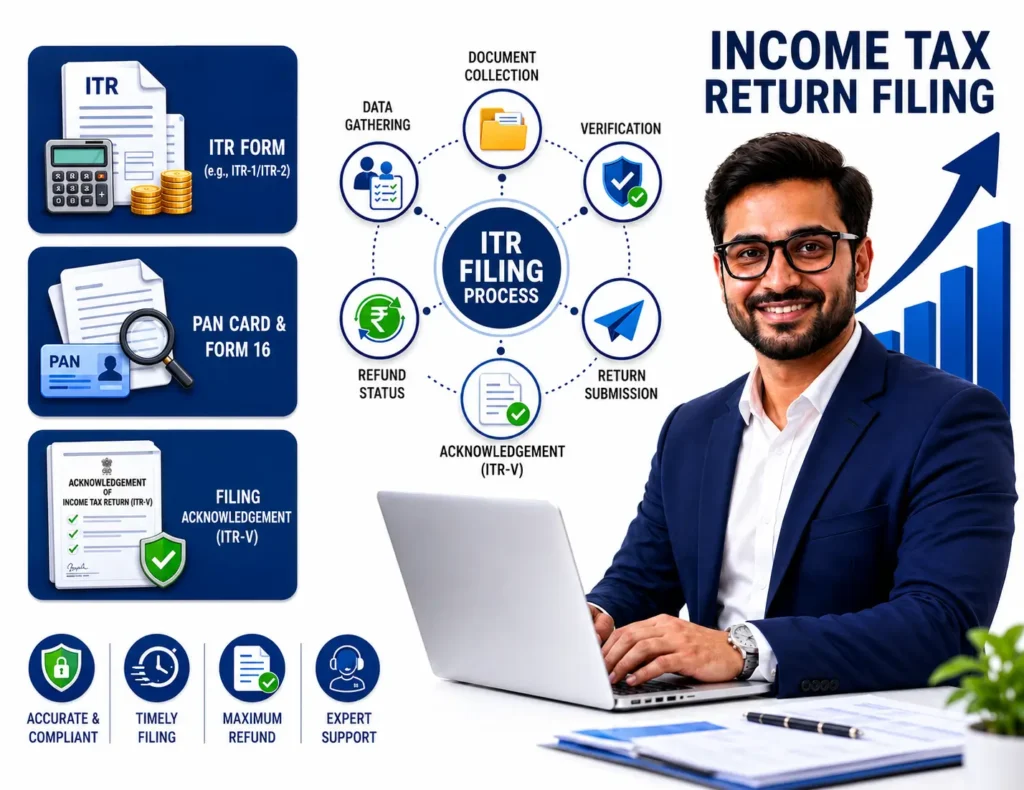
Filing IT returns online (e-filing) through the Income Tax portal is now the standard process for all taxpayers. Here is the complete step-by-step process:
1. Gather All Required Documents
Collect your Form 16 (from employer), Form 26AS (TDS statement), bank interest certificates, investment proofs under Section 80C/80D, and details of any capital gains or rental income. Visit our documents guide for a complete checklist.
2. Register or Log In on the Income Tax e-Filing Portal
Go to incometax.gov.in and log in using your PAN as the user ID. If you are a new user, complete the one-time registration using your PAN, mobile number, and email ID.
3. Select the Correct Assessment Year & ITR Form
For Financial Year 2024–25, select Assessment Year 2025–26. Choose the appropriate ITR form (ITR-1 to ITR-7) based on your income sources. See our ITR-4 guide if you are a professional or small business owner.
4. Fill In Your Income, Deductions & Tax Details
Enter income from all sources: salary, business, capital gains, house property, and other income. Claim deductions under Chapter VI-A (80C, 80D, 80G, etc.). Pre-filled data from Form 26AS and AIS (Annual Information Statement) can be imported automatically.
5. Compute Tax Liability & Pay Any Remaining Tax
The portal auto-calculates your total tax. If there is a shortfall after TDS credit, pay the balance as Self-Assessment Tax (SAT) using Challan 280 before submitting the return.
6. Review, Submit & e-Verify Your Return
Preview your ITR summary, then click Submit. Complete e-verification within 30 days using Aadhaar OTP, Net Banking, or EVC. Only after e-verification is your return considered officially filed. Learn more about Income Tax Return Filing.
7. Download ITR Acknowledgement (ITR-V)
After verification, download your ITR-V acknowledgement from the portal. This serves as official proof of filing and is required for loan applications, visa processing, and other financial purposes.
Let SetupFiling.in Handle It All
Too busy to navigate the portal yourself? Our CA-assisted IT return filing service handles everything — from document collection to submission and e-verification — at affordable rates. We serve salaried employees, freelancers, NRIs, businesses, and companies across India.
IT Return Filing Deadlines (AY 2026-27)
Missing the Income Tax Return due date attracts interest under Section 234A, late fee under Section 234F, and the loss of ability to carry forward certain losses. Know your deadline:
| Taxpayer Category | Applicable Forms | Due Date |
|---|---|---|
Individuals, HUFs (non-audit, non-business) | ITR-1, ITR-2 | July 31, 2026 |
Individuals, HUFs (business/professional, non-audit) | ITR-3, ITR-4 | August 31, 2026 |
Businesses requiring tax audit | ITR-3, ITR-5, ITR-6 | October 31, 2026 |
International transactions (transfer pricing) | ITR-3, ITR-5, ITR-6 | November 30, 2026 |
Belated return (with late fee) | All forms | December 31, 2026 |
Revised return | All forms | March 31, 2027 |
Updated return (ITR-U) | ITR-U | Within 48 months |
⚠️ Late Filing Penalty: A late fee of ₹5,000 is levied under Section 234F if the return is filed after the due date (reduced to ₹1,000 if total income is below ₹5 lakh). Additionally, interest at 1% per month under Section 234A is charged on outstanding tax.