
Section 144B Of Income Tax Act | SetupFiling.In

Section 144B of Income Tax Act: Faceless Assessment

Got a notice under Section 144B? Don’t panic. Our experienced CAs handle faceless assessment responses, appeals, and compliance — fast, affordable, and 100% online.

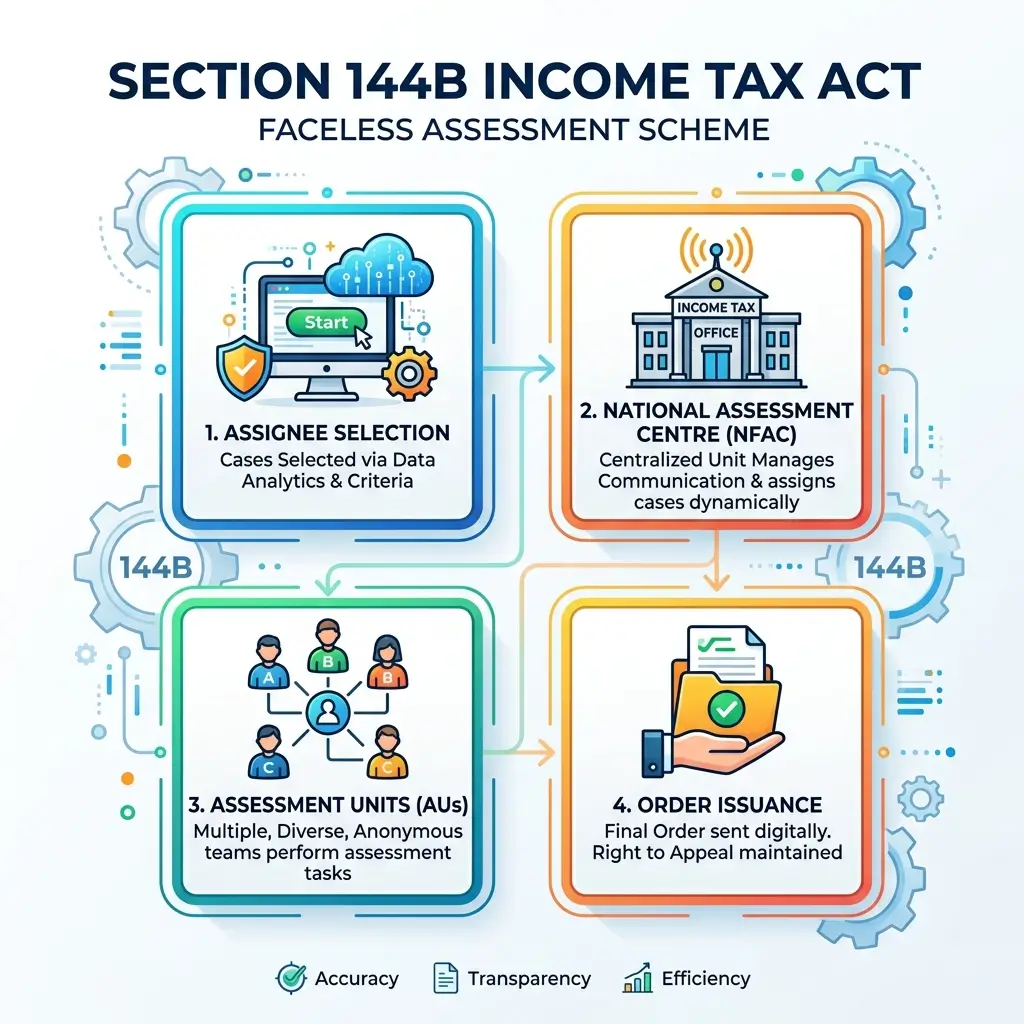
Infographic diagram of Section 144B of the Income Tax Act, 1961, illustrating the Faceless Assessment Scheme workflow including NFAC, RFAC, Assessment Units, and the case flow from selection to final order.

50,000+

Clients Served

15+ Years

CA Expertise

Same Day

Filing Available

100%

Online Process

What is Section 144B of the Income Tax Act?

Section 144B of the Income Tax Act, 1961 was introduced by the Finance Act, 2021 (effective from 1 April 2021) and governs the Faceless Assessment Scheme for best judgment assessments. In simple terms, it eliminates all physical interaction between the taxpayer and the income tax officer — making the entire process digital, transparent, and anonymous.

Before the faceless scheme, taxpayers had to visit the local Income Tax Officer’s office, which created opportunities for harassment and corruption. Section 144B changed this completely by routing all assessments through the National Faceless Assessment Centre (NaFAC), with cases randomly assigned to Assessment Units across India.

Key Fact (AEO-Ready Answer): Section 144B of the Income Tax Act mandates that all best judgment assessments — where a taxpayer has not filed a return or has not responded to departmental notices — must be conducted without physical interface, entirely through the e-filing portal (incometax.gov.in).

Legislative History of Section 144B

The Faceless Assessment Scheme was first introduced under Section 143(3A) through the Finance (No. 2) Act, 2019. The scheme was initially for regular scrutiny assessments. The Finance Act 2021 extended the faceless framework to best judgment assessments under Section 144, creating a dedicated Section 144B in the Income Tax Act. This made India one of the pioneering countries to implement fully digitalised, anonymous income tax assessments.

When Does Section 144B Apply? — Triggering Conditions

Section 144B applies whenever a best judgment assessment is to be completed under Section 144 of the Income Tax Act. A Section 144 best judgment assessment is initiated when:

  • A taxpayer fails to file the Income Tax Return within the due date (including belated or revised return periods)
  • A taxpayer fails to comply with a notice under Section 142(1) — requiring them to produce books, documents, or information
  • A taxpayer fails to comply with a Section 148 notice (income escaping assessment)
  • A taxpayer fails to respond to notices issued during the assessment proceedings
  • A taxpayer’s return appears to be incorrect, incomplete, or fraudulent
⚠ Important: From Assessment Year 2021-22 onwards, all Section 144 assessments must mandatorily follow the Section 144B faceless procedure. There is no discretion left with the Assessing Officer to proceed otherwise.

How Faceless Assessment Under Section 144B Works — Step by Step

The faceless assessment procedure under Section 144B follows a well-defined electronic workflow. Here is how the process works from notice to final order:

Automated Case Selection

The ITBA system identifies the taxpayer's case using risk parameters and data analytics. No manual selection by any officer.

Notice Issued by NaFAC

National Faceless Assessment Centre issues notice electronically under Section 143(2) or 148, specifying reasons and discrepancies.

Taxpayer Response

Taxpayer must respond electronically with ITR, supporting documents, and explanations via the e-filing portal within the stipulated time.

Assessment Unit Review

A randomly assigned Assessment Unit in a different city reviews the response, prepares a draft order, and may issue additional queries.

Draft Order & Show Cause

If additions are proposed, a draft assessment order with proposed additions is shared. Taxpayer gets 15 days to respond via Show Cause Notice.

Final Order Passed

After considering the taxpayer's reply, the final assessment order is passed and delivered electronically. Appeal rights are mentioned in the order.

Key Principle: Under Section 144B, the taxpayer will never meet or interact with the Assessing Officer physically or even know their identity. The anonymity is designed to prevent bias and corruption.

⏰ ITR Filing Due for AY 2026-27

 Don’t miss the deadline! File before 31st July 2026

Key Provisions of Section 144B — Detailed Analysis

Section 144B(1) — Mandatory Faceless Assessment

Every best judgment assessment under Section 144 must be made by the faceless procedure. No exceptions are allowed. The National e-Assessment Centre (NeAC) has jurisdiction over all such assessments, irrespective of the taxpayer’s location.

Section 144B(2) — Structure of Faceless Assessment

The faceless assessment involves four key units:

  • National Faceless Assessment Centre (NaFAC): The central coordinating authority that receives cases, allocates them, and passes final orders
  • Assessment Unit (AU): The unit that performs the actual analysis of income, makes additions, and prepares the draft order
  • Verification Unit (VU): Verifies documents, statements, and evidence submitted by the taxpayer
  • Technical Unit (TU): Provides technical inputs including legal interpretation, valuation, transfer pricing, etc.

Section 144B(7) — Personal Hearing (Video Conferencing)

While the scheme is designed to be paperless, a taxpayer can request a personal hearing via video conferencing if they want to present their case orally. This is a significant right that taxpayers should utilise when the case involves complex facts or large tax additions. The request must be made in writing through the e-filing portal.

Section 144B(9) — Best Judgment Principles

When making a best judgment assessment, the Assessing Officer (via the Assessment Unit) must act in good faith to the best of their judgment. This means they must:

  • Not be arbitrary or capricious
  • Consider all material on record
  • Give the taxpayer a reasonable opportunity to be heard
  • Document reasons for every addition to income
Sub-Section Subject Significance

144B(1)

Mandatory faceless assessment

All Section 144 assessments must be faceless

144B(2)

Units and structure

Defines NaFAC, AU, VU, TU roles

144B(7) 

Video conferencing hearing

Taxpayer can request oral hearing via VC

144B(8)

Communication

All communication through e-filing portal

144B(9)

Best judgment principles

Good faith and reasonableness required

144B(14)

Exceptions

Central Government may notify exceptions

How to Respond to a Section 144B Notice — Complete Guide

Receiving a Section 144B notice can be stressful, but a timely and well-drafted response can prevent heavy tax additions and penalties. Here is a complete action plan:

Step 1: Read and Understand the Notice

Carefully read the notice to identify the DIN (Document Identification Number), the assessment year, the specific issues raised, and the deadline for response. Always verify the notice authenticity on the Income Tax portal by cross-checking the DIN.

Step 2: Collect Required Documents

  • Income Tax Return (ITR) acknowledgement for the relevant assessment year
  • Form 26AS and Annual Information Statement (AIS) / Tax Information Summary (TIS)
  • Bank statements for the full financial year
  • Audited Financial Statements (Balance Sheet, P&L, etc.)
  • Proof of all income sources (salary slips, business invoices, rental agreements)
  • Investment proofs (80C, 80D, capital gains statements, etc.)
  • Any correspondence previously exchanged with the Income Tax Department
  • Books of accounts and vouchers

Step 3: Draft a Point-by-Point Reply

Address each discrepancy or query raised in the notice separately. Provide factual explanations backed by documentary evidence. The reply must be in the format prescribed for e-Proceedings on the Income Tax portal.

Step 4: Submit Response Electronically

Login to incometax.gov.in → Go to “e-Proceedings” → Click “View Notices” → Select the relevant notice → Click “Submit Response” → Upload all documents → Submit before the deadline.

⚠ Deadline Alert: Notices under Section 144B typically give 15–30 days to respond. Missing the deadline can result in a best judgment assessment, addition to income, and penalties. Always respond on time or apply for an extension before the deadline.

Step 5: Request Video Conferencing (If Needed)

If your case involves complex facts, high additions, or disputed legal positions, request a personal hearing via video conferencing under Section 144B(7). This allows you (or your CA) to present your case orally before the Assessment Unit.

Penalties and Consequences Under Section 144B

Failure to respond to a Section 144B notice or to cooperate in the faceless assessment can result in severe financial consequences:

Default Applicable Section Penalty / Consequence

Failure to respond to notice

Section 271(1)(b)

₹10,000 per failure

Concealment of income

Section 271(1)(c)

₹1,000 to ₹5,000 late fee

Interest on tax due

Sections 234A, 234B, 234C

1% per month on unpaid tax

Best judgment additions

Section 144

Additional income added = higher tax liability

Prosecution (in serious cases)

Section 276C

Rigorous imprisonment up to 7 years + fine

How to Appeal Against a Section 144B Assessment Order

If you disagree with the final order passed under Section 144B, you have a right to appeal. Here is the appeal hierarchy:

First Appeal — CIT(A) under Section 246A

File an appeal before the Commissioner of Income Tax (Appeals) within 30 days of receiving the assessment order. The appeal must be filed electronically on the e-filing portal. Filing fees range from ₹250 to ₹10,000 depending on the assessed income.

Second Appeal — ITAT under Section 253

If the CIT(A) order is also unfavourable, you can file a second appeal before the Income Tax Appellate Tribunal (ITAT) within 60 days of the CIT(A) order. ITAT is the last fact-finding authority for income tax disputes.

High Court — Section 260A

A further appeal on substantial questions of law can be filed before the jurisdictional High Court under Section 260A within 120 days of the ITAT order.

Supreme Court

Matters involving significant questions of law of national importance can be taken to the Supreme Court of India as the final appellate authority.

💡 Pro Tip: Filing an appeal does not automatically stay the demand. You must separately apply for a stay of demand under Section 220(6) to prevent coercive recovery action during the appeal period. setupfiling.in assists with both appeal filing and stay petitions.

Got a Section 144B Notice? Act Now.

Don’t let a tax notice become a tax demand. Our experts are ready to help you respond correctly, protect your interests, and avoid penalties.

Frequently Asked Questions (FAQs)

What is Section 144B of the Income Tax Act?

Section 144B of the Income Tax Act, 1961 governs the Faceless Assessment Scheme for best judgment assessments. Introduced by the Finance Act 2021, it mandates that all assessments under Section 144 (where taxpayers have not filed returns or failed to comply with notices) must be conducted without any physical interface between the taxpayer and the Income Tax Department. The entire process happens electronically through the Income Tax E-Filing portal.

Who is covered under Section 144B faceless assessment?

Any taxpayer who: (1) has not filed an income tax return by the due date, (2) has not complied with a notice under Section 142(1), (3) has not responded to a Section 148 notice for income escaping assessment, or (4) whose accounts appear incorrect or incomplete — may be subject to a best judgment assessment under Section 144, which will mandatorily follow the Section 144B faceless procedure from AY 2021-22 onwards.

What happens if I receive a Section 144B notice?

Immediately: (1) Download and read the notice from incometax.gov.in under e-Proceedings. (2) Note the DIN number, assessment year, queries raised, and response deadline. (3) Engage a Chartered Accountant to prepare your reply. (4) Collect all supporting documents. (5) Submit your electronic response before the deadline. Non-response can result in a best judgment assessment with income additions and penalties of ₹10,000 per failure. Contact SetupFiling.in immediately for urgent assistance.

What is the penalty for not responding to a Section 144B notice?

Non-response can attract: (1) Penalty of ₹10,000 per failure under Section 271(1)(b). (2) Best judgment assessment with arbitrary income additions under Section 144. (3) Interest at 1% per month under Sections 234A, 234B, and 234C on unpaid taxes. (4) In cases of proven concealment, penalty of 100%–300% of tax under Section 271(1)(c). In extreme cases, prosecution under Section 276C with up to 7 years of imprisonment.

How is Section 144B different from Section 143(3)?▾

Section 143(3) is a regular scrutiny assessment for taxpayers who have filed their returns and are cooperating with the process. Section 144B is a best judgment assessment for non-filers or those who have failed to comply with departmental notices. Both use the faceless framework, but Section 144B carries a much higher risk of income additions because the Assessing Officer makes the best judgment in the absence of the taxpayer’s cooperation.

What documents do I need to respond to a 144B notice?

You typically need: ITR copy for the relevant year, Form 26AS, AIS/TIS report, bank statements (full financial year), audited financial statements (P&L, Balance Sheet), investment proofs, capital gains statements, salary slips or business income records, proof of deductions claimed, and any earlier correspondence with the Income Tax Department. SetupFiling.in provides a customised document checklist based on your specific notice.

Other Income Tax Services by SetupFiling.in

Beyond Section 144B notice handling, SetupFiling.in offers a complete suite of income tax compliance services:

Chat with an Expert! 🟢 24/7 Live Support Available
1