
Income Tax Demand Notice 143(1) — Get Expert Help to Reply, Rectify & Resolve Your Case Today
Received an outstanding demand under Section 143(1) of the Income Tax Act, 1961? SetupFiling.in's Chartered Accountants review your notice, identify the exact reason, and file your response or rectification request correctly — the first time.
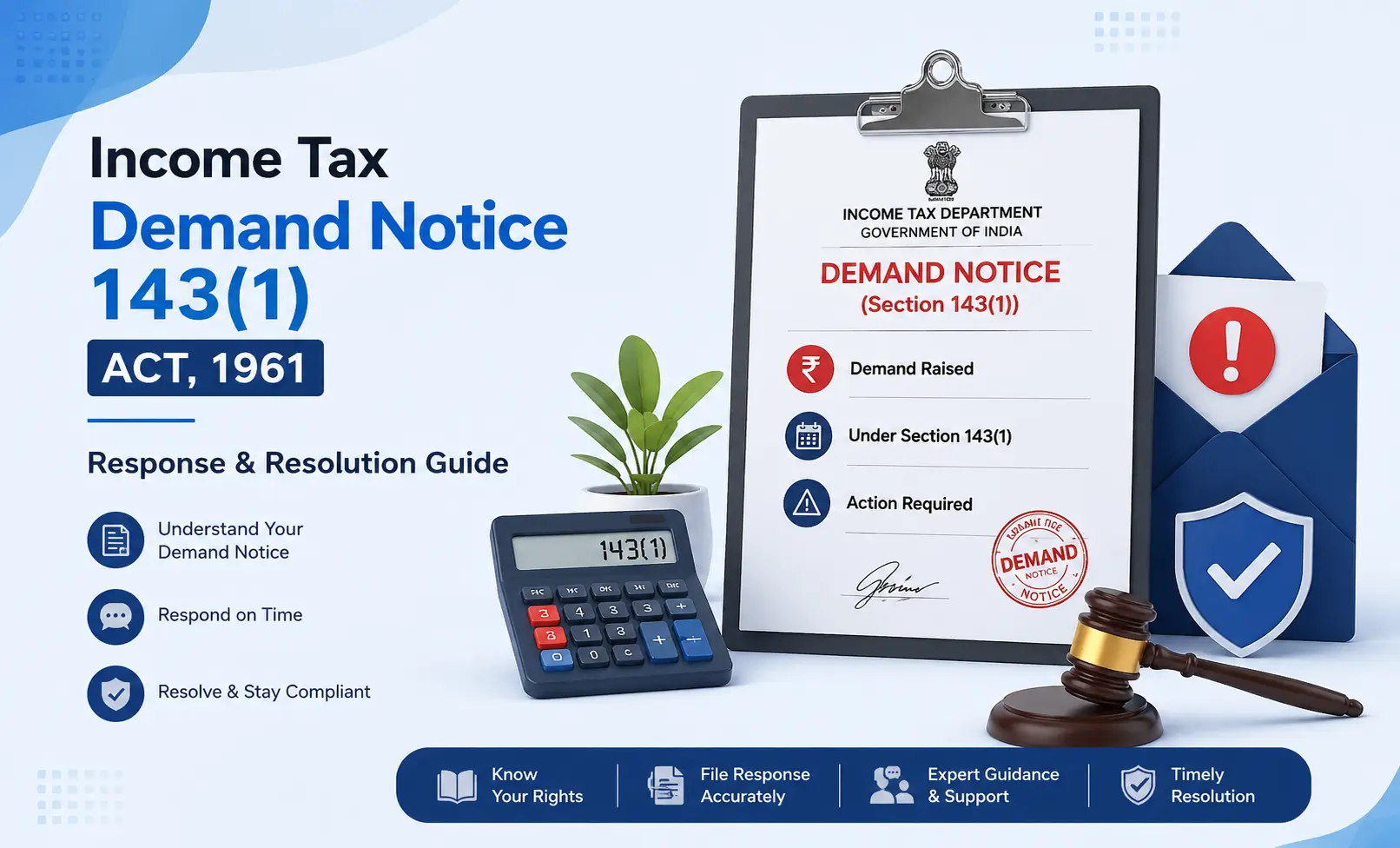
An Income Tax Demand Notice 143(1) is sent by the Income Tax Department's Centralized Processing Center (CPC) after your filed ITR is processed against its own records. If the department's calculation of your income, deductions, TDS credit, or tax paid does not match what you reported, it raises this notice specifying the additional tax you owe.
Many taxpayers panic when they see an outstanding demand in their account, but in most cases the issue is a mismatched TDS entry, a missed challan, or a disallowed deduction — all of which can be corrected once the right response or rectification is filed within the deadline. This guide, prepared by the SetupFiling.in tax team, walks you through what the notice means, why it was issued, and exactly how to respond so you avoid extra interest or refund adjustments.
Key Takeaways
- Section 143(1) intimation is issued after the CPC processes your filed Income Tax Return and compares it with department records.
- A demand usually results from a TDS credit mismatch, an incorrect deduction claim, unpaid self-assessment tax, or an interest calculation difference.
- The intimation can show no demand, a refund, or an additional tax payable — only the third case is called a "demand notice."
- You can either agree and pay online, or disagree and submit supporting proof through the e-filing portal.
- A genuine calculation error can be corrected through a rectification request under Section 154.
- Ignoring a valid demand attracts 1% monthly interest under Section 220(2) and can trigger refund adjustment under Section 245.
- Professional CA review helps avoid wrong responses that can escalate into a dispute.
What Is an Income Tax Demand Notice Under Section 143(1)?
Once your ITR is filed, the CPC's automated system checks your reported income, deductions and tax payments against Form 26AS, the Annual Information Statement, and challan records. Based on this comparison, it issues an intimation under Section 143(1) of the Income Tax Act, 1961. Returns filed for financial years starting on or after 1 April 2026 are processed under the equivalent provision, Section 270(1) of the Income Tax Act, 2025.
| Outcome | What It Means |
|---|---|
| No demand, no refund | Your return matches department records; no action needed. |
| Refund determined | Excess tax paid is credited to your pre-validated bank account. |
| Tax demand raised | Additional tax is payable — this is the 143(1) demand notice. |
Before finalising a demand, the CPC first sends a proposed adjustment under Section 143(1)(a) and gives you 30 days to respond. If there is no reply, the adjustment is finalised and the demand notice is issued.
Common Reasons You May Receive a 143(1) Demand Notice
1. TDS Credit Mismatch
If your employer, bank, or deductor has reported different figures in Form 26AS or AIS than what you claimed, the department reduces your credit and raises a demand for the difference.
2. Incorrect Deduction Claims
Deductions claimed under Sections 80C, 80D or similar provisions without adequate proof are disallowed during processing, increasing your taxable income.
3. Unpaid Self-Assessment Tax
If self-assessment tax was calculated incorrectly or left partly unpaid before filing, the shortfall — plus interest — appears as a demand.
4. Interest Under Sections 234A, 234B and 234C
Delays in filing the return or in paying advance tax attract interest under these sections, which often forms part of the total demand.
5. Incorrect Challan Details
A wrongly entered challan number, BSR code, or payment date can prevent the system from matching a tax payment you already made.
6. Missing Form 10E for Section 89 Relief
Claiming relief on salary arrears without filing Form 10E leads to the claim being disallowed and the tax recalculated.
7. Disallowed Chapter VI-A Deductions Under the New Regime
Filing under the New Tax Regime (Section 115BAC) while claiming deductions not permitted under it results in an automatic disallowance and a higher demand.
How to Download Your 143(1) Intimation
- Visit the e-filing portal: Go to the official Income Tax E-Filing website.
- Log in: Use your PAN and password to access your account.
- Open "e-File" > "Income Tax Returns": Select "View Filed Returns."
- Choose the assessment year: Pick the year for which you want the intimation.
- Download the PDF: The Section 143(1) intimation contains the department's full calculation.
Intimation Under Section 143(1) vs. Demand Notice
| Particular | Intimation u/s 143(1) | Demand Notice |
|---|---|---|
| Purpose | Communicates ITR processing result | Informs additional tax is payable |
| Issued After | Processing of return | Processing reveals outstanding tax |
| Payment Required | Not always | Yes, if correct |
| Response Required | Only if adjustments made | Yes |
Every demand is communicated through a 143(1) intimation, but not every intimation carries a demand. Depending on your case, you may also receive a Section 156 Notice of Demand specifying the exact payable amount, or a Section 245 notice proposing to adjust a pending refund against the outstanding demand.
Opening the 143(1) PDF and Finding the Password
The intimation is emailed as a password-protected PDF. The password is your PAN in lowercase, immediately followed by your date of birth in DDMMYYYY format — no spaces or special characters. For example, PAN ABCDE1234F with DOB 10 April 1990 gives the password abcde1234f10041990. Companies and HUFs use the date of incorporation instead.
How to Respond to an Income Tax Demand Notice 143(1)
- Log in to the e-filing portal: Access your account with PAN credentials and open pending actions.
- Select "Response to Outstanding Demand": Choose the relevant assessment year and review the details.
- Agree or Disagree: Agree if the calculation is correct; disagree if you believe it contains an error, and explain why.
- Submit supporting documents: Upload tax challans, Form 26AS, deduction proofs, or other relevant evidence.
Not sure whether to agree or disagree with your demand?
Send us a copy of your 143(1) intimation on WhatsApp and our CA team will review it free of cost before you respond.
Send Notice for Free ReviewHow to Pay the 143(1) Demand Challan
If you agree with the demand, pay it through the e-Pay Tax facility on the income tax portal or via Challan 280, selecting Minor Head 400 – Tax on Regular Assessment. Choosing the wrong payment head can prevent your payment from being matched against the demand, so this step needs to be accurate.
What Happens If You Ignore a 143(1) Demand?
Ignoring a valid demand allows the department to charge interest at 1% per month under Section 220(2), and it may adjust future refunds against the outstanding amount under Section 245. Large unresolved demands can also trigger recovery proceedings, so timely action is always the safer route.
Rectification Under Section 154 for a Genuine Mistake
If the demand contains a clear processing error — such as an incorrect tax credit, wrong interest calculation, or missing payment record — you can file a rectification request under Section 154 through the portal. The CPC reviews the request and corrects the intimation where a valid mistake is found. If it is rejected, you can refile with more details or pursue an appeal for complex disputes.
Time Limit for Issuing a 143(1) Intimation
The department must send the intimation within 9 months from the end of the financial year in which you filed your return — reduced from 12 months by the Finance Act, 2021. For example, an FY 2024-25 return filed in July 2025 falls under FY 2025-26, so the intimation can be issued up to December 31, 2026.
Why Get Professional Help from SetupFiling.in?
A wrong response to a demand notice can turn a simple mismatch into a prolonged dispute. SetupFiling.in has helped 50,000+ customers across India file accurate ITRs, respond to notices, and complete rectifications with support from experienced Chartered Accountants. We review your intimation, identify the exact cause of the demand, and file the correct response or rectification on your behalf — end to end.
Related reading: Income Tax E-Filing Guide, Notice for Defective Return under Section 139, Form 26AS and Form 16 for ITR Filing, Benefits of ITR Filing, and How to File Income Tax Return.
Get Your Demand Notice Resolved by a CA
Share your 143(1) intimation with us on WhatsApp and our tax team will review it, explain the exact reason for the demand, and file your response or rectification for you.
Place Your Order NowFrequently Asked Questions
What is a 143(1) demand notice in simple terms?
It is an intimation from the Income Tax Department's CPC stating that, after processing your ITR, you owe additional tax compared to what you originally reported.
How many days do I have to respond to a 143(1) notice?
You generally get 30 days from the date of the proposed adjustment under Section 143(1)(a) to respond before the department finalises the demand.
What is the password to open the 143(1) intimation PDF?
Your PAN in lowercase followed immediately by your date of birth in DDMMYYYY format, with no spaces or special characters.
Can I disagree with the demand raised under Section 143(1)?
Yes. On the e-filing portal you can select "Disagree with Demand" and upload supporting documents explaining why the calculation is incorrect.
What happens if I don't pay or respond to the demand?
Interest accrues at 1% per month under Section 220(2), and the department can adjust future refunds against the demand under Section 245.
How do I correct a genuine mistake in the demand notice?
File a rectification request under Section 154 through the income tax e-filing portal; the CPC reviews and corrects valid errors.
Which minor head should I select while paying the 143(1) demand?
Select Minor Head 400 – Tax on Regular Assessment while paying through Challan 280 or the e-Pay Tax facility.
Can SetupFiling.in help me respond to my demand notice?
Yes. Our CA team reviews your intimation, identifies the exact reason for the demand, and files the correct response or rectification for you.
Ready to Resolve Your Income Tax Demand Notice?
Talk to a SetupFiling.in tax expert now and get a clear, correct response filed before your deadline.
WhatsApp Us: +91 98182 09246