
Quick Answer: Input Tax Credit (ITC) under GST is the credit a GST-registered business gets for the tax it already paid on purchases (inputs, input services, and capital goods) used for business purposes. This credit can be used to reduce the GST payable on outward sales, so tax is effectively paid only on the value added at each stage. ITC can only be claimed if you hold a valid tax invoice, have received the goods or services, your supplier has filed their GST return and paid the tax, and you file your own GST return on time.
What Is Input Tax Credit (ITC) Under GST?
Goods and Services Tax (GST) works on a value-added principle. Every business in a supply chain pays GST on what it buys and collects GST on what it sells. Input Tax Credit is the mechanism that prevents the same tax from being charged again and again at each stage of that chain — commonly called the "cascading effect" or tax-on-tax.
In simple terms, ITC is the GST you paid on your business purchases, which you are allowed to subtract from the GST you collected on your sales. Only the balance — the net tax on the value you actually added — is paid to the government. This is exactly what makes a valid GST Registration Certificate guide so important, because ITC can only flow to businesses that hold an active GST registration.
Legal Basis of ITC
Input Tax Credit is governed primarily by Section 16 of the Central Goods and Services Tax (CGST) Act, 2017, along with Section 17 (apportionment and blocked credits), Rule 36 (documentary requirements), Rule 37 (reversal on non-payment), Rule 42/43 (reversal for exempt supplies), and Rule 36(4)/matching with GSTR-2B.
How ITC Works — A Simple Example
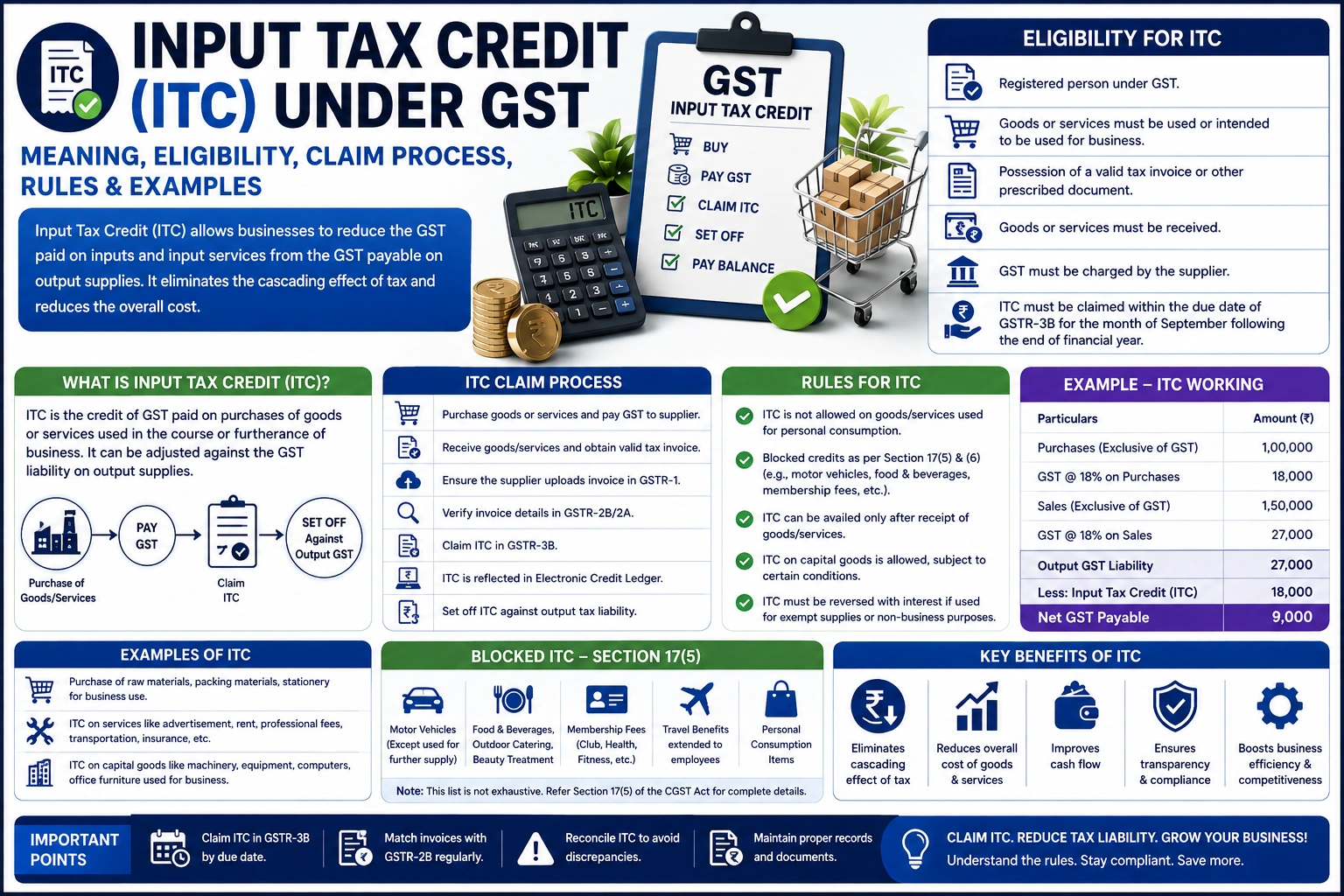
Assume a manufacturer buys raw material worth ₹1,00,000 and pays 18% GST (₹18,000) on it. The manufacturer then sells the finished product for ₹1,50,000 and charges 18% GST (₹27,000) to the buyer.
| Particulars | Amount |
|---|---|
| GST paid on purchase (Input Tax) | ₹18,000 |
| GST collected on sale (Output Tax) | ₹27,000 |
| Input Tax Credit claimed | ₹18,000 |
| Net GST payable to government | ₹9,000 |
Without ITC, the manufacturer would have to pay the full ₹27,000 again, even though ₹18,000 was already paid on inputs. ITC ensures tax is paid only once, on the value actually added (₹50,000 in this case).
Who Is Eligible to Claim ITC Under GST?
Any person registered under GST who uses goods or services for furthering their business can claim ITC, subject to the conditions in Section 16(2) of the CGST Act. Before you can claim ITC at all, your business must first complete GST registration online in India, since ITC is available only to GSTIN holders filing regular returns.
Conditions to Claim ITC Under Section 16(2)
- You must possess a valid tax invoice, debit note, or other prescribed document issued by a registered supplier.
- You must have actually received the goods or services (or both), including cases of "bill to ship to" transactions.
- The tax charged on the supply must have actually been paid to the government by the supplier, either in cash or through their own ITC.
- You must have furnished your GST return (GSTR-3B) for the relevant period.
- Where goods are received in lots or instalments, ITC can be claimed only after the last lot is received.
- If payment for the invoice (including tax) is not made to the supplier within 180 days from the invoice date, the claimed ITC must be reversed, along with applicable interest.
- The invoice or debit note details must be reflected in the supplier's GSTR-1/IFF and consequently in your own GSTR-2B statement.
Documents and Records Required to Claim ITC
- Tax invoice issued by a GST-registered supplier
- Debit note (if applicable) issued by the supplier
- Bill of entry for imported goods
- Invoice issued by the recipient under reverse charge, along with proof of tax payment
- Delivery challan, in specific cases such as job work or supply on approval
- GSTR-2B statement showing the matched invoices for the tax period
If you're unsure which documents your business needs, our guide on documents required for GST registration is a useful starting point before you dive into ITC-specific paperwork.
Step-by-Step Process to Claim Input Tax Credit
Here is exactly how a registered taxpayer claims ITC on the GST portal for a given tax period.
Verify GST Registration & Purchase Invoices
Confirm your GSTIN is active and collect all purchase invoices for the tax period, checking supplier GSTIN, invoice number, date, and tax amount.
Download and Review GSTR-2B
Log in to the GST portal, go to Services > Returns > GSTR-2B, and download the auto-generated statement that lists eligible and ineligible ITC based on your suppliers' filings.
Reconcile GSTR-2B with Your Purchase Register
Match every invoice in GSTR-2B against your own purchase records to identify missing invoices, mismatches, or duplicate entries before claiming credit.
Identify and Exclude Blocked or Ineligible Credit
Remove ITC on items blocked under Section 17(5), such as personal-use goods, motor vehicles (with exceptions), and certain food and beverage expenses.
Report Eligible ITC in GSTR-3B
Enter the eligible ITC amount in Table 4 of GSTR-3B under the correct heads — IGST, CGST, SGST, and Cess — as reflected in GSTR-2B.
File GSTR-3B and Pay Net Tax
Offset your output tax liability with the claimed ITC and pay any remaining balance through the electronic cash ledger, then file the return before the due date.
Maintain Records for Future Audit
Retain invoices, e-way bills, and reconciliation statements for at least six years, since GST officers can verify ITC claims during audits or assessments.
Not Registered Under GST Yet?
You cannot claim Input Tax Credit without an active GSTIN. Get registered in as little as 24 hours with expert assistance.
Time Limit to Claim ITC
Under Section 16(4) of the CGST Act, ITC for any invoice or debit note of a financial year must be claimed on or before 30th November of the following financial year, or the date of filing the annual return (GSTR-9), whichever is earlier. Missing this deadline means the credit lapses permanently, so timely reconciliation is critical. Staying on top of GST return filing due dates is one of the simplest ways to avoid losing eligible credit.
Key ITC Rules Every Taxpayer Should Know
1. Matching with GSTR-2B (Rule 36(4))
ITC can be availed only to the extent it appears in your GSTR-2B. If a supplier has not filed their GSTR-1 or IFF, the corresponding credit will not reflect in your statement and cannot be claimed until it does.
2. Blocked Credit Under Section 17(5)
Certain categories of ITC are specifically disallowed regardless of business use, including motor vehicles for personal transport (with limited exceptions), food and beverages, outdoor catering, health and life insurance (unless mandatory), club memberships, works contract services for construction of immovable property (with exceptions), and goods or services used for personal consumption.
3. Reversal of ITC on Exempt Supplies (Rule 42 & 43)
If a business makes both taxable and exempt supplies, ITC attributable to exempt supplies and inputs used for non-business purposes must be reversed proportionately, following the formula prescribed under Rule 42 for inputs/input services and Rule 43 for capital goods.
4. Reversal for Non-Payment Within 180 Days
If you do not pay the supplier (value plus tax) within 180 days of the invoice date, the ITC already claimed must be reversed along with interest. It can be reclaimed once payment is actually made.
5. ITC on Capital Goods
Full ITC can be claimed on capital goods used entirely for business purposes in the year of purchase itself — there is no need to spread it over the asset's useful life, unlike depreciation. However, if depreciation is claimed on the tax component of the capital goods under the Income Tax Act, ITC on that same tax component cannot be claimed under GST.
GSTR-2B vs GSTR-3B: What's the Difference for ITC?
| Basis | GSTR-2B | GSTR-3B |
|---|---|---|
| Nature | Auto-generated, static statement | Self-declared summary return |
| Purpose | Shows eligible/ineligible ITC based on supplier filings | Where you actually claim and offset ITC |
| Frequency | Monthly, generated on the 14th | Monthly/Quarterly, filed by the taxpayer |
| Editable | No — reference document only | Yes — taxpayer enters figures |
Common Reasons ITC Claims Get Rejected or Blocked
- Invoice not uploaded or not reflected by the supplier in their GSTR-1
- Mismatch between GSTR-2B and the purchase register
- Claiming ITC on goods/services blocked under Section 17(5)
- Non-payment to the supplier within 180 days
- ITC claimed after the Section 16(4) deadline
- Supplier's GST registration cancelled or suspended before filing returns
- Incorrect GSTIN or invoice details on the tax invoice
Many of these issues trace back to a shaky registration foundation. If your GSTIN status, address, or authorised signatory details are incorrect, it's worth reviewing our checklist on common mistakes during GST registration to prevent downstream ITC problems.
Worked Examples of ITC Calculation
Example 1: Trader Purchasing and Reselling Goods
A trader buys goods worth ₹5,00,000 and pays 18% GST (₹90,000). The trader sells the same goods for ₹6,50,000, charging 18% GST (₹1,17,000). ITC of ₹90,000 is claimed, so net GST payable is ₹27,000 (₹1,17,000 − ₹90,000).
Example 2: Business With Partial Exempt Supplies
A company has total ITC of ₹2,00,000 for the month. 30% of its turnover relates to exempt supplies. As per Rule 42, ITC attributable to exempt supplies (₹60,000) must be reversed, leaving eligible ITC of ₹1,40,000 to offset against output tax.
Example 3: Blocked Credit on a Motor Car
A company purchases a car for employee use and pays ₹1,80,000 as GST. Since motor vehicles for personal transport of persons are blocked under Section 17(5) (with limited exceptions for further supply, transportation, or driving training businesses), this ₹1,80,000 cannot be claimed as ITC.
Need Help Filing GST Returns & Claiming ITC Correctly?
Our compliance experts reconcile GSTR-2B, file GSTR-3B accurately, and make sure no eligible credit is left unclaimed.