
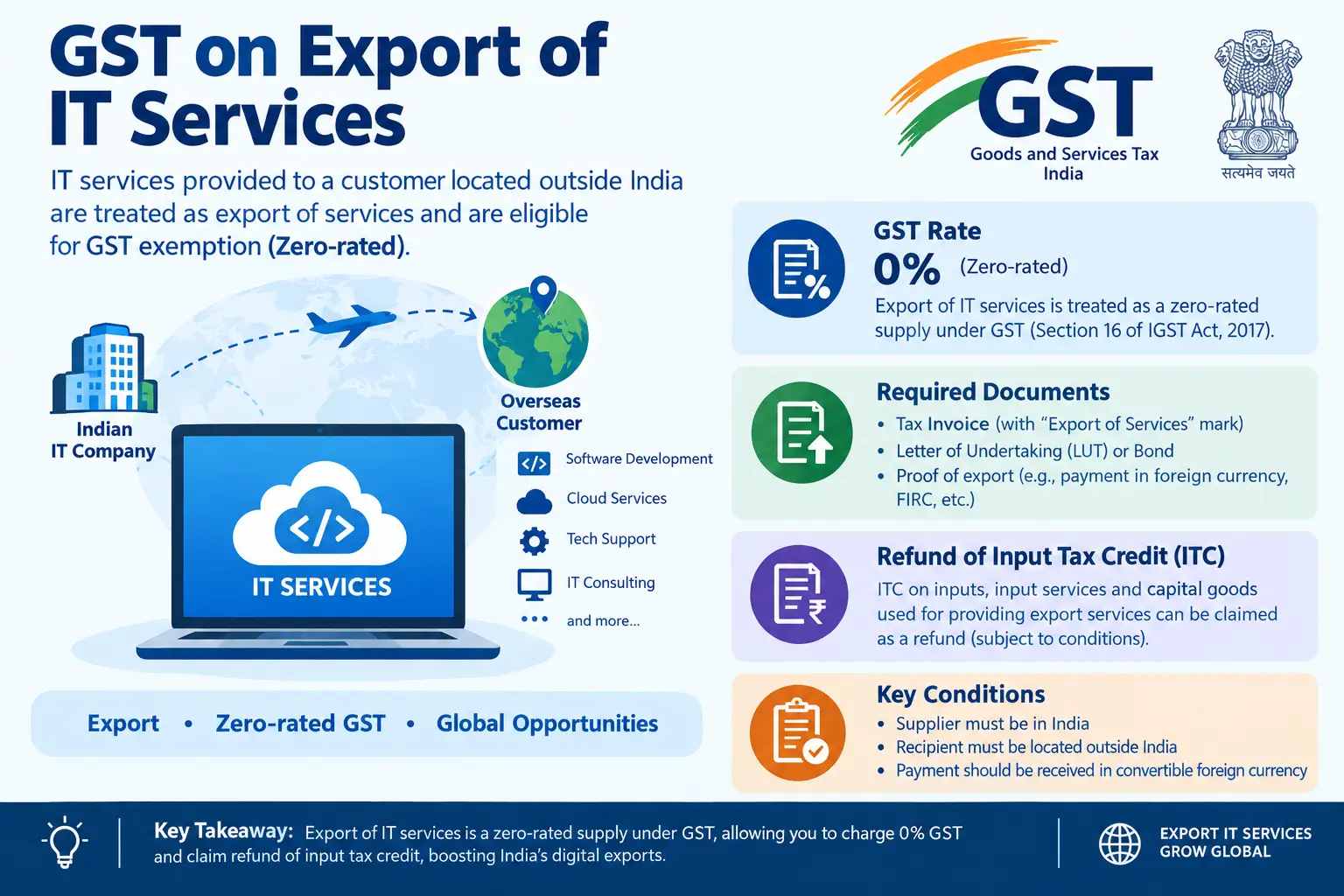
Is GST Applicable on Export of IT Services?
Yes, but at a special rate. When an Indian company or freelancer provides software development, IT consulting, technical support, or SaaS access to a client based outside India, the transaction qualifies as an export of service under GST, provided it meets the conditions set out in Section 2(6) of the IGST Act. Export of service is a zero-rated supply, meaning the effective GST rate is 0%, rather than the standard 18% that applies to domestic IT services.
Zero-rating is a significant advantage over exemption: unlike an exempt supply, a zero-rated export still allows the exporter to claim input tax credit on business expenses such as software subscriptions, cloud hosting, and office costs, while charging no GST to the overseas client.
Conditions for IT Services to Qualify as Export
Supplier in India
The person or company providing the IT service must be located in India.
Recipient Outside India
The client receiving and paying for the service must be located outside India.
Place of Supply Outside India
Under the default rule for services, the place of supply is the recipient's location, which must fall outside India.
Payment in Convertible Foreign Exchange
Payment must be received in convertible foreign exchange, or in Indian rupees where permitted by the RBI.
Not Merely Distinct Establishments
The supplier and recipient must not be establishments of the same legal entity, such as an Indian branch invoicing its own foreign head office.
Common Classification Traps for IT Exporters
Two situations regularly catch IT businesses off guard when claiming export benefits, and both are worth understanding before you invoice a client abroad.
Captive Units & Group Companies
An Indian subsidiary billing its own foreign parent company, or a branch office billing its head office, is generally treated as billing the same legal person rather than a genuine export, since establishments of a distinct person under the same PAN or entity structure don't count as separate parties for export purposes.
Intermediary Services
If your role is arranging or facilitating a service between a foreign client and another vendor, rather than providing the IT service yourself, you may be classified as an intermediary. For intermediary services, the place of supply is your own location in India, not the client's, which disqualifies the transaction from zero-rating.
SAC Codes Commonly Used for IT Service Exports
| Service Type | SAC Code | GST Rate (Export) |
|---|---|---|
| IT design and software development services | 998313 | 0% (zero-rated under LUT) |
| IT consulting and support services | 998314 | 0% (zero-rated under LUT) |
| IT infrastructure and hosting services | 998315 | 0% (zero-rated under LUT) |
| Software maintenance and support | 998316 | 0% (zero-rated under LUT) |
Domestic IT services billed to Indian clients continue to attract the standard 18% GST under the same SAC codes. Use our HSN and SAC code finder to confirm the exact code for your specific IT service.
LUT: Exporting IT Services Without Paying IGST Upfront
A GST-registered IT exporter has two ways to handle tax on export invoices: pay IGST at the time of billing and later claim a refund, or file a Letter of Undertaking (LUT) and export without paying IGST at all. Filing an LUT is the far more efficient route for most IT businesses, since it avoids tying up working capital in a refund claim. Read our full step-by-step guide to filing LUT in GST for the exact process and annual renewal timeline.
Who Needs GST Registration for IT Service Export?
Export of service is treated as inter-state supply under GST law, and businesses making inter-state taxable supply are generally required to register regardless of turnover, unless they exclusively make exempt supplies. This means freelance developers, IT consultants, and software companies billing overseas clients are typically advised to Register for GST from the start of their export activity, rather than waiting to cross the standard ₹20 lakh threshold that applies to purely domestic service providers.
Documents Required for GST Registration of an IT Export Business
Identity & Entity Proof
- PAN card of the proprietor, partners, or the company/LLP
- Aadhaar card of the authorised signatory
- Recent passport-size photograph
- Certificate of Incorporation or partnership deed, where applicable
Business & Bank Proof
- Proof of the office or work-from-home address
- Cancelled cheque, bank statement, or passbook copy
- Foreign client invoices or contracts, and FIRC where available
For a complete, printable checklist covering every document type, see our GST registration documents checklist.
How to Set Up GST for IT Service Export: Step by Step
Choose a Package and Share Your Details
Select a registration package above, provide your business details and foreign client information, and complete payment.
Send Your Documents
Share PAN, Aadhaar, address proof, a photograph, and bank details with our team over WhatsApp or email.
Form GST REG-01 Filed with the Correct SAC Code
Our compliance team files your application, classifying your service correctly under the applicable IT services SAC code.
GSTIN, Certificate & Portal Login Delivered
Once approved, you receive your GSTIN, GST Registration Certificate, and GST portal User ID and Password.
LUT Filed for Zero-Rated Export
We file your Letter of Undertaking so you can invoice overseas clients without charging or paying GST upfront.
Export Invoices & Returns Filed
Export invoices are reported correctly in GSTR-1 and GSTR-3B each period, keeping your export documentation audit-ready.
Why GST Registration Matters for IT Exporters
Zero-Rated Billing
Invoice overseas clients at 0% GST once LUT is filed, keeping your pricing competitive internationally.
Input Tax Credit
Claim credit on GST paid for software tools, cloud hosting, and office expenses used for the exported service.
Clean Client Invoicing
Issue professional, GST-compliant export invoices that overseas clients and their finance teams can process without friction.
Bank & RBI Compliance
A valid GSTIN supports smoother processing of foreign remittances and FIRC documentation with your bank.
Loan & Investor Readiness
Consistent GST Filings serve as verifiable revenue proof when raising funding or applying for business credit.
Avoids Interest & Penalties
Registering on time avoids interest and penalty exposure for operating as an unregistered exporter.