
GST on Construction in India: The Basics
GST on construction in India applies at two levels: once on the service a builder or contractor provides (works contract or construction service), and again on every material — cement, steel, sand, bricks, tiles — that goes into the project. Since the GST 2.0 rate rationalisation effective 22 September 2025, the old four-slab structure was compressed into a simpler 5% and 18% system (with a separate 40% slab for luxury and sin goods), and this reshuffled several construction-related rates, most notably cutting cement from 28% to 18%.
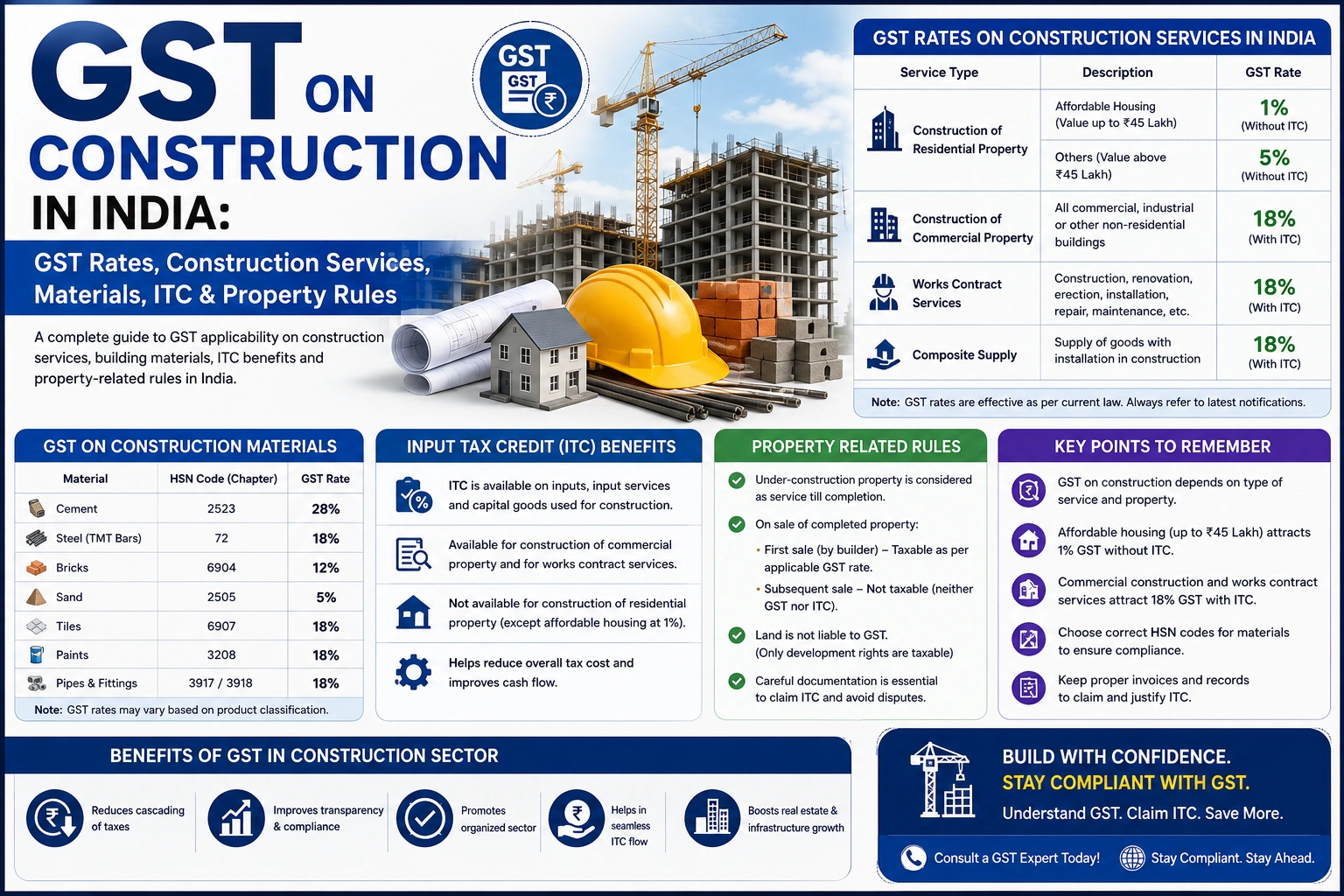
Whether you are a homeowner planning a build, a promoter launching a residential project, or a contractor bidding on a government tender, getting the applicable GST rate wrong can distort your cost sheet and, worse, cost you Input Tax Credit you were otherwise entitled to. This guide breaks down every rate, every ITC condition and every property-sale scenario you are likely to encounter, and shows you where to get your GST registration in India set up correctly from day one.
GST Rates on Construction Services
Most construction services in India attract 18% GST under SAC code 9954, the "works contract" head that covers any contract combining materials and labour to build, alter or repair immovable property. A handful of categories are taxed differently to keep housing and public infrastructure affordable.
| Type of construction service | GST rate | Input Tax Credit |
|---|---|---|
| Works contract services – general (commercial, industrial, government buildings) | 18% | Available to the contractor |
| Affordable housing (as per notified carpet-area & value criteria) | 1% on the sale value | Not available |
| Other residential real estate projects | 5% on the sale value | Not available |
| Commercial units within a real estate project | 12%–18% depending on ITC option chosen | Case-specific |
| Government infrastructure (roads, bridges, canals, water-supply pipelines) | 12%, subject to notified conditions | Available to the contractor |
| Pure labour contracts for single residential units / government housing schemes | Exempt / concessional | Not applicable |
Contractors executing works contracts should always confirm rate applicability against the current CBIC notification before invoicing, since the rate a promoter charges a buyer (1%/5%) is different from the rate a sub-contractor charges the main contractor (18%).
GST Rates on Construction Materials
Cement now attracts 18% GST, down from 28% earlier, following the GST Council's rate rationalisation effective 22 September 2025 — the single biggest relief construction material buyers have seen since GST was introduced in 2017. Other core materials sit across the 5% and 18% slabs, with a few exceptions.
| Material | HSN code | GST rate |
|---|---|---|
| Cement (OPC, PPC, white & blended cement) | 2523 | 18% |
| TMT bars / structural steel | 7214 / 7308 | 18% |
| Sand (natural) | 2505 | 5% |
| Clay & fly-ash bricks (with ITC) | 6901 / 6815 | 12% (or 6% under the no-ITC composition option) |
| AAC blocks | 6815 | 12% |
| Ready-mix concrete (RMC) | 3824 | 18% |
| Ceramic & vitrified tiles | 6907/6908 | 18% |
| Marble & granite – finished slabs | 6802 | 18% |
| Paints & varnishes | 3208/3209 | 18% |
| Sanitary fittings & bathroom fixtures | 6910/7324 | 18% |
Always quote and bill against the correct HSN code on purchase orders and e-way bills. A mismatched HSN is one of the most common triggers for ITC reconciliation notices during a GST audit, especially on high-value cement and steel purchases.
Input Tax Credit (ITC) Rules for Construction
ITC on construction of immovable property is blocked under Section 17(5)(c) and 17(5)(d) of the CGST Act when the property is being built for the taxpayer's own use. This is the single most misunderstood rule in construction GST — many businesses assume they can offset GST paid to a contractor against their output tax, and then face a reversal demand at audit.
- Blocked: A company builds its own office, warehouse or factory shed and pays 18% GST to the contractor — that GST cannot be claimed as ITC.
- Allowed – exception 1: If the works contract service is received in order to supply further works contract services (i.e. you are a sub-contractor passing the service on), ITC can be claimed.
- Allowed – exception 2: If construction relates to plant and machinery (foundations, structural supports directly connected to machinery), ITC is not blocked.
- Blocked for promoters: Residential developers who opt for the concessional 1% (affordable housing) or 5% (other residential) GST rate cannot claim ITC on inputs at all — this is the trade-off for the lower rate.
- 80% procurement condition: Promoters using the concessional residential scheme must procure at least 80% of inputs and input services from GST-registered suppliers, or pay tax under reverse charge on the shortfall — see our note on the reverse charge mechanism (RCM) under GST.
- No ITC on renovation/repair: Credit is not available for repair or renovation expenditure capitalised to the property, even where the original construction qualified.
GST on Under-Construction vs. Ready-to-Move Property
GST applies only to under-construction property — a completed flat with an occupancy certificate (OC) attracts no GST at all, because the sale of completed immovable property is treated as a sale of land/building outside the scope of "supply" under Schedule III of the CGST Act.
| Property status | GST applicability |
|---|---|
| Under-construction, affordable housing category | 1% of sale value (no ITC to promoter) |
| Under-construction, other residential | 5% of sale value (no ITC to promoter) |
| Under-construction, commercial unit | 12%–18%, ITC generally available to the developer |
| Ready-to-move / completed with Occupancy Certificate before sale | No GST (stamp duty & registration charges still apply) |
| Resale of an existing property | No GST |
The 1% and 5% rates already reflect the standard one-third abatement for land value, so they apply to the full agreement value shown on the cost sheet — buyers do not need to separately deduct land cost before calculating GST.
GST Registration for Builders & Contractors
Any builder, promoter, works contractor or building-material supplier whose annual turnover crosses the applicable threshold must register under GST before raising a single tax invoice. Operating without registration once you cross the threshold attracts penalties and blocks your clients from claiming ITC on payments made to you.
- Sole proprietors and small contractors — see GST registration for sole proprietorship businesses.
- Builders operating as a private limited company — see GST registration for a private limited company.
- Setting up a new construction firm in the capital — see how to register a construction company in Delhi before applying for GST.
- Not sure what paperwork you need? Check the checklist of GST registration documents.
- Want to know the exact cost? See the GST registration fees breakdown.
Once approved, you receive a 15-digit GSTIN along with a GST registration certificate — the document you'll need for every tender, purchase order and bank loan application going forward.
How to Apply for GST Registration — Step by Step
You can complete GST registration for a construction or contracting business entirely online in five steps, without visiting a GST Seva Kendra.
- Gather your documents: PAN, Aadhaar, business address proof, bank details and photographs — the full list is on our GST registration documents page.
- File Part A of Form REG-01: Submit PAN, mobile number and email to generate a Temporary Reference Number (TRN), or let us apply for GST registration online on your behalf.
- Complete Part B with business details: Add principal place of business, nature of the construction/contracting business, authorised signatory details and bank account.
- Upload documents & submit for verification: Follow the full step-by-step GST registration process to avoid resubmission notices.
- Track your ARN and receive your GSTIN: Use your Application Reference Number to track your ARN status until your GST Registration Certificate and portal User ID/Password are issued.
Get your GST Registration Certificate without the paperwork
We handle the filing, follow-ups and portal setup — you get your GST Registration Certificate plus User ID and Password of the GST portal.
Apply Now for GSTCommon Mistakes Contractors & Builders Make with GST
- Charging the old 12% works contract rate after the GST 2.0 change instead of the current 18%.
- Claiming ITC on construction of an office or warehouse for own use, which is blocked under Section 17(5).
- Billing cement at the outdated 28% rate instead of the revised 18% rate.
- Missing the 80% registered-supplier procurement condition under the residential concessional scheme.
- Using the wrong HSN code for bricks, tiles or marble, causing ITC mismatches.
- Delaying GST registration after crossing the turnover threshold, resulting in penalties and interest.
For a deeper walkthrough, read our detailed guide on 10 common GST registration mistakes to avoid, and if you're already registered, our professional GST return filing assistance keeps your monthly and annual returns error-free. If a registration ever needs to be closed, see how to cancel your GST registration. For a wider view of the process end-to-end, see the complete online GST registration process.
Frequently Asked Questions
What is the current GST rate on construction services in India?
Most construction and works contract services are taxed at 18% under SAC 9954. Affordable housing is taxed at 1% and other residential real estate at 5%, both without Input Tax Credit, while notified government infrastructure projects may attract 12%.
What is the GST rate on cement in 2026?
Cement attracts 18% GST, reduced from 28% effective 22 September 2025 as part of the GST 2.0 rate rationalisation. This applies to OPC, PPC, white cement and other blended cement products under HSN 2523.
Can I claim Input Tax Credit on GST paid for constructing my own building?
No. Section 17(5)(c) and (d) of the CGST Act block ITC on construction of immovable property for own use. ITC remains available only where the construction relates to plant and machinery, or where the works contract service is used to supply further works contract services.
Is GST applicable on a ready-to-move flat?
No. GST applies only to under-construction property. Once a flat has an Occupancy Certificate and is sold as a completed unit, no GST is charged — only stamp duty and registration charges apply.
What GST rate applies to affordable housing projects?
Affordable housing projects, as defined by carpet area and value criteria notified by the government, are taxed at 1% of the sale value, with no Input Tax Credit available to the promoter.
Do contractors need GST registration to bid on construction tenders?
Yes. Any contractor whose turnover crosses the applicable GST threshold must register and hold a valid GSTIN and GST Registration Certificate before raising tax invoices for tender-based or private construction work.
What documents are required to get GST registered as a builder or contractor?
You typically need PAN, Aadhaar, proof of business address, bank account details, incorporation documents (for companies/LLPs) and passport-size photographs of the authorised signatory.
What is the GST rate on steel and TMT bars used in construction?
Structural steel and TMT bars are taxed at 18% GST under HSN 7214/7308, unchanged by the GST 2.0 reforms.
How long does it take to get a GST Registration Certificate?
Once the application and documents are submitted correctly, GST registration is typically approved within 3 to 7 working days, after which the GST Registration Certificate along with the portal User ID and Password is issued.