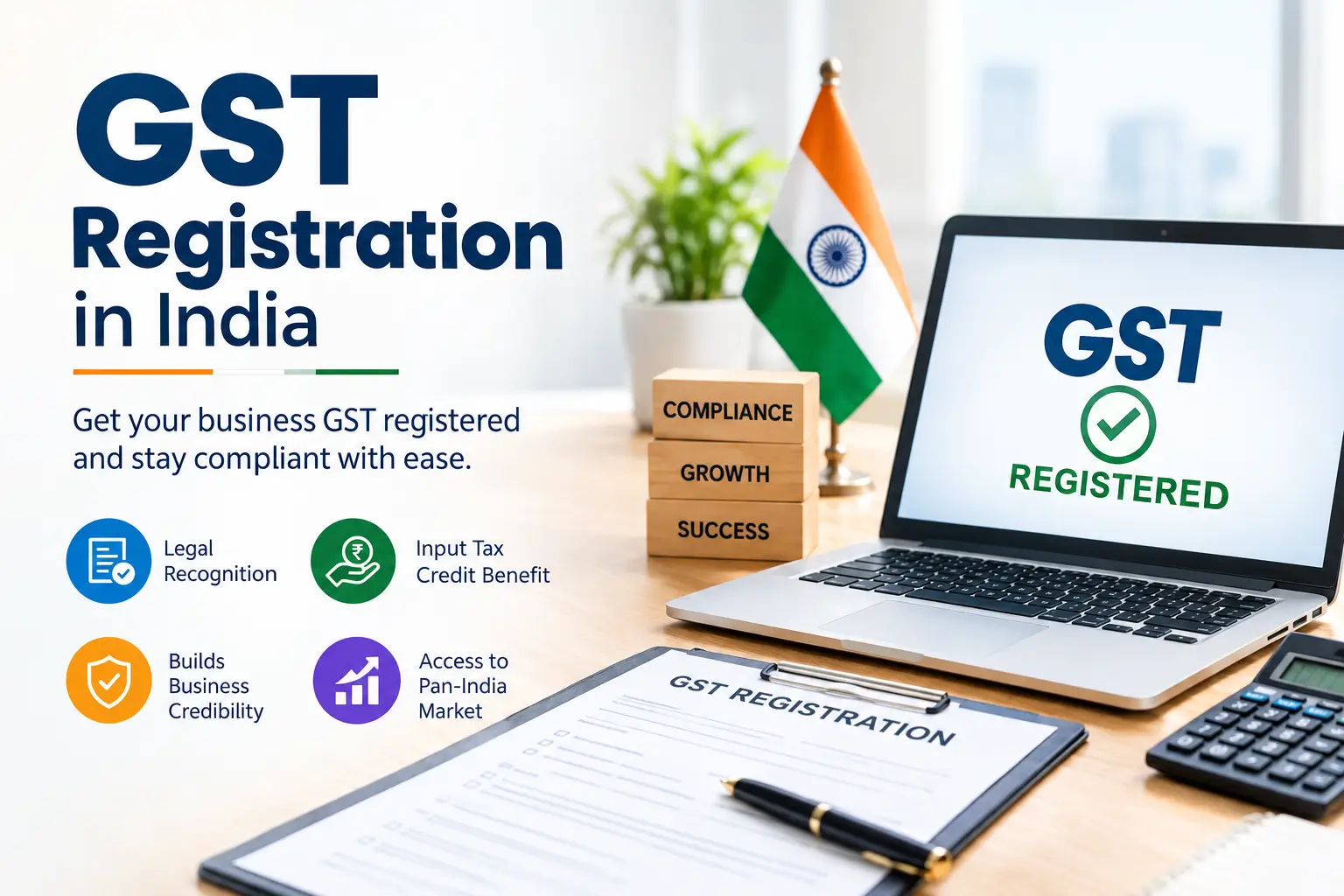
GST Registration

Need GST Registration? Get your GSTIN quickly with expert CA/CS support. We handle REG-01 filing, document verification, and ARN tracking for a smooth and hassle-free GST registration process.

Get Free Expert Consultation

    50K +

    Happy Clients

    3500+

    Expert Advisors

    100%

    Online Process

    4.8+

    Customer Rating

    Choose The Best GST Registration Package For Your Business

    Silver Package

    48- 72 hours Fast Track GST Registration Certificate

    999 499/-
    • GST Registration Certificate
    • GST Portal User ID and Password for GST Return Filing
    50% off

    Gold Package

    GST Registration + 6 Month GST Return Filing

    3999 1999/-
    • GST Registration Certificate
    • GST return filing for 6 months (up to 100 transactions)
    Recommended Plan

    Premium Package

    GST Registration + 12 Month GST Return Filing

    7398 3,699
    • GST Certificate within 24hrs
    • GST return filing for 12 months (up to 100 transactions)
    50% off

    Now Get GST for Your Business in Just 1 Day

    Get your GST Registration now! Fast, easy, and secure. Start today to stay compliant and grow your business!

    GST Registration in India — Overview

    Goods and Services Tax (GST) is India’s unified indirect tax system that replaced VAT, Service Tax, Excise Duty, and 17 other levies. Registering under GST gives your business a unique GSTIN (GST Identification Number) — a 15-digit alphanumeric ID required to collect tax, claim input tax credit (ITC), and operate legally beyond certain turnover thresholds.

    Without GST registration, your business cannot issue tax invoices, and customers cannot claim ITC on purchases from you — making you less competitive in B2B markets.

    What is GST?

    GST stands for Goods and Services Tax. It is a single tax that is applied to the supply of goods and services across India.

    It is collected at every step of the supply chain, but businesses can claim credit for the tax they paid on purchases. This makes GST a tax only on the value added at each stage.

    In simple terms, GST means:

    • One tax for the whole country
    • Easy to understand
    • Transparency in the system
    GST Registration certificate, GST Certificate

    Who must register for GST?

    BUSINESS TYPE TURNOVER THRESHLD STATE COVERED

    Goods — General States

    ₹40 Lakhs/year

    Most states

    Goods — Special Category States

    ₹20 Lakhs/year

    NE states, Uttarakhand, J&K, HP

    Services (all states)

    ₹20 Lakhs/year

    All states

    Inter-state supply

    ₹0 (mandatory)

    All states

    E-commerce operators/sellers

    ₹0 (mandatory)

    All states

    Casual/Non-resident taxable person

    ₹0 (mandatory)

    All states

    Even if you fall below these thresholds, voluntary registration is recommended if you deal with GST-registered businesses — it lets you claim ITC and boosts your credibility.

    1.4 Cr+

    Businesses registered under GST in India

    1-3 day

    Average processing time with expert help

    ₹0

    Government fee for GST registration

    Documents Required For GST Registration

    Applicant Documents

    1. PAN card and Aadhar card, photograph of the Proprietor/Partners/Directors
    2. Certificate of Incorporation – If Applicable 
    3. PAN Card of Firm or Company – If Applicable
    4. MOA/Partnership Deed/ Trust Deed – If Applicable for you

    Business Address Proof

    1. Rent Agreement  – If Rented 
    2. Electricity bill 
    3. Property Tax Receipt – if available

    Note – Applicant Name and Date of Birth must should be same on all documents like pan card , adhaar card and Mobile number most should be linked with adhaar card for adhaar authentication.

    Time Require for GST Registration: 1 Day

    After filing your GST application, you’ll receive an Application Reference Number (ARN) instantly. This ARN can be used to track the status of your application.

    As for the actual GST number, the GST officer typically takes 1 day under fast mode gst application

    If you are applying GST under Normal Mode then GST Office may take time of 7 to 15 day to issue GST Certificate

    GST Registration Threshold Limits (State-Wise)

    STATE CATEGORY EXCLUSIVE SUPPLY OF GOODS SERVICES / BOTH GOODS & SERVICES

    Normal Category States (e.g., Maharashtra, Delhi, Tamil Nadu, Uttar Pradesh, Karnataka, etc.)

    ₹40 Lakh

    ₹20 Lakh

    Special Category States – Group A (Puducherry, Meghalaya, Mizoram, Tripura, Manipur, Sikkim, Nagaland, Arunachal Pradesh, Uttarakhand)

    ₹20 Lakh

    ₹10 Lakh

    Special Category States – Group B (Assam, Jammu & Kashmir, Himachal Pradesh)

    ₹40 Lakh

    ₹20 Lakh

    Specific Exception States (Telangana)

    ₹20 Lakh

    ₹20 Lakh

    Compulsory GST Registration

     Regardless of turnover, GST registration is mandatory for:

    • Inter-state taxable suppliers (except for certain service providers).
    • Casual Taxable Persons and Non-Resident Taxable Persons.
    • E-commerce operators and those selling through them.
    • Those required to pay tax under Reverse Charge (RCM).

    Note: Businesses falling below these limits can still opt for Voluntary Registration to claim Input Tax Credit (ITC) or to sell to larger B2B clients who require GST invoices

    What are Benefits of GST Registration?

    Apply for GST is required for businesses that exceed a certain turnover limit, but even if you fall below this limit, registering for GST offers several benefits:

    1. Claim Input Tax Credit

    Business owners can claim an input tax credit on the GST they have paid on goods purchased and the expenses incurred during registered operations, thereby decreasing their total tax liability.

    2. Freedom to Sell Anywhere in India

    As long as a business is registered with GST, they will be able to sell their goods and/or services in any Indian state, even if they are not compliant in that state.

    3. Can start selling on Amazon/Flipkart

    Businesses that want to list their goods/services on large e-commerce platforms (such as Amazon and Flipkart) must be GST registered.

    4. No Penalties from Non compliance

    By maintaining compliance with GST rules and regulations, businesses will not face any financial penalties or legal action due to noncompliance

    Step-by-Step GST Registration Process

    Step 1: Gather & verify all documents

    Collect PAN, Aadhaar, address proof, and business documents. Ensure names match exactly across all documents — mismatches cause rejections.

    Step 2: Generate TRN on GST portal

    Visit gst.gov.in → Services → Registration → New Registration. Enter PAN, email, and mobile to get a Temporary Reference Number (TRN) valid for 15 days.

    Step 3: Fill Part B of the application

    Use TRN to log in and fill Form GST REG-01. Provide business details, promoter info, bank account details, HSN/SAC codes, and place of business.

    Step 4: Upload documents & submit

    Upload all required documents in the prescribed format and size. Submit using DSC, e-sign (Aadhaar OTP), or EVC as applicable.

    Step 5: Track ARN & respond to queries

    An Application Reference Number (ARN) is issued. The GST officer may raise queries (SCN) within 3 working days — respond promptly to avoid delays.

    Step 6: Receive GSTIN & certificate

    Once approved (within 7 working days typically), your GSTIN and Registration Certificate are available on the GST portal under ‘Services → User Services.’

    Compliances after GST Registration

    Bank Account Update

    After Getting GST Certificate, Its mandatory to update Bank Account detail in GST within 45 day. Non-Compliance may result into GST Cancellation at Govt end.

    Display GST Certificate

    After getting GST number, Its mandatory under gst law to update gst number on board and display gst certificate at business address. Non-Compliance may result of penaty of Rs25000/-

    Filing of GST Returns

    One of the most important compliances after GST registration is the timely filing of GST returns on monthly, quarterly, and annual basis before due date to avoid penalty

    Issuance of Tax Invoices

    Businesses need to issue GST-compliant invoices to their customers for all taxable supplies made. Invoices should contain all the necessary information such as GSTIN, customer details, invoice number, taxable value, and tax amount.

    Maintenance of Books of Accounts

    It is essential for businesses to maintain accurate and up-to-date books of accounts as per the GST law. This includes keeping records of all invoices, expenses, input tax credit availed, and other financial transactions.

    Compliance with E-way Bill Rule

    Businesses need to generate e-way bills for the movement of goods exceeding specified values as per the GST rules. Failure to comply with e-way bill regulations can lead to penalties.

    Payment of Taxes

    Businesses are required to make timely payment of GST taxes to the government. Payment should be done online through the GST portal using the appropriate challans.

    Reverse Charge Mechanism (RCM)

    Under the RCM, the recipient of goods or services is liable to pay GST instead of the supplier. Businesses need to comply with reverse charge provisions when applicable.

    Penalty for Not Obtaining GST Registration

    Penalties for not obtaining GSTIN registration in India can be significant and are imposed on businesses that fail to comply with the registration requirements. According to Section 122 of the CGST Act, a penalty of 100% of the tax due or ₹10,000, whichever is higher, is levied on businesses that fail to obtain GST registration when required to do so.

    Some of the key penalties for not obtaining GST registration or committing other offenses under GST include:

    Penalty for not registering under GST:

    1. 100% of the tax due or ₹10,000, whichever is higher.
    2. Penalty for incorrect invoicing: ₹25,000
    3. Penalty for late filing of GST returns: ₹100 per day per Act (₹100 for CGST and ₹100 for SGST), with a maximum of ₹5,000
    4. Penalty for fraudulent activities: ₹10,000 or the equivalent tax amount evaded

    These penalties are applicable to businesses that commit offenses under the GST Act, such as failing to register, providing false information, or not collecting Tax Collected at Source (TCS) when required. . It is essential for businesses to understand and comply with their GST registration and filing obligations to avoid these penalties and maintain compliance with the tax laws.

    Get your GST Registration Certificate today.

    Our CA-assisted team handles the entire process — from document collection to GSTIN delivery. No back-and-forth with the portal, no rejections, no stress.

    Frequently Asked Questions (FAQs)

    GST (Goods and Services Tax) is a unified indirect tax levied on the supply of goods and services across India. It replaced various indirect taxes like VAT, service tax, and excise duty.

    You must register for GST if:

    • Your aggregate turnover exceeds ₹40 lakh (₹20 lakh for NE and hill states) for goods.
    • Your aggregate turnover exceeds ₹20 lakh (₹10 lakh for NE and hill states) for services.
    • You engage in interstate supplye-commerce, or are an input service distributor (ISD).
    • You are required to pay tax under reverse charge mechanism (RCM).
    • You are a casual taxable person or non-resident taxable person.
    • You are an agent or distributor.

    Yes, if you supply services or goods online (like through Amazon, Flipkart, etc.), GST registration is mandatory, regardless of turnover.

    • Regular Taxpayer
    • Composition Scheme Taxpayer
    • Casual Taxable Person
    • Non-Resident Taxable Person
    • Input Service Distributor (ISD)
    • E-commerce Operator

    Typical documents include:

    • PAN card of the business or applicant
    • Aadhaar card
    • Proof of business registration or incorporation certificate
    • Identity and address proof of promoters/directors
    • Bank account details
    • Address proof of the business place

    You can apply online through the official GST portal: https://www.gst.gov.in

    Steps:

    • Visit the portal and click “Register Now”
    • Fill Part-A (basic details)
    • Fill Part-B (business details and documents)
    • Verification via OTP and ARN generation
    • Application processing and issuance of GSTIN

    No, GST registration is free of charge on the GST portal.

    GSTIN is a 15-digit unique identification number issued to every registered taxpayer under GST.

    You must apply for GST registration within 30 days from the date you become liable.

    Failure to register when required may result in:

    • Penalty of ₹10,000 or the amount of tax evaded (whichever is higher)
    • Legal action and interest on unpaid taxes

    Yes, even if your turnover is below the threshold, you can voluntarily register for GST to avail benefits like input tax credit and expand your business credibility.

    Yes, you can amend business details or cancel your registration if your business is closed or turnover falls below the threshold.

    A simplified scheme for small taxpayers with turnover up to ₹1.5 crore (₹75 lakh for NE states), paying tax at a lower rate but not eligible to claim input tax credit.

    Usually, 1 to 7 working days if documents are correct and verification is smooth.

    Yes. You must register separately in each state where your business has a presence.

    The turnover limit for GST registration is:

    • ₹40 lakhs for goods suppliers (₹20 lakhs in special category states)
    • ₹20 lakhs for service providers (₹10 lakhs in special category states)

    There are different GST registration types based on business nature, including:

    • Regular Taxpayer
    • Composition Scheme
    • Casual Taxable Person
    • Non-Resident Taxable Person
    • Input Service Distributor (ISD)
    • E-commerce Operator

    The types of GST registration include:

    • Normal Registration
    • Composition Scheme Registration
    • Temporary Registration
    • Non-Resident Registration
    • TDS/TCS Registration
    • UIN (Unique Identification Number) Registration

    A consent letter for GST registration is a document required when a business uses a rented or shared property as its registered office. It serves as proof that the owner allows the business to use the premises.

    The threshold limit for GST registration refers to the minimum turnover above which a business must register under GST:

    • ₹40 lakhs (goods)
    • ₹20 lakhs (services)
    • Lower limits apply for special category states

    The GST registration process Rule 8 CGST includes:

    1. Submission of application (Part A & B)
    2. OTP verification via mobile and email
    3. Uploading required documents
    4. ARN generation
    5. Verification by GST officer
    6. Issuance of GSTIN

    Deemed registration under GST occurs when the GST officer does not take action within the prescribed time. In such cases, the registration is automatically approved.

    A letter of authorization for GST registration allows a person (such as a consultant or employee) to act on behalf of the business for GST-related matters.

    A person liable for registration under GST includes:

    • Businesses exceeding the threshold limit
    • Inter-state suppliers
    • E-commerce sellers
    • Casual taxable persons
    • Non-resident taxable persons
    • Persons required to pay tax under reverse charge

    Yes. Your home address can be the principal place of business. You’ll need to provide utility bills (electricity/telephone) as proof of address.

    Regular taxpayers file monthly returns and can claim ITC. Composition scheme is for businesses under ₹1.5 crore turnover — they pay a fixed tax rate but cannot issue tax invoices or claim ITC. Ideal for retail and restaurant businesses.

    Important GST Tools

    GST Registration in States