Income Tax Return Filing for A.Y. 2026-27 - File Now

File your Income Tax Return Filing for A.Y. 2026-27 easily with expert assistance and quick processing. Avoid penalties, maximize tax benefits, and ensure accurate filing with a smooth online process designed for individuals, professionals, and businesses across India.

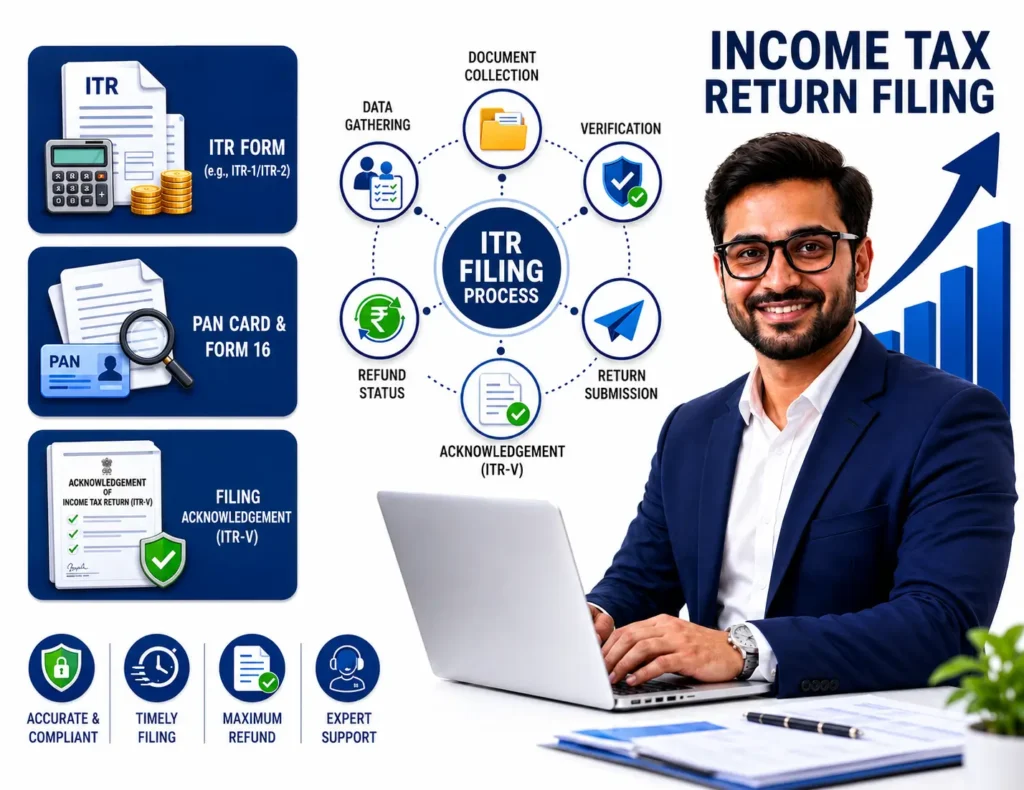
Professional man explaining income tax return filing process with graphics.

50,000+

Clients Served

15+ Years

CA Expertise

Same Day

Filing Available

100%

Online Process

Simple, Affordable Plans for ITR A.Y. 2026-27 Filing

Basic Plan

999/-
  • Business Income
  • Salary Income
  • Interest Income

Standard Plan

1,499/-
  • Basic Plan Income +
  • Share Trading Income
  • Game and Lottery Income

Special Plan

2,999/-
  • Standard Plan +
  • Balance Sheet and P & L account
  • CA Attestation with UDIN

File Your ITR for A.Y. 2026-27

Join 50,000+ entrepreneurs and professionals who trust SetupFiling.in for accurate, expert-led income tax return filing. Backed by CAs, CSs, and Tax Attorneys with 15+ years of experience.

Income Tax Return Filing for AY 2026-27 : Overview

The Income Tax Return Filing season for Assessment Year (A.Y.) 2026-27 — covering income earned during Financial Year 2025-26 (April 1, 2025 to March 31, 2026) — is officially underway. With the landmark Income Tax Act, 2025 coming into force from April 1, 2026, this filing cycle has a unique dual-law context: your AY 2026-27 return is still governed entirely by the old Income Tax Act, 1961, even though you will file it after the new Act has taken effect.

Whether you are a salaried employee, a freelancer, a business owner, or a senior citizen, this comprehensive guide covers every critical update you need for smooth, penalty-free Income Tax Return Filing for AY 2026-27.

🏛️ Key Legal Update: Two Acts, One Filing Season
The Income Tax Act, 2025 replaced the 1961 Act effective April 1, 2026. However, all returns pertaining to income earned before March 31, 2026 — including the AY 2026-27 ITR — are fully governed by the Income Tax Act, 1961. The new Act applies from Tax Year 2026-27 onwards (returns due in 2027).

What Is ITR Filing for AY 2026-27?

Income Tax Return (ITR) filing is the formal process of reporting your total income, deductions, and taxes paid to the Income Tax Department of India for a given assessment year. For AY 2026-27, you are declaring income earned between April 1, 2025 and March 31, 2026.

Assessment Year (AY) is always one year ahead of the Financial Year (FY). So the FY 2025-26 income gets assessed (reviewed and taxed) in AY 2026-27. The terms used in the new Income Tax Act, 2025 — “Tax Year” — will align with the financial year going forward, but that change only applies from Tax Year 2026-27 (i.e., for income earned after April 1, 2026).

“Even though you file your AY 2026-27 return after April 1, 2026, it is governed entirely by the provisions of the Income Tax Act, 1961 — the new Act plays no role here.”

Who Must File an ITR?

Filing an Income Tax Return is mandatory if any of the following conditions apply to you for FY 2025-26:

  • Your gross total income exceeds the basic exemption limit (₹4 lakh under new regime; ₹2.5 lakh under old regime for those under 60).
  • You wish to claim a refund of TDS or advance tax paid in excess.
  • You have foreign assets or foreign income.
  • You deposited more than ₹1 crore in bank accounts, spent more than ₹2 lakh on foreign travel, or paid electricity bills exceeding ₹1 lakh.
  • You have business losses you want to carry forward.
  • You are a company or firm regardless of profit or loss.

New ITR Forms for AY 2026-27

On March 30, 2026, the Central Board of Direct Taxes (CBDT) notified updated Income Tax Return forms effective for AY 2026-27. These were released ahead of the new financial year — unusually early — to give taxpayers adequate preparation time. All forms are filed under the Income Tax Act, 1961 and Income-tax Rules, 1962.

ITR-1 SAHAJ

Resident individuals with total income up to ₹50 lakh from salary, up to 2 house properties, other sources, and LTCG u/s 112A up to ₹1.25 lakh.

ITR-2

Individuals & HUFs without income from business/profession. Includes capital gains, foreign income, and multiple house properties.

ITR-3

Individuals & HUFs with income from profits and gains of business or profession. Due date extended to August 31, 2026.

ITR-4 SUGAM

For individuals, HUFs, and firms (excluding LLPs) with presumptive income from business or profession. Due date August 31, 2026.

ITR-5

Firms, LLPs, AOPs, BOIs, and other entities not eligible for ITR-1 to ITR-4.

ITR-6

Companies other than those claiming exemption under Section 11 of the Income Tax Act.

ITR-7

Persons including companies required to furnish returns under Sections 139(4A), (4B), (4C), or (4D).

ITR-U

Updated Return — allows persons to update income or reduce losses within 48 months from the end of the relevant assessment year.

What's New in the 2026 Forms?

The 2026 amendments introduced several practical changes to make filing more user-friendly and data-accurate:

  • Secondary address field: All forms from ITR-1 to ITR-7 now include an alternate/secondary address alongside the primary one, reducing communication errors.
  • Primary and secondary contact details: Sections for two mobile numbers and two email IDs are now explicitly labelled as “primary” and “secondary.”
  • Simplified capital gains reporting: The split in reporting for income earned at different rates in FY 2024-25 has been removed for AY 2026-27, as the same tax rates apply for the entire FY 2025-26.
  • ITR-1 expansion: Salaried individuals with LTCG under Section 112A up to ₹1.25 lakh can now file the simpler ITR-1 instead of ITR-2.

ITR Filing Due Dates for AY 2026-27

A significant structural update for AY 2026-27 is the staggered due date system announced in Budget 2026, with ITR-3 and ITR-4 getting an extended deadline to August 31, 2026. Here are all the key dates:

Taxpayer Category Applicable Forms Due Date

Individuals, HUFs (non-audit, non-business)

ITR-1, ITR-2

July 31, 2026

Individuals, HUFs (business/professional, non-audit)

ITR-3, ITR-4

August 31, 2026

Businesses requiring tax audit

ITR-3, ITR-5, ITR-6

October 31, 2026

International transactions (transfer pricing)

ITR-3, ITR-5, ITR-6

November 30, 2026

Belated return (with late fee)

All forms

December 31, 2026

Revised return

All forms

March 31, 2027

Updated return (ITR-U)

ITR-U

Within 48 months

✅ Good news: The due date for filing revised returns has been extended to March 31 of the following year (from the earlier December 31 deadline). So if you filed your AY 2026-27 return and later find an error, you can revise it until March 31, 2027.

Income Tax Slabs for FY 2025-26 (AY 2026-27)

For AY 2026-27, taxpayers can choose between two tax regimes: the New Tax Regime (default) and the Old Tax Regime. The new regime is the default, but you can opt for the old regime at the time of ITR filing if it is more beneficial for you.

New Tax Regime Slabs (Default for AY 2026-27)

The new tax regime offers significantly simplified and lower rates. These rates apply uniformly to all individuals regardless of age — unlike the old regime, there is no special slab for senior citizens under the new regime.

Income Range Tax Rate Tax Amount on Slab

Up to ₹4,00,000

Nil

₹0

₹4,00,001  – ₹8,00,000

5% 

₹20,000

₹8,00,001 – ₹12,00,000

10%

₹40,000

₹12,00,001 – ₹16,00,000

15% 

₹60,000

₹16,00,001 – ₹20,00,000

20%

₹80,000

₹20,00,001 – ₹24,00,000

25%

₹1,00,000

Above ₹24,00,000

30%

On balance

✅ Zero Tax for Income up to ₹12 Lakh: Section 87A rebate of up to ₹60,000 ensures that resident individuals with taxable income up to ₹12 lakh pay zero income tax under the new regime. For salaried individuals, the effective tax-free limit is ₹12.75 lakh (after ₹75,000 standard deduction).

Old Tax Regime Slabs (Optional for AY 2026-27)

Income Range Below 60 yrs Senior Citizen (60–80) Super Senior (80+)

Up to ₹2,50,000

Nil

Nil

Nil

₹2,50,001 – ₹3,00,000

5% 

Nil

Nil

₹3,00,001 – ₹5,00,000

5%

Nil

Nil

₹5,00,001 – ₹10,00,000

20%

20%

20%

Above ₹10,00,000

30%

30%

30%

Note: Health & Education Cess at 4% is applicable on the total income tax amount in both regimes. Surcharge is applicable for income above ₹50 lakh, with rates of 10% to 25% depending on income level (surcharge capped at 25% under new regime vs up to 37% under old regime).

New Regime vs Old Regime: Which to Choose?

Choosing the right tax regime is arguably the most important decision in your Income Tax Return Filing for AY 2026-27. The new regime’s attractiveness has grown significantly with the enhanced rebate and standard deduction, but the old regime still benefits taxpayers with substantial deductions.

⭐ DEFAULT REGIME

New Tax Regime
  • Lower slab rates (5% to 30%)
  • Standard deduction: ₹75,000
  • Section 87A rebate up to ₹60,000
  • Effective zero tax up to ₹12.75 lakh (salaried)
  • Surcharge capped at 25%
  • No need to invest for tax saving
  • Best for: Those with limited deductions

⭐ OPTIONAL REGIME

Old Tax Regime
  • Higher slab rates but rich deductions
  • Standard deduction: ₹50,000
  • Section 80C: Up to ₹1.5 lakh
  • HRA exemption, LTA, 80D, NPS
  • Home loan interest deduction (Sec 24b)
  • Section 87A rebate up to ₹12,500
  • Best for: Those with high deductions
💡 Quick Decision Rule

Calculate your tax under both regimes using the Income Tax Department’s online calculator at incometax.gov.in. Generally, if your total eligible deductions (80C + 80D + HRA + home loan interest) exceed ₹3.5–4 lakh, the old regime may still save you more tax. Below that threshold, the new regime is typically better.

Salaried taxpayers can switch between regimes every year at the time of ITR filing. Business and professional taxpayers must use Form 10IEA to exercise this option and can switch back to the old regime only once in a lifetime.

Ready to File Your ITR for AY 2026-27?

Don’t wait for deadline, file your ITR now quickly and avoid penalties easily.

Documents Required for ITR Filing AY 2026-27

Having the right documents in order before you begin filing significantly reduces errors and speeds up the process. Here is a comprehensive checklist:

  • PAN Card — your unique taxpayer identifier and login credential
  • Aadhaar Card — mandatory to be linked with PAN for ITR filing
  • Form 16 — issued by your employer by June 15, 2026; contains salary details and TDS
  • Form 26AS — tax credit statement showing TDS, advance tax, and self-assessment tax
  • Annual Information Statement (AIS) — comprehensive view of your financial transactions reported to the department
  • Bank statements — for interest income calculation and verification
  • Capital gains statements — from your broker/mutual fund house showing STCG and LTCG for FY 2025-26
  • Home loan certificate — from your lender showing principal and interest paid in FY 2025-26
  • Rent receipts / HRA proofs — if claiming HRA exemption under old regime
  • Section 80C investment proofs — PPF passbook, ELSS statements, LIC premium receipts, etc.
  • Health insurance premium receipts — for Section 80D deduction
  • Challan 280 copy — if you paid advance tax or self-assessment tax during the year

Step-by-Step Guide to File ITR for AY 2026-27

1. Collect All Documents

Gather Form 16 (from employer), Form 26AS, AIS (Annual Information Statement), TIS (Taxpayer Information Summary), bank statements, capital gains statements from broker, and rent receipts if applicable. Check AIS at incometax.gov.in under the 'e-file' section.

2. Login to the e-Filing Portal

Visit incometax.gov.in and log in using your PAN (which serves as your User ID) and password. If you are a new user, register using your PAN, Aadhaar, and mobile number.

3. Select AY 2026-27 and Correct ITR Form

Go to 'e-File' → 'Income Tax Returns' → 'File Income Tax Return'. Select Assessment Year 2026-27 and choose the appropriate ITR form based on your income sources. When in doubt between ITR-1 and ITR-2, check if your LTCG under 112A exceeds ₹1.25 lakh.

4. Choose Your Tax Regime

Select between New Tax Regime (default) and Old Tax Regime. The portal will show your pre-filled data. Compare tax liability under both regimes — use the built-in comparison tool to pick the most beneficial option for FY 2025-26.

5. Verify Pre-filled Data and Enter Income Details

The portal pre-fills data from Form 16, AIS, and previous filings. Verify every detail carefully — salary income, TDS deducted, advance tax paid, capital gains from shares/mutual funds, interest income, house property income, and any other sources.

6. Claim Deductions (Old Regime Only)

If you have opted for the old tax regime, enter all eligible deductions under Section 80C, 80D, HRA, 80G, home loan interest, etc. Ensure you have investment proofs. The new regime only allows standard deduction and a few specific deductions.

7. Compute Tax and Pay Any Balance

The portal auto-computes your total tax liability. If TDS/advance tax already paid is less than your liability, pay the balance as Self-Assessment Tax using Challan 280 before filing. Note the BSR code and challan serial number for entry in ITR.

8. Review, Submit, and Verify

Preview your return carefully and submit. Within 30 days, verify your return — the fastest method is e-verification using Aadhaar OTP, net banking, or Demat account. Without verification, the return is treated as not filed. You can also send a signed ITR-V to CPC Bengaluru within 30 days.

Penalties for Late or Non-Filing

Missing the Income Tax Return Filing deadline for AY 2026-27 has financial consequences. Here is what you should know:

₹0

Penalty

If total income ≤ ₹2.5 lakh (old regime) or ≤ ₹4 lakh (new regime) — no late fee under Section 234F.

₹1,000

Section 234F Penalty

Late filing penalty if total income ≤ ₹5 lakh. File before December 31, 2026 to limit penalty to ₹1,000.

₹5,000

Section 234F Penalty

Maximum late filing penalty for incomes above ₹5 lakh if ITR is filed after the due date but before December 31, 2026.

Additionally, interest at 1% per month (or part thereof) is levied under Section 234A on unpaid tax amount from the due date until the actual date of filing. If you have outstanding tax dues, this interest can add up significantly. Section 234B and 234C interest applies for shortfall in Advance Tax Payments.

⚠️ If you miss even the belated return deadline of December 31, 2026, you can file an Updated Return (ITR-U) within 48 months. However, you will pay an additional tax of 25%–50% on the tax and interest due, depending on when you file.

Ready to File Your ITR for AY 2026-27?

Don’t wait for deadline, file your ITR now quickly and avoid penalties easily.

Frequently Asked Questions (FAQs)

What is the filing date for Income Tax Return?

The statutory due date to file an Income Tax Return (ITR) in India depends on the taxpayer category. For individual taxpayers, salaried employees, and non-audit cases, the standard deadline is July 31st of the respective Assessment Year. For taxpayers whose accounts require a mandatory audit under Section 44AB, the deadline is October 31st.

  • July 31st: Salaried individuals, HUFs, and businesses not requiring a tax audit.
  • August 31st: Working partners of firms whose accounts are not subject to audit.
  • October 31st: Corporate taxpayers, firms, and individuals subject to a mandatory audit.

December 31st: Final absolute cutoff to submit a Belated or Revised Return for the financial year.

Will the ITR date be extended?

Taxpayers should never assume or wait for an extension of the ITR filing date. The Central Board of Direct Taxes (CBDT) only grants deadline extensions under extraordinary circumstances, such as severe technical glitches on the e-filing portal or natural disasters. Filing after the standard deadline triggers immediate statutory interest and penalty liabilities.

When can we start filing ITR for AY 24-25?

E-filing for Assessment Year (AY) 2024-25 (covering Financial Year 2023-24) typically opens in the first week of April 2024 when the Income Tax Department enables offline utilities and online forms. However, salaried individuals should wait until mid-June when employers issue Form 16 and update tax credit statements like Form 26AS.

What is the penalty for late filing?

Filing your ITR after the designated due date attracts an automatic late fee penalty under Section 234F of the Income Tax Act. The maximum late filing fee is Rs. 5,000 if the return is submitted after the deadline but before December 31st. For small taxpayers with a total income below Rs. 5 Lakh, the penalty is capped at a maximum of Rs. 1,000.

What if ITR is not filed before 31st July? / What happens if I miss the tax return deadline?

Missing the July 31st ITR deadline leads to severe financial and legal restrictions. You will face immediate late fees up to Rs. 5,000 under Section 234F, accumulate interest at 1% per month on unpaid taxes under Section 234A, and completely lose the right to carry forward business or capital losses to offset future income.

  • Late Filing Fee: Automatic levy of Rs. 1,000 or Rs. 5,000 based on net income brackets.
  • Interest Accumulation: Mandatory 1% interest per month calculated on any outstanding tax liabilities.
  • Loss Forfeiture: Inability to carry forward capital gains or business losses to subsequent financial years.

Refund Delays: Any eligible tax refund will be significantly delayed, causing a loss of interest on the refund amount.

When to file ITR income?

You must file an Income Tax Return if your gross total income before any deductions exceeds the basic exemption limit. Under the New Tax Regime, filing is mandatory if income exceeds Rs. 3 Lakh, while under the Old Tax Regime, the threshold is Rs. 2.5 Lakh. You must also file if you want to claim tax refunds or hold foreign assets.

What is ITR-1 or 2 or 3 or 4?

The Income Tax Department has structured four primary tax forms based on the complexity and nature of a taxpayer’s income streams. ITR-1 is for basic salaried individuals, ITR-2 covers capital gains and multiple properties, ITR-3 handles complex business/professional income, and ITR-4 is dedicated to businesses opting for presumptive taxation schemes.

Who is eligible for ITR 1?

ITR-1 (Sahaj) is exclusively meant for resident individuals whose total annual income does not exceed Rs. 50 Lakh. Eligible income sources must solely include income from Salary or Pension, one single house property, agricultural income below Rs. 5,000, and other miscellaneous sources like bank savings interest.

Ineligibility Alert: You cannot file ITR-1 if you are a company director, hold unlisted equity shares, own foreign assets, or have brought-forward financial losses.

Who is eligible for ITR 2? / What is ITR-2 and who should file it?

ITR-2 is designed for individuals and Hindu Undivided Families (HUFs) who do not have any profits or gains from a business or profession. It is mandatory if your total income exceeds Rs. 50 Lakh, if you have earned capital gains from selling shares or property, own multiple houses, or hold foreign investments.

  • High Earners: Individuals with annual income exceeding Rs. 50 Lakh.
  • Investors: Anyone with short-term or long-term capital gains from mutual funds, stocks, or real estate.

Global Assets: Resident individuals holding offshore bank accounts, foreign property, or foreign equity options.

Who will file ITR 2 and 3?

The fundamental difference between these two forms lies in business income. ITR-2 is filed by individuals with high salaries, capital gains, or foreign assets, but no business operations. Conversely, ITR-3 is mandatory for any individual or HUF earning income as a partner in a firm, running a sole proprietorship business, or practicing an audited profession.

Who should file ITR 1 and ITR 4?

ITR-1 and ITR-4 are simplified forms for taxpayers with total incomes under Rs. 50 Lakh. ITR-1 is exclusively for straightforward salaried individuals and pensioners with simple interest income. ITR-4 (Sugam) is dedicated to small businesses, freelancers, and professionals who calculate their taxes using the simplified Presumptive Taxation Scheme under Sections 44AD, 44ADA, or 44AE.

Is ITR 1 or ITR 2 for salaried people?

Both forms are used by salaried individuals, depending on the complexity of their financial portfolio. Use ITR-1 if your salary is under Rs. 50 Lakh, you hold one house, and have no capital gains. Switch to ITR-2 if your salary crosses Rs. 50 Lakh, or if you sold assets like equity or real estate within the financial year.

Who is eligible for ITR 4?

ITR-4 is for resident individuals, HUFs, and partnership firms (excluding LLPs) with total income up to Rs. 50 Lakh derived from business or professional operations. It requires computing income under presumptive taxation guidelines, meaning you declare profits at a fixed percentage of gross receipts without maintaining detailed account books.

Who should file ITR 3 and ITR 4?

Both forms cater to business and professional income. ITR-4 is meant for small-scale entrepreneurs and professionals opting for simplified presumptive tax reporting up to a Rs. 50 Lakh income threshold. ITR-3 is a comprehensive form for individuals who maintain books of accounts, incur business depreciation, engage in intraday equity trading, or require standard financial audits.

Can I file ITR online myself? / Can I file tax returns myself?

Yes, any individual can independently file their Income Tax Return online. The Income Tax Department provides a user-friendly e-filing portal equipped with pre-filled forms drawing data directly from your Annual Information Statement (AIS). For straightforward salary structures, self-filing takes less than twenty minutes via online assistance platforms.

Can I file ITR without CA?

Yes, hiring a Chartered Accountant is not a legal or technical requirement to submit a standard tax return. Taxpayers with income from salaries, house properties, or fixed deposits can easily execute their filings using self-service tax preparation portals. A CA is only recommended for intricate business audits, complex capital gains formatting, or corporate filings.

Can I file ITR using mobile?

Yes, you can file your ITR using a mobile phone. The Income Tax Department offers a responsive e-filing portal optimized for mobile browsers, and specialized fintech platforms provide clean mobile application interfaces. Ensure you have a stable network connection and your mobile number is linked to your Aadhaar card for quick OTP verifications.

How to file ITR first time? / How to file ITR in an easy way? / How to file ITR automatically?

Filing your return easily is simple when you follow this automated, step-by-step digital process:

  1. Portal Registration: Create an account on the official e-filing dashboard using your PAN as your user ID.
  2. Verify AIS/26AS: Open the Annual Information Statement (AIS) to let the system pull pre-filled data regarding your salary, TDS deductions, and bank interest.
  3. Form Validation: Review the pre-populated ITR form fields generated by the platform’s automation tools.
  4. Tax Settlement: Complete Payment for any outstanding self-assessment taxes or claim your eligible refund amount.

e-Verification: Finalize the process by entering an Aadhaar-linked OTP to instantly verify your return within 30 days.

Is e-filing safe?

Yes, online e-filing is completely safe, highly secure, and heavily regulated. The official government framework utilizes advanced end-to-end data encryption layers, secure multi-factor authentication, and mandated Aadhaar-linked OTP verifications. This setup ensures your confidential financial statements and identity details remain thoroughly protected against unauthorized access.

How to file ITR for free? / How much ITR is free? / Which tax file is free?

Filing your tax return is entirely free when handled directly on the government’s official e-filing portal. The portal provides free access to online forms, offline preparation utilities, calculations, and processing engines. You will never be charged a transactional platform fee to submit a return, regardless of which ITR form your income requires.

How much is the ITR fee?

There is no government processing fee or charge levied by the Income Tax Department to file a standard return. The process is free. The only out-of-pocket costs a taxpayer might encounter are professional preparation fees if utilizing an assisted platform or hiring a private Chartered Accountant.

Is 7 lakh income tax free?

Yes, a net taxable income up to Rs. 7 Lakh is entirely tax-free under the New Tax Regime due to the statutory tax rebate provided under Section 87A. Additionally, when you include the standard flat deduction of Rs. 50,000 for salaried professionals, an individual earning a gross salary up to Rs. 7.5 Lakh pays zero income tax.

What is the minimum salary to file an ITR?

You are legally required to file an ITR if your total annual income before deductions crosses the basic exemption limit. This limit stands at Rs. 3 Lakh under the New Tax Regime and Rs. 2.5 Lakh under the Old Tax Regime. Even if your net tax liability calculates to zero, filing remains mandatory if your gross salary exceeds these thresholds.

Can I file ITR without paying tax?

Yes, you can absolutely file an Income Tax Return without paying any tax. This process is called filing a Nil Return. It is used when your net taxable income sits comfortably below the basic exemption threshold, or when all tax liabilities are completely neutralized by tax deductions, exemptions, or Section 87A rebates.

  • Proof of Income: A Nil ITR serves as official legal verification of your income for bank loan applications and visa processes.

TDS Recovery: Filing a Nil return is the only valid mechanism to claim a full refund of any tax money wrongfully deducted via TDS by banks or clients.