💳 Pay Now |
✍️ Learning Center
Confused between the GST Regular Scheme and the Composition Scheme? SetupFiling.in explains the exact turnover limits, tax rates, and Input Tax Credit rules for both — then registers your business under the right scheme, online, with expert CA/CS support.
Every business that registers under GST must choose between two paths: the GST Regular Scheme, where tax is charged on the actual sale value with full Input Tax Credit (ITC) available, or the GST Composition Scheme, a simplified option for small businesses that pay a flat, low percentage of turnover as tax with fewer compliance requirements — but without ITC and without the ability to make inter-state sales.
Choosing the right scheme affects your invoicing, your return filing frequency, your ability to sell across state lines, and how much tax you actually pay. Our team of Chartered Accountants and Company Secretaries with 15+ years of experience assesses your turnover, business model, and customer base before recommending and registering you under the scheme that fits — through our dedicated GST Composition Scheme registration service or standard GST registration for the Regular Scheme.
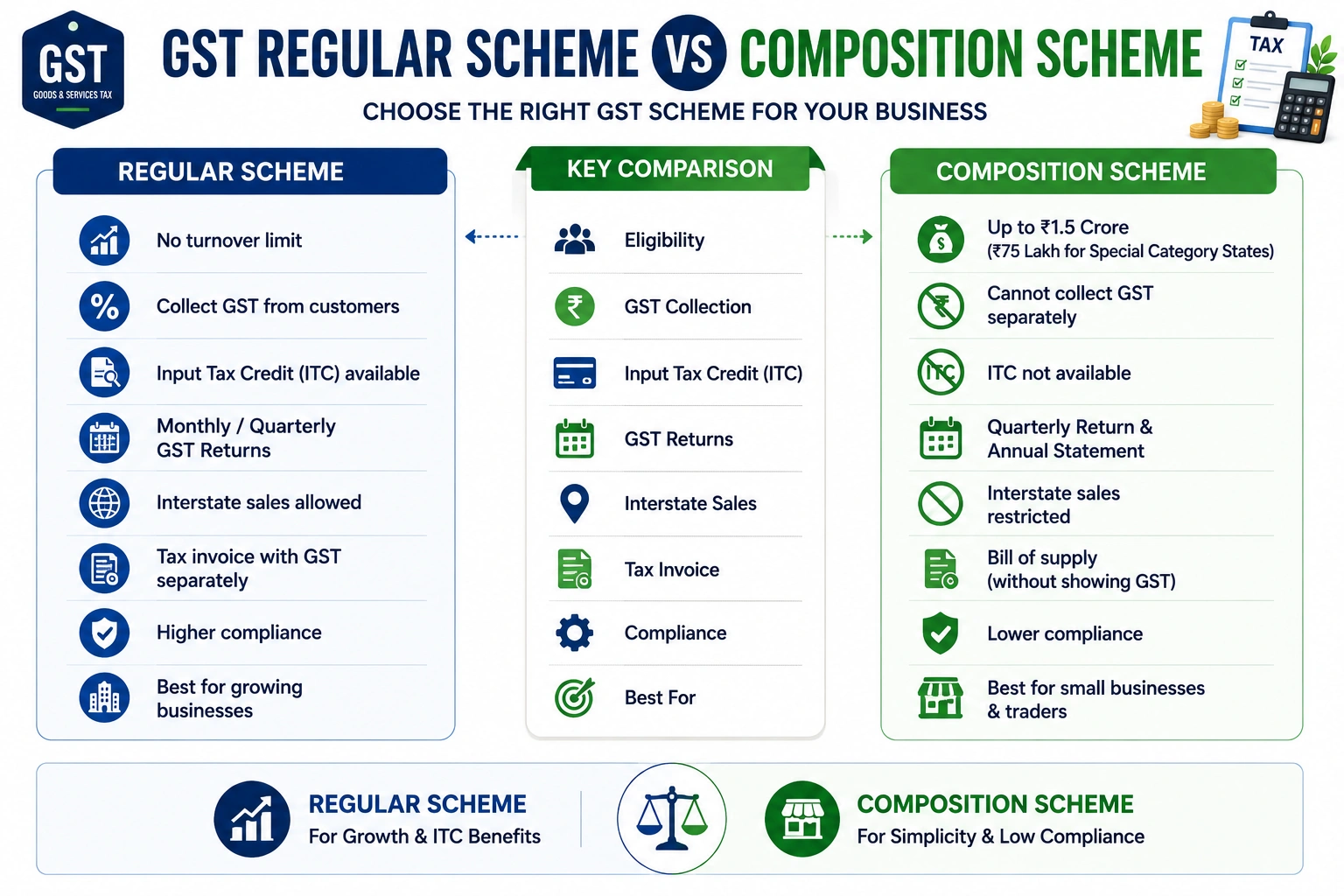
A side-by-side comparison of the two GST schemes across turnover limits, tax rates, ITC eligibility, and compliance.
| Parameter | GST Regular Scheme | GST Composition Scheme |
|---|---|---|
| Turnover Eligibility | No upper limit — mandatory once threshold (₹40 lakh / ₹20 lakh for services) is crossed | Up to ₹1.5 crore (₹75 lakh in special category states); ₹50 lakh for eligible service providers |
| Tax Rate | As applicable per HSN/SAC (5%, 12%, 18%, 28%) | 1% (traders/manufacturers), 5% (restaurants), 6% (specified services) of turnover |
| Input Tax Credit (ITC) | Fully available on eligible purchases | Not available |
| Inter-State Sales | Allowed | Not allowed |
| Return Filing | Monthly/quarterly GSTR-1 and GSTR-3B | Quarterly CMP-08 payment + annual GSTR-4 |
| Tax Invoice | Can issue a regular tax invoice showing GST charged | Must issue a "Bill of Supply"; cannot charge GST separately from customer |
| E-commerce Selling | Permitted on all marketplaces | Restricted for suppliers of goods through e-commerce operators required to collect TCS |
| Best Suited For | B2B businesses, inter-state suppliers, exporters, and businesses wanting to pass on ITC | Small local traders, retailers, and service providers with limited turnover and local customers |
You supply goods or services inter-state, sell through e-commerce marketplaces, deal primarily in B2B transactions where buyers want to claim ITC, or expect your turnover to grow beyond composition limits soon.
You run a small local business — a shop, restaurant, or local service — with turnover under the prescribed limit, sell mainly to end consumers within your state, and want lower tax outgo with simpler quarterly compliance.
Our CA/CS team reviews your business model, turnover, and customer base before recommending a scheme — talk to us on WhatsApp before you register, or explore our complete GST registration service page for the Regular Scheme.
If your business has outgrown the Composition Scheme or you need ITC, we help you migrate through updating details through GST amendment, and support your ongoing filings via GSTR-3B filing assistance.
A simple 6-step process — our experts help you pick the scheme before filing, not after.
Send your estimated turnover, business type, and whether you sell inter-state via WhatsApp or the Apply Now form.
Our CA/CS team reviews your inputs and recommends Regular or Composition Scheme based on eligibility and business goals.
PAN, Aadhaar, and address proof are verified and the appropriate GST application is prepared.
We file your application (including Form CMP-02 if opting for Composition) and generate the Application Reference Number (ARN).
The GST officer reviews the application; we respond to any clarification (SCN) on your behalf if raised.
You receive your GST Registration Certificate along with the User ID and Password of the GST portal, under the correct scheme, ready to start invoicing.
Explore other filings and registrations businesses commonly need alongside GST registration.
Common questions from entrepreneurs deciding between GST Regular Scheme and Composition Scheme.
The Regular Scheme taxes actual sale value at applicable GST rates with full Input Tax Credit, while the Composition Scheme charges a flat, lower percentage of turnover with simpler quarterly compliance but no ITC and no inter-state sales.
Businesses with annual turnover up to ₹1.5 crore (₹75 lakh in special category states) can opt in; eligible service providers can opt in up to ₹50 lakh turnover, provided they don't make inter-state supplies or sell through e-commerce operators required to collect TCS.
Rates vary by business type — typically 1% for traders and manufacturers, 5% for restaurant services (without alcohol), and 6% for other eligible service providers, calculated on total turnover.
No. Businesses registered under the Composition Scheme cannot claim ITC on their purchases, and they cannot charge GST separately on invoices issued to customers.
It depends on your business model — Composition Scheme suits small, local, B2C businesses wanting lower tax and simpler filing, while Regular Scheme suits businesses that need ITC, sell inter-state, or work with B2B clients who require GST-compliant invoices.
Yes. You can opt out of the Composition Scheme anytime by filing Form CMP-04, or you will be required to switch automatically if your turnover exceeds the composition threshold during the year.
Yes. Our CA/CS team assesses your turnover and business model, recommends the right scheme, and completes your GST registration — including certificate and portal login delivery — for either the Regular Scheme or Composition Scheme.
Join 50,000+ businesses who trust SetupFiling.in for fast, expert-assisted, 100% Online GST Registration under the right scheme.