💳 Pay Now |
✍️ Learning Center

Confused about which GST scheme is right for your business? Compare tax rates, Input Tax Credit rules, return filing frequency, and real tax savings between the Composition Scheme and the Regular Scheme, and register under the option that fits your MSME best.
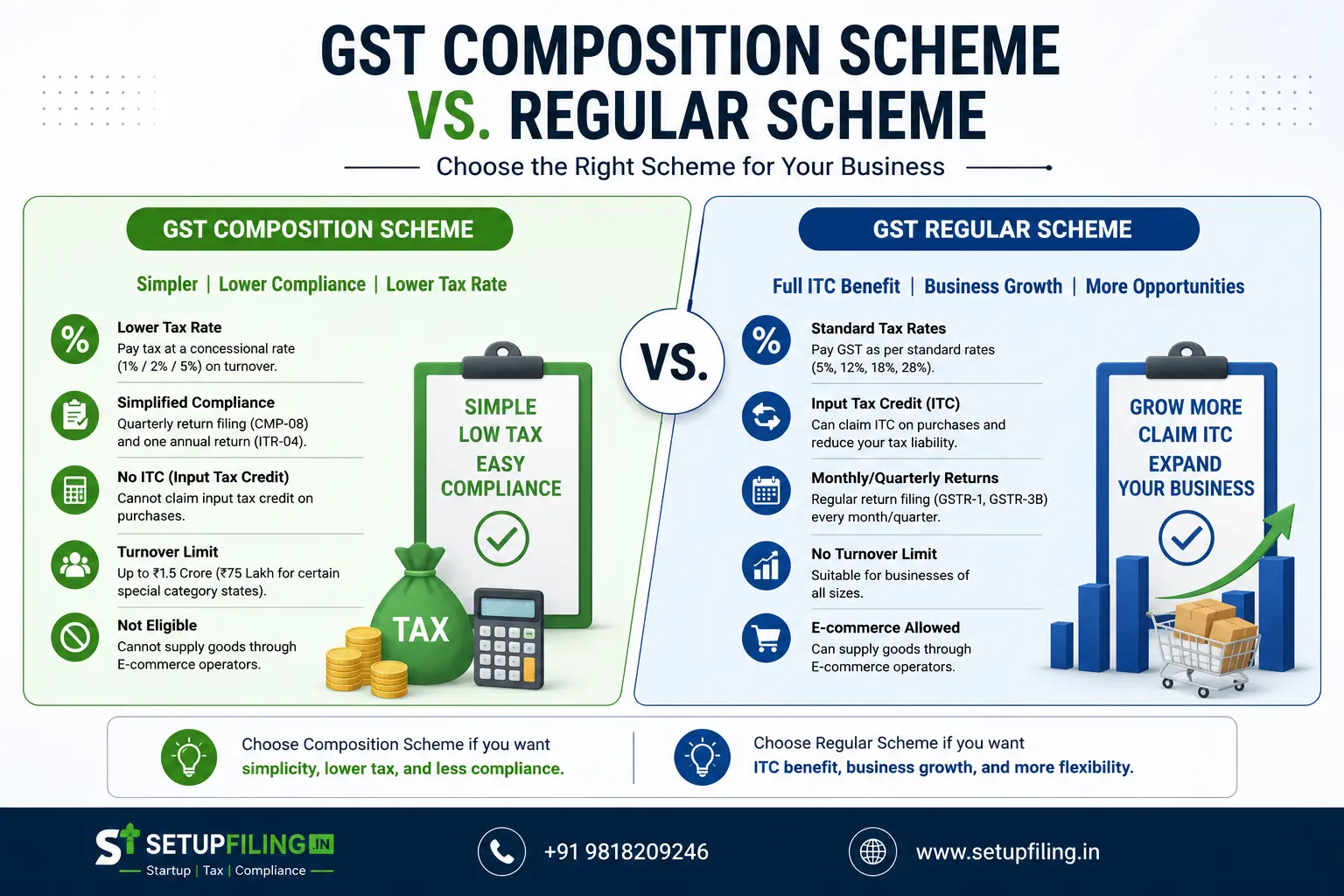
Quick answer: There is no single scheme that saves more tax for every MSME — it depends on your margins and buyers. The Composition Scheme usually saves more tax for small traders and retailers with low margins and mostly cash/retail (B2C) sales, since it charges a flat 1%–6% rate with minimal paperwork but no Input Tax Credit. The Regular Scheme usually saves more for businesses with higher input costs, B2B customers, or interstate sales, because Input Tax Credit can offset a large part of the tax paid on purchases. MSMEs should compare both based on actual purchase-to-sale ratio before choosing.
The GST Composition Scheme is a simplified tax option for small businesses with turnover up to ₹1.5 crore (₹75 lakh in some special category states). Instead of the regular GST rate slabs, a composition dealer pays tax at a flat, low percentage of turnover — commonly 1% for traders and manufacturers, and up to 6% for eligible service providers under the composition scheme for services (turnover up to ₹50 lakh). Composition dealers file a simpler quarterly statement (CMP-08) and one annual return, instead of multiple monthly filings.
The Regular GST Scheme is the standard registration under which a business charges GST at the applicable slab rate (commonly 5%, 12%, 18% or 28% depending on the goods or services) on every taxable sale. Regular taxpayers can claim Input Tax Credit (ITC) on GST paid for purchases, raw materials, rent, and business expenses, which reduces the net tax payable. Regular scheme businesses generally file monthly or quarterly returns (GSTR-1 and GSTR-3B) along with an annual return.
| Feature | Composition Scheme | Regular Scheme |
|---|---|---|
| Turnover Limit | Up to ₹1.5 crore (₹75 lakh in some states) | No upper limit |
| Tax Rate | Flat 1%–6% of turnover | 5% / 12% / 18% / 28% based on HSN/SAC |
| Input Tax Credit (ITC) | Not available | Available on eligible purchases |
| Return Filing | Quarterly (CMP-08) + Annual Return | Monthly/Quarterly (GSTR-1, GSTR-3B) + Annual Return |
| Tax Charged on Invoice | Cannot charge GST separately from customer | GST charged separately on every invoice |
| Interstate Sales | Not allowed (intra-state supply only) | Allowed |
| Best Suited For | Small traders, retailers, low-margin B2C businesses | B2B businesses, exporters, higher input-cost businesses |
The right answer depends on your specific purchase-to-sale ratio, customer type, and growth plans — not a one-size-fits-all rule. Our GST experts can review your numbers and recommend the scheme that minimises your actual tax outflow.
Whether you register under the Composition Scheme or the Regular Scheme, the base document checklist is the same:
| Document | Applicable To |
|---|---|
| PAN Card of business owner / entity | All applicants |
| Aadhaar Card with linked mobile number | All applicants |
| Passport-size photograph | Proprietor / Partners / Directors |
| Business address proof (electricity bill, rent agreement, NOC) | All applicants |
| Bank account details (cancelled cheque / statement) | All applicants |
| Certificate of Incorporation (if company/LLP) | Private Limited, LLP, OPC |
| Digital Signature Certificate (DSC) | Companies and LLPs |
| Turnover estimate / last year's sales data | To decide Composition vs Regular |
Confirm whether your annual turnover falls within the ₹1.5 crore (or ₹50 lakh for services) limit for the Composition Scheme.
Estimate your tax under both schemes using your actual purchase and sales figures, factoring in the Input Tax Credit you would lose under Composition.
If most of your buyers are GST-registered businesses wanting ITC, the Regular Scheme is usually the better fit; if you sell mainly to end consumers, Composition may work better.
Send your turnover, business type, and customer mix to our team via WhatsApp or the order form after checkout.
Our GST experts file your gst reG-01 application (with CMP-02 if opting for Composition) with the correct scheme selection.
An Application Reference Number (ARN) is generated instantly, and any officer query is handled on your behalf during verification.
Once approved, you receive your GST Registration Certificate and GST Portal login, and we help you set up billing correctly under your chosen scheme.
Transparent, fixed pricing. No hidden charges. We help you register under the Composition or Regular Scheme, whichever fits your MSME best.
Just the GST registration — fast and affordable.
GST Registration + 6 months of returns.
GST Registration + 12 Month GST Return.
The Composition Scheme charges a flat, low tax rate on turnover with no Input Tax Credit and simpler quarterly filing, while the Regular Scheme charges standard slab rates but allows Input Tax Credit on purchases, with more frequent return filing.
It depends on your business. Low-margin traders and retailers with mostly B2C sales usually save more under the Composition Scheme, while businesses with high input costs or B2B/interstate sales usually save more under the Regular Scheme through Input Tax Credit.
Yes, service providers with turnover up to ₹50 lakh can opt for the composition scheme for services at a 6% flat rate, in addition to a small percentage of services allowed for goods-based composition dealers.
No, businesses registered under the Composition Scheme cannot claim Input Tax Credit on their purchases, which is one of the main trade-offs against its lower flat tax rate.
No, composition dealers can only make intra-state (within the same state) supplies. Interstate sales require registration under the Regular Scheme.
You can switch schemes by filing the relevant form (such as CMP-02 to opt in, or CMP-04 to opt out) on the GST portal, typically at the start of a financial year. Our team can help you file the switch correctly.
The turnover limit is ₹1.5 crore for most states (₹75 lakh in some special category states) for goods, and ₹50 lakh for the composition scheme applicable to services.
Choose the Silver Package if you only need the GSTIN. Choose the Gold Package if you also want 6 months of return filing handled for you. Choose the Premium Package if you want a full year of GST return filing covered along with faster 24-hour delivery.
Join 50,000+ businesses who trusted us with their compliance. Get your GSTIN in as fast as 24 hours.