
India's trading sector — whether domestic wholesale, retail distribution, or cross-border import-export — runs on a handful of legal building blocks: the right entity structure, a Certificate of Incorporation, tax registrations, and, for anyone moving goods across the border, an Import Export Code. Skip or misorder any one of these and your company can be legally formed but still unable to invoice, import, or open a current account.
Why the Entity Structure You Pick Comes First
Every other registration — PAN, TAN, GST, IEC — is issued to a legal entity, so the structure decision has to happen before anything else. A sole proprietorship is fastest to start but offers no liability protection and struggles to raise institutional credit. A partnership firm splits control and capital between partners but still exposes personal assets. Most serious trading businesses now register as a Private Limited Company or an LLP for exactly this reason — limited liability, easier access to trade finance, and credibility with overseas suppliers.
| Structure | Liability Protection | Best Suited For |
|---|---|---|
| Sole Proprietorship | None — personal assets at risk | Solo traders, very small local volumes |
| Partnership Firm | None — joint personal liability | Family-run trading businesses |
| LLP | Limited to capital contribution | Trading houses with 2+ partners |
| Private Limited Company | Limited to share capital | Import-export firms, funded startups |
If you're still weighing the trade-offs, our comparison of proprietorship versus private limited structures breaks down the liability and taxation differences in more detail. For a wider view of every legal form available, see the full range of company registration types recognised under Indian law.
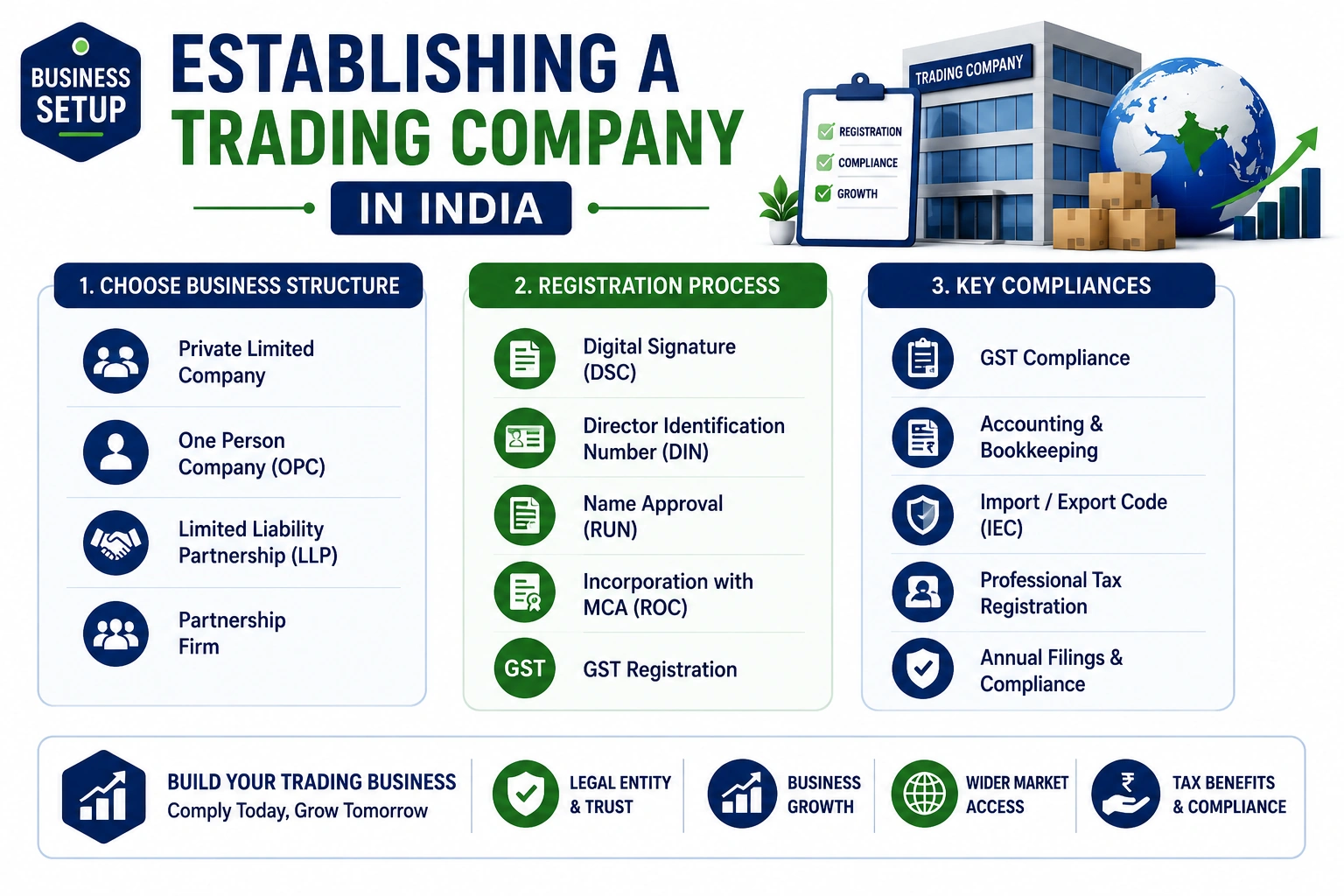
Step-by-Step: How to Establish a Trading Company in India
- Choose your business structureDecide between LLP and Private Limited Company based on the number of promoters and funding plans.
- Reserve your company name and apply for DSC/DINName approval is filed through the MCA's RUN service, alongside Digital Signature Certificates for all proposed directors.
- File incorporation through SPICe+The integrated MCA form covers company incorporation, PAN, TAN, and EPFO/ESIC registration in a single filing.
- Receive your Certificate of IncorporationOnce approved, the Registrar of Companies issues the Certificate of Incorporation along with your Corporate Identification Number (CIN).
- Register for GST and apply for an IEC CodeGST registration lets you invoice legally within India; the Import Export Code from DGFT is mandatory the moment you plan to import or export goods.
For a deeper look at the incorporation stage specifically, read our guide to company incorporation in India, or start directly with the online company registration process.
Documents You'll Need Before Filing
- PAN and Aadhaar of all directors/partners
- Passport-size photographs and address proof of directors
- Registered office proof — rent agreement or ownership document with a recent utility bill
- No Objection Certificate (NOC) from the property owner, where applicable
- Digital Signature Certificate for each director filing the application
For a location-specific walkthrough, see how registration is handled for businesses filing out of the capital in our guide to company registration in Delhi.
Import Export Code: The Step Trading Companies Can't Skip
Unlike a domestic-only trading business, any company planning to move goods across international borders needs an iec code issued by the Directorate General of Foreign Trade. It's a one-time registration, but it's tied to your company's PAN, so it must be applied for after incorporation, not before. You can start the process directly through our online IEC application service.
Compliance Doesn't Stop at Incorporation
A registered trading company still has to file annual returns with the MCA, maintain statutory registers, and renew certain licenses periodically. Underestimating this ongoing workload is one of the most common reasons trading companies fall out of good standing in their first year — our overview of yearly compliance obligations for companies lays out exactly what's due and when.
Start Your Trading Company the Right Way
Incorporation, PAN/TAN, DSC, IEC, and GST — handled together so nothing is missing when you're ready to invoice or import.
Apply Now for Registration WhatsApp UsAlternative Structures Worth Considering
Not every trading business needs a full private limited setup from day one. If you're testing a niche import line with low initial volume, a registered partnership firm can be a faster, lower-cost entry point, with the option to convert to a private limited company once volumes justify it. Very small trading operations sometimes also start as a small company under the Companies Act, which comes with relaxed compliance thresholds. For a broader look at every legal route available before you commit, see how business registration works in India across entity types.