What Is an E-Way Bill?
An e-way bill is an electronic document generated on the government's e-way bill portal that must accompany the movement of goods above a specified value. It is governed by Rule 138 of the CGST Rules, 2017, read with Section 68 of the CGST Act, and is meant to track the movement of goods and prevent tax evasion during transit.
The document records details of the consignor, consignee, goods being transported, their value, and the vehicle or transporter carrying them. Once generated, it produces a unique E-Way Bill Number (EBN) that the supplier, recipient, and transporter can all use to verify the shipment.
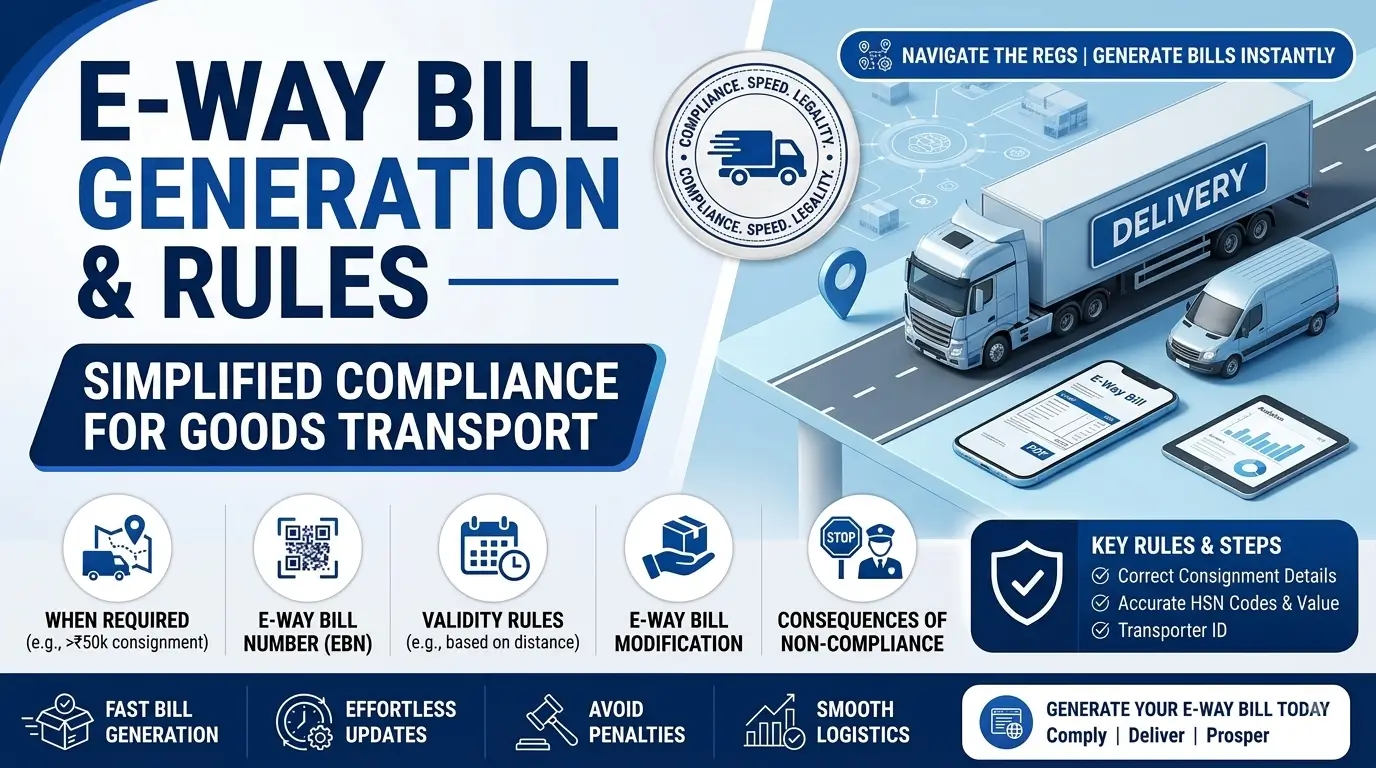
When Is an E-Way Bill Required?
Consignment Value Threshold
An e-way bill is mandatory when the value of goods being moved exceeds ₹50,000, whether the movement is due to a supply, a return, or an inward supply from an unregistered person.
Inter-State Movement
For inter-state transport of goods, the ₹50,000 threshold applies uniformly across India, regardless of the reason for movement.
Intra-State Movement
Some states set a higher or lower threshold for intra-state movement, so it's worth checking your specific state's notified limit before assuming the standard threshold applies.
Job Work & Principal-to-Job-Worker Transfers
An e-way bill is required for goods sent for job work across states, irrespective of the consignment value.
Who Is Responsible for Generating the E-Way Bill?
| Scenario | Who Generates It |
|---|---|
| Registered supplier transporting goods on their own vehicle | The supplier (consignor) |
| Registered recipient arranging their own transport | The recipient (consignee) |
| Goods handed to a transporter, neither party has generated it | The transporter |
| Supply by an unregistered person to a registered recipient | The registered recipient |
| E-commerce or courier-based movement | The e-commerce operator or courier agency, where applicable |
For a full breakdown of which documents to keep ready, see our GST registration documents checklist.
How to Generate an E-Way Bill: Step-by-Step Process
Log In to the E-Way Bill Portal
Access the official e-way bill portal using your GSTIN-linked username and password, the same credentials issued at the time of GST registration.
Select "Generate New" Under E-Way Bill
Choose whether the transaction is outward or inward, and select the relevant sub-type such as supply, export, job work, or sales return.
Fill in Part-A Details
Enter the recipient's GSTIN, invoice or challan number and date, value of goods, HSN code, and reason for transportation.
Fill in Part-B Transport Details
Add the vehicle number for road transport, or the transporter ID, transport document number, and date for rail, air, or ship movement.
Generate the E-Way Bill
Submit the form to receive a unique 12-digit E-Way Bill Number (EBN) along with a QR code that can be printed or carried digitally during transit.
Carry the E-Way Bill During Transit
The transporter must carry the e-way bill, either as a printout or digitally, along with the invoice, for verification at any checkpoint.
E-Way Bill Validity Rules
Validity is calculated from the date and time of Part-B generation and depends on the distance the goods must travel.
| Distance | Validity for Regular Cargo | Validity for Over-Dimensional Cargo |
|---|---|---|
| Up to 200 km | 1 day | 1 day per 20 km |
| Each additional 200 km (or part thereof) | 1 additional day | 1 additional day per 20 km |
The validity can be extended before or within 8 hours after expiry, provided the transporter updates the reason for the delay, such as a natural calamity, law-and-order situation, or vehicle breakdown, on the portal.
When Is an E-Way Bill Not Required?
Non-Motorised Transport
Goods moved by non-motorised conveyance, such as a hand cart, are exempt from e-way bill requirements.
Exempted Goods
Goods specifically listed as exempt from GST, such as certain fresh fruits, vegetables, and specified agricultural produce, do not require an e-way bill.
Movement Within 50 km for Job Work
Intra-state movement of goods for weighment or job work purposes within a notified short distance may be exempt, subject to state-specific rules.
Transport by a Non-Motorised Conveyance to or from a Port
Certain customs-bonded movements to or from ports, airports, and land customs stations are exempt under specific conditions.
Consequences of Not Generating an E-Way Bill
Transporting goods worth more than the notified threshold without a valid e-way bill is treated as a compliance failure under GST law. Goods and the vehicle carrying them can be detained or seized until the applicable tax and penalty are paid, and repeated non-compliance can attract closer scrutiny of a business's GST Filings going forward. Keeping e-way bills accurate and up to date also reduces friction during audits and GST show cause notice proceedings.
Recent Update: E-Way Bill 2.0 Portal
NIC has rolled out a second, synchronised e-way bill portal to reduce downtime risk during high-traffic periods. Both portals mirror data in real time, so an e-way bill generated on one is instantly usable on the other. Read our advisory on the E-Way Bill 2.0 portal launch for the full details on what changed and how it affects day-to-day generation.