💳 Pay Now |
✍️ Learning Center

E-invoicing is now mandatory for every GST-registered business crossing the notified turnover limit. Understand who must comply, how the Invoice Registration Portal (IRP) works, and get your GST registration and return filing handled by our experts so your business stays fully compliant.
Get GST registered first, so your billing system is ready to comply with e-invoicing the moment your turnover crosses the threshold.
Just the GST registration — fast and affordable
GST Registration + 6 Months of Returns
GST Registration + 12 Month GST Return
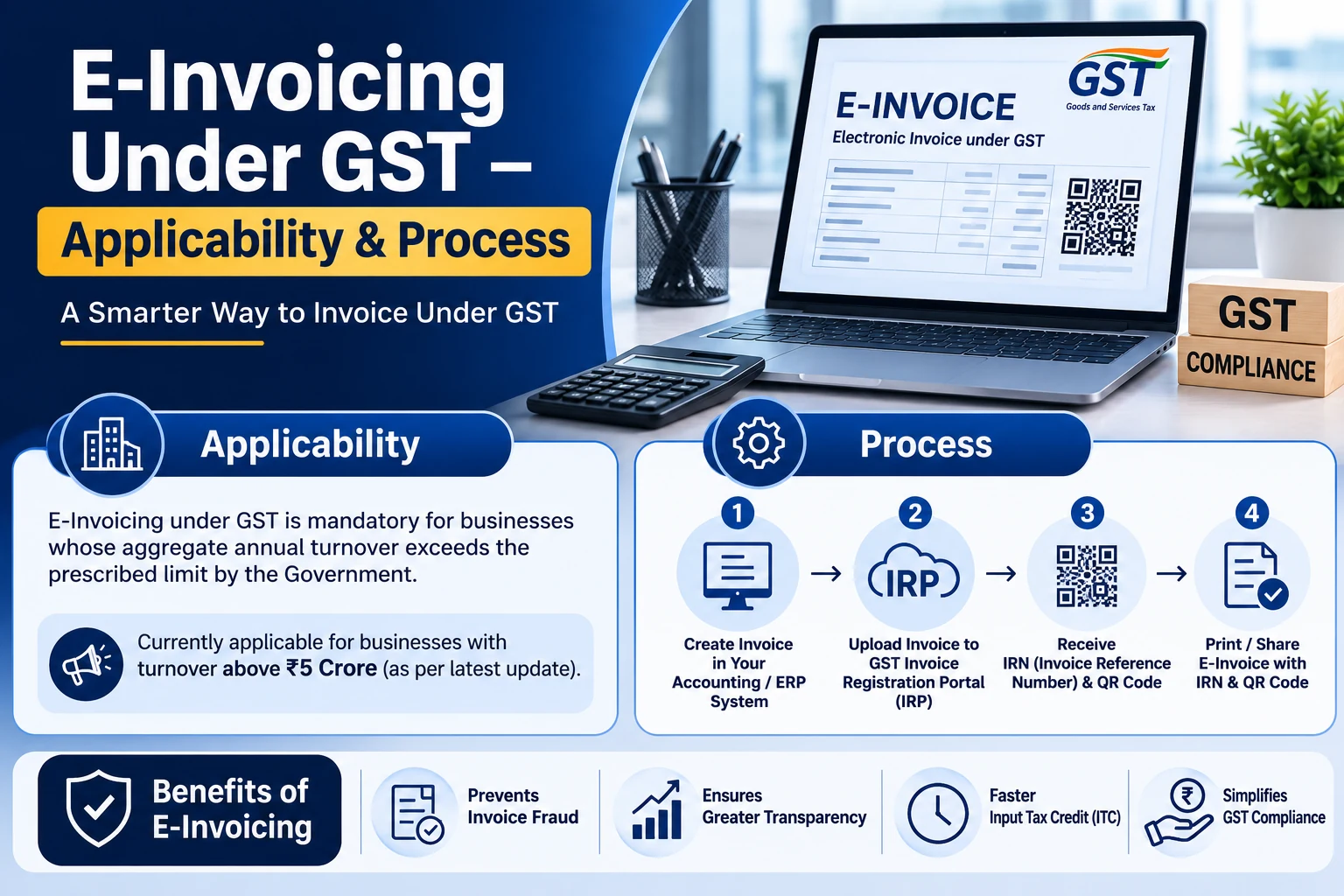
E-invoicing under GST is the process of electronically authenticating B2B invoices, export invoices, and specified other invoices through the government's Invoice Registration Portal (IRP) before they are issued to the buyer. It does not mean the government generates your invoice for you; you continue creating invoices in your own billing or accounting software, but each invoice must be reported to the IRP to receive a unique Invoice Reference Number (IRN) and a signed QR code.
Once validated, the invoice details are automatically shared with the GST portal and, where applicable, the e-way bill system, reducing manual data entry and mismatches between your books and your gst returns.
As of 2026, e-invoicing is mandatory for GST-registered businesses whose aggregate annual turnover (AATO) has exceeded ₹5 crore in any financial year from FY 2017-18 onwards, under Notification No. 10/2023-Central Tax. A few key rules apply:
This applicability threshold is revised periodically by the GST Council. Always verify the current limit before assuming your business is exempt, since the government has progressively lowered this limit over the years.
Generate the invoice in your existing accounting or billing software in the standard e-invoice schema format.
Upload the invoice data to the IRP, either directly or through a GST Suvidha Provider (GSP) integrated with your billing system.
The IRP validates the invoice, generates a unique Invoice Reference Number (IRN), and returns a digitally signed QR code.
Print or send the invoice with the IRN and QR code embedded, which makes it a legally valid tax invoice.
Validated invoice details automatically flow into your GSTR-1 return and, where required, the e-way bill system, reducing manual reconciliation.
Failing to generate a valid e-invoice where mandated has real financial and operational consequences:
| Non-Compliance | Consequence |
|---|---|
| Invoice not reported to IRP | Treated as an invalid invoice under GST law |
| Non-generation of e-invoice | Penalty of 100% of the tax due or ₹10,000, whichever is higher, per invoice |
| Incorrect e-invoice | Penalty of up to ₹25,000 per invoice |
| Invalid invoice used for ITC | Buyer's Input Tax Credit claim can be disallowed or delayed |
Beyond penalties, an invalid invoice can disrupt e-way bill generation, delay GST refunds, and affect your business's credibility during bank loan or vendor documentation checks.
SetupFiling has helped over 50,000 customers across India get GST registered and stay compliant with return filing, so their systems are ready when e-invoicing applicability kicks in. Whether you are registering for the first time or need ongoing return filing support, our team handles the process end to end.
Already registered and need help with ongoing filings? Explore our GST return filing service or file your GSTR-3B return with our team.
Businesses preparing for e-invoicing compliance often need these services as well:
As of 2026, businesses with an aggregate annual turnover exceeding ₹5 crore in any financial year from FY 2017-18 onwards must generate e-invoices, as per Notification No. 10/2023-Central Tax. This limit is revised periodically by the GST Council.
No. You continue to generate invoices using your own billing or accounting software. E-invoicing only requires you to report those invoices to the Invoice Registration Portal to obtain a valid IRN and QR code.
No, e-invoicing under the current rules applies mainly to B2B supplies, exports, and supplies to government entities. Standard B2C invoices are generally not required to be reported to the IRP.
An invoice that should have been reported to the IRP but wasn't is treated as invalid under GST law, and penalties of 100% of the tax due or ₹10,000 per invoice, whichever is higher, can apply.
Yes. Only GST-registered businesses can generate e-invoices, since the IRN is linked to your GSTIN. You must be GST registered before e-invoicing applicability can be assessed for your business.
Yes. Once your aggregate turnover crosses the notified threshold in any financial year, e-invoicing remains mandatory in subsequent years, even if your turnover later falls below ₹5 crore.
Yes, export invoices from businesses crossing the turnover threshold must also be reported to the IRP, which supports export documentation and refund claims.
Choose one of the GST registration packages above based on whether you also need return filing support, and our team will complete your registration and guide you on e-invoicing applicability for your business.
Join 50,000+ businesses that trust SetupFiling for fast, transparent, and expert-led GST compliance.