
What Is Copyright Registration in India?
Copyright is the legal right granted to the creator of an original literary, dramatic, musical, or artistic work, along with cinematograph films and sound recordings, to control how that work is reproduced, distributed, performed, or adapted. Under the Copyright Act, 1957, copyright arises automatically the moment an original work is created and fixed in a tangible form — you do not need to register it to own it.
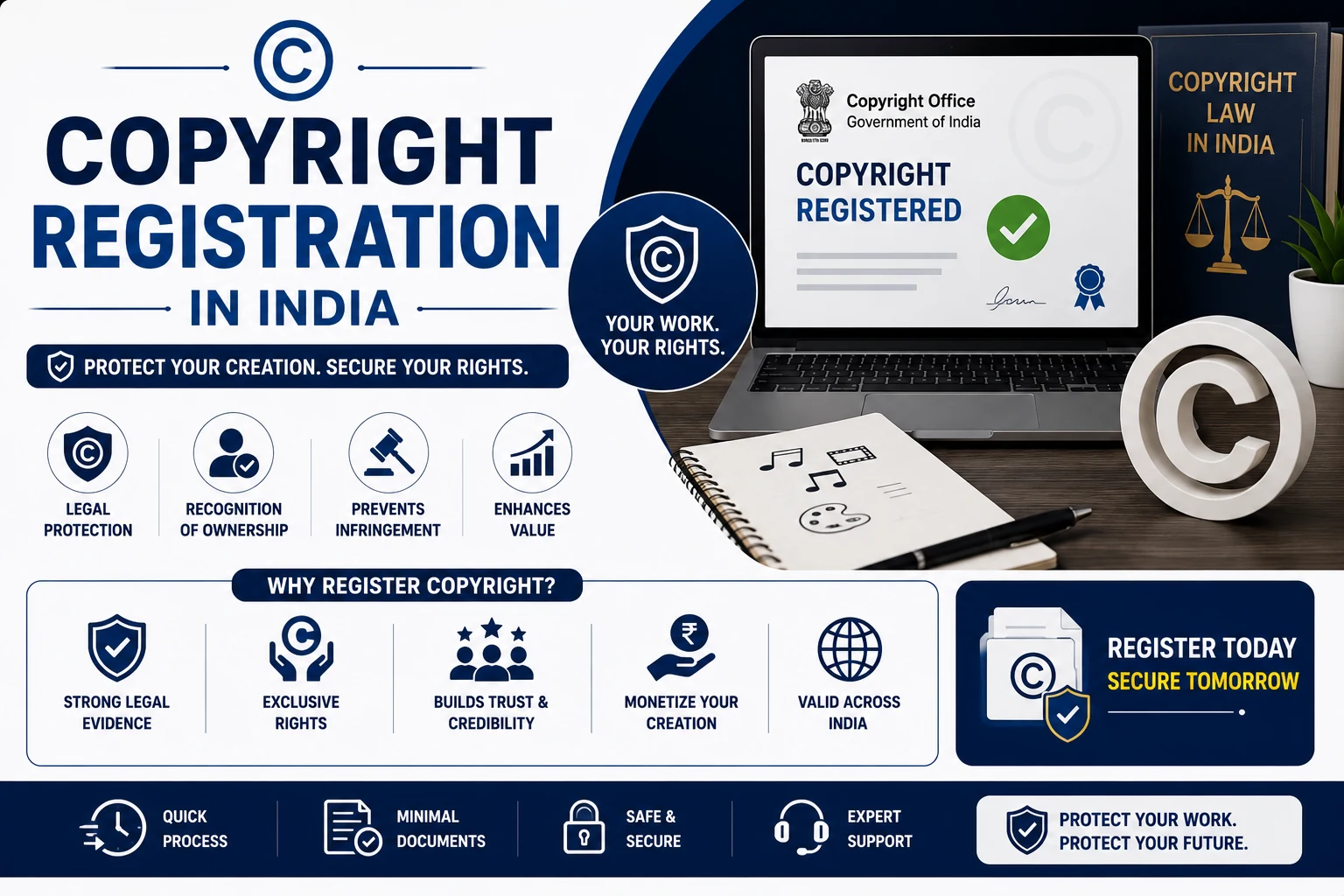
However, formal Copyright Registration in India creates an official, time-stamped public record of ownership with the Copyright Office. This record becomes invaluable evidence in infringement disputes, licensing negotiations, and while enforcing your rights before courts or online platforms. If you're building a brand around your creative work, pairing it with Trademark Registration in India gives you layered protection for both the content and the brand identity around it.
Why Copyright Registration Matters for Creators & Businesses
While registration is optional in law, it is practically essential for anyone who plans to monetise, license, or defend their work. Registering strengthens your legal standing in several concrete ways:
- Prima facie proof of ownership: A registration certificate is accepted as strong evidence of authorship and the date of creation in court and arbitration proceedings.
- Deterrent against infringement: A public record discourages competitors and third parties from copying your book, software, design, song, or film.
- Easier licensing and assignment: Buyers, publishers, and investors prefer dealing with registered works because ownership is unambiguous.
- Global recognition: As India is a signatory to the Berne Convention, a work protected in India is automatically recognised across all member countries under the principle of national treatment, without needing separate registration abroad.
- Asset value: A registered copyright can be assigned, licensed for royalty, or used as collateral, turning creative output into a recognised business asset.
Works You Can Register Under Copyright Law
The Copyright Office maintains a Register of Copyrights across six broad categories of original work:
- Literary works (books, blogs, articles, source code, and computer programs)
- Dramatic works (scripts, screenplays, stage plays)
- Musical works (compositions, notations, background scores)
- Artistic works (logos, paintings, drawings, sculptures, photographs, product packaging)
- Cinematograph films (movies, ad films, YouTube productions, documentaries)
- Sound recordings (podcasts, jingles, albums, voiceovers)
Software and mobile applications are registered as "literary work," while a product logo can be registered both as an artistic work under copyright and separately as a brand mark through Logo Trademark Registration for complete protection.
Documents Required for Copyright Registration in India
Keep the following ready before your application is drafted — this keeps the filing accurate and avoids objections during examination.
Common Documents for All Copyright Work
- Completed Form XIV: This form contains information about the applicant, the work, and the nature of the applicant's interest in the work.
- Two copies of the work: For unpublished works, two copies of the entire work must be submitted. For published works, two copies of the best edition of the work must be submitted.
- No Objection Certificate (NOC): If the author is not the applicant, an NOC from the author is required. If the work is published, an NOC from the publisher is also required.
Additional Documents for Specific Copyright Categories
- Artistic works: A soft copy of the work in PDF/JPG format is required.
- Sound recording works: A soft copy of the work in MP3 format is required.
- Literary/dramatic, musical, and software works: A soft copy of the work in PDF format is required. For software, a PDF containing at least the first ten and last ten pages of the source code — or the entire source code if under 20 pages — with no redacted or blocked-out sections, is required.
Step-by-Step Copyright Registration Process in India
Copyright applications are filed in Form XIV under Rule 70 of the Copyright Rules, 2013, through the e-filing facility on the official Copyright Office portal. Here is exactly how the process moves from application to certificate:
- Check Eligibility & Choose the Work CategoryConfirm which of the six registrable categories your work falls under — literary, dramatic, musical, artistic, cinematograph film, or sound recording.
- Prepare Documents & Draft the ApplicationOur team drafts Form XIV along with the Statement of Particulars and Statement of Further Particulars that must accompany every filing.
- File Form XIV OnlineThe application is submitted through the Copyright Office's e-filing portal along with the prescribed government fee and copies of the work.
- Diary Number Is IssuedThe portal generates a Diary Number instantly on successful submission — this is your official filing acknowledgement and tracking reference.
- Mandatory 30-Day Waiting PeriodThe application stays open for 30 days, during which any third party may file an objection against the registration.
- Examination by the Copyright OfficeIf no objection is raised, an examiner scrutinises the application. Where discrepancies exist, a discrepancy letter is issued and must be responded to.
- Copyright Registration Certificate IssuedOnce the examiner is satisfied, the work is entered into the Register of Copyrights and the registration certificate is issued to the applicant.
Copyright Registration Fees in India
Government fees for copyright applications are prescribed under the Second Schedule to the Copyright Rules, 2013, and are charged per work — each additional work needs its own application and fee. Separate, lower fees apply if you later need to update or correct particulars already on the Register of Copyrights.
| Type of Work | Government Fee (INR) |
|---|---|
| Literary, Dramatic, Musical, or Artistic Work | ₹500 per work |
| Literary or Artistic Work (used in relation to goods) | ₹2,000 per work |
| Cinematograph Film | ₹5,000 per work |
| Sound Recording | ₹2,000 per work |
| Change in Particulars for Literary or Artistic Work | ₹200 per work |
| Change in Particulars for Cinematograph Film | ₹2,000 per work |
| Change in Particulars for Sound Recording | ₹1,000 per work |
On top of the government fee, professional service charges apply for drafting, filing, and follow-up with the Copyright Office. SetupFiling.in's complete assistance package starts at ₹4,999 + government fee — see the pricing panel above to get started instantly on WhatsApp.
Timeline for Copyright Registration
End-to-end registration typically takes anywhere from a few months up to a year, largely governed by the mandatory 30-day objection window and the volume of pending applications at the Copyright Office. If no objection is filed and the examiner raises no discrepancy, most straightforward applications move to certificate issuance well within this window; contested or discrepancy-heavy filings take longer.
Copyright vs Trademark vs Patent — What's the Difference?
Copyright
Protects the expression of an original creative work — books, music, films, software, art. Arises automatically; registration adds legal proof.
Trademark
Protects brand identifiers — names, logos, taglines — that distinguish your goods or services. Explore Trademark Registration Fees in India to compare costs.
Patent
Protects new inventions, processes, or technical solutions. See our Patent Registration services for novel products or processes.
Many businesses need all three together — for instance, a software company may hold copyright over its source code, a trademark over its product name, and, where applicable, a patent over a novel underlying process. Product shapes and ornamental designs are separately covered under Design Registration for Products.
Who Should Register Copyright in India?
- Authors, bloggers, and content publishers protecting written work
- Software companies and app developers protecting source code
- Musicians, composers, and podcast producers
- Filmmakers, ad agencies, and video production houses
- Designers and artists protecting logos, illustrations, and artwork
- Startups building a defensible content or product library — pair this with Startup India Registration for added recognition benefits
Why Choose SetupFiling.in for Copyright Registration
SetupFiling.in is an online professional business services platform founded by experienced Chartered Accountants, Company Secretaries, and Trademark Attorneys with over 15+ years of combined expertise. We've assisted 50,000+ entrepreneurs, startups, and established businesses across India with Company Registration, GST Registration, Trademark Filing, FSSAI Licensing, and Copyright Registration — always with a focus on transparent pricing and accurate filing. Read more about our Chartered Accountants and Company Secretaries team, or contact our compliance experts for a free consultation.
Frequently Asked Questions on Copyright Registration in India
What is copyright registration in India?
Copyright registration in India is the process of officially recording ownership of an original literary, artistic, musical, or dramatic work, a cinematograph film, or a sound recording with the Copyright Office, by filing Form XIV under the Copyright Rules, 2013.
Is copyright registration mandatory in India?
No, copyright exists automatically once an original work is created and fixed in tangible form. Registration is optional but strongly recommended, since it provides documentary proof of ownership that is valuable in infringement and licensing disputes.
What is the government fee for copyright registration?
Government fees are ₹500 per work for literary, dramatic, musical, or artistic works; ₹2,000 per work for a literary or artistic work used in relation to goods, and for sound recordings; and ₹5,000 per work for cinematograph films. Fees for changing particulars later range from ₹200 to ₹2,000 per work depending on the category.
How long does copyright registration take in India?
Registration generally takes a few months up to a year, largely because of the mandatory 30-day objection period and the Copyright Office's examination process. Timelines extend further if an objection or discrepancy is raised.
What is a Diary Number in copyright filing?
A Diary Number is the unique tracking reference generated instantly by the Copyright Office e-filing portal when your Form XIV application is successfully submitted. It confirms your filing date and is used to track the application's status.
Can software and mobile apps be copyrighted in India?
Yes. Computer programs and source code are registrable as "literary work" under the Copyright Act, 1957, giving software developers and companies formal protection against unauthorised copying or distribution.
How long does copyright protection last in India?
For literary, dramatic, musical, and artistic works, protection generally lasts for the lifetime of the author plus 60 years thereafter. For cinematograph films and sound recordings, protection runs for 60 years from the year of publication.
What documents are required for copyright registration?
Common documents include a completed Form XIV, two copies of the work (the entire work if unpublished, or the best edition if published), and a No Objection Certificate from the author and publisher where the applicant is different from either. Additional soft copies apply by category — PDF/JPG for artistic works, MP3 for sound recordings, and PDF for literary, dramatic, musical, or software works, with software requiring the first and last ten pages of source code (or the full code if under 20 pages).
Can I register copyright for a logo?
Yes, a logo can be registered as an "artistic work" under copyright law. For complete brand protection, businesses typically pair this with a separate trademark filing to protect the logo as a brand identifier as well.
What happens if someone objects to my copyright application?
If an objection is filed during the 30-day waiting period, the Copyright Office may conduct a hearing between the parties before deciding whether to proceed with registration, which can extend the overall timeline.
Does a copyright registered in India get protection in other countries?
Yes. As India is a signatory to the Berne Convention, a work protected under Indian copyright law receives automatic recognition in all member countries under the principle of national treatment, without separate registration abroad.
Ready to Register Your Copyright?
Get expert-drafted Form XIV filing, transparent pricing, and a dedicated compliance manager to track your application from Diary Number to certificate.