💳 Pay Now |
✍️ Learning Center

Running a business from home and wondering if you need a shop or office to get a GST number? In most cases you do not. Learn which address proofs are accepted for a residential address, when an NOC is needed, and how to avoid common rejections.
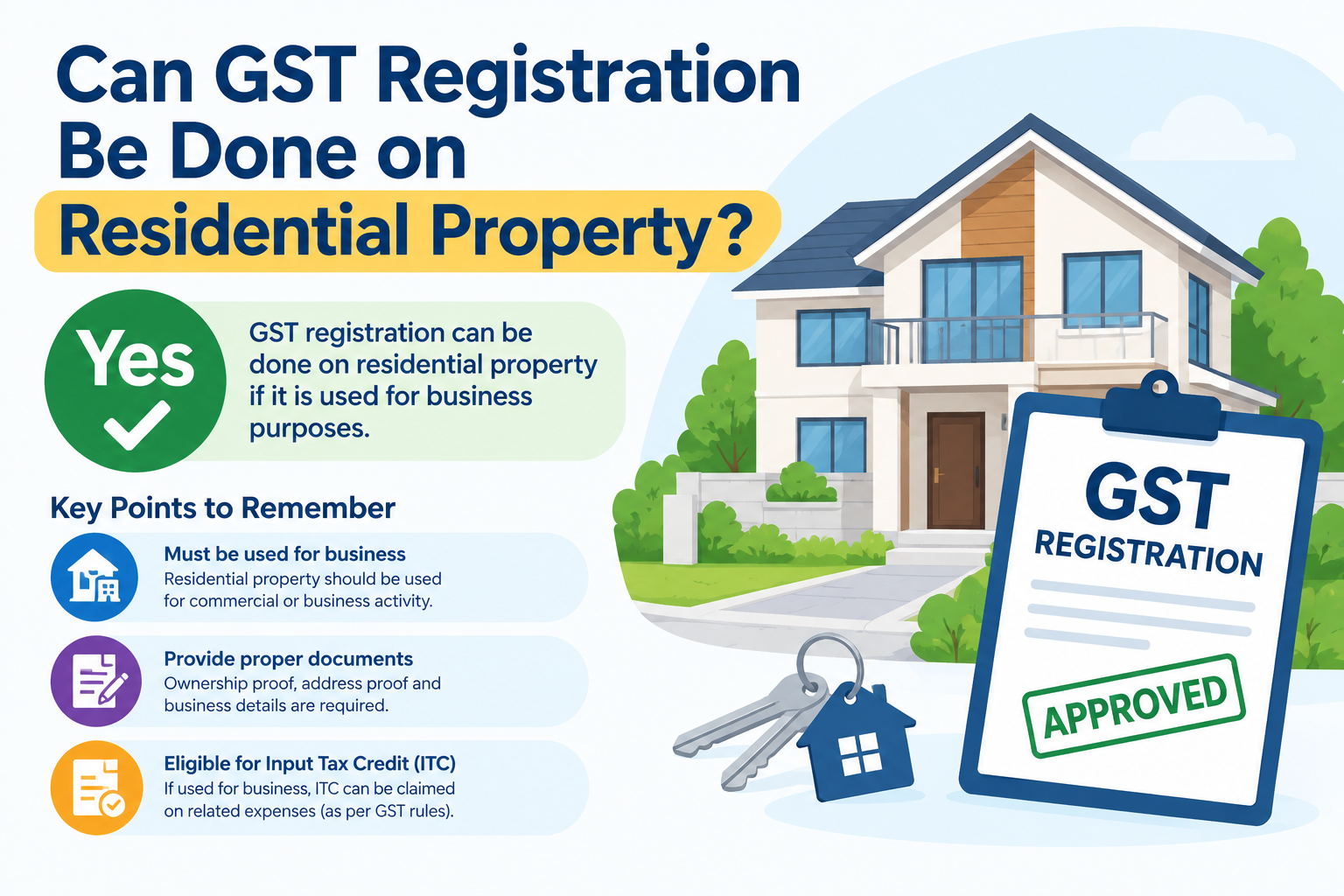
Quick answer: Yes, GST registration can be done on a residential property. GST law does not require a commercial shop or office, so freelancers, consultants, online sellers and home-based businesses can use their home as the principal place of business. You need valid address proof for the property: ownership documents or a recent electricity bill if you own it, a rent agreement with the owner's proof if it is rented, or a consent letter (NOC) from the owner if the property is neither owned nor rented by you. Your state's local rules and housing society bylaws still apply separately.
No. The GST registration process asks you to declare a principal place of business and upload proof that you are entitled to use that address. It does not ask whether the building is zoned as commercial or residential. This is why so many home-based professionals, small manufacturers, boutique owners, tutors, designers, developers and e-commerce sellers register under their residential address.
The key requirement is documentary: you must be able to show that the address is genuinely yours to use, and that the proof matches the name and address you enter in the application.
| Your Situation | Documents Usually Accepted |
|---|---|
| You own the residential property | Latest property tax receipt, municipal khata copy, or a recent electricity bill for the property |
| You live in a rented house or flat | Valid rent or lease agreement, along with the owner's address proof such as an electricity bill, property tax receipt or municipal khata copy |
| The property is owned by a family member, or is shared, and is neither owned nor rented by you | Consent letter (NOC) signed by the owner, along with the owner's address proof such as an electricity bill or municipal khata copy |
Some states, for example Maharashtra, are particular about registered rent agreements. Document expectations can also vary by officer, so keep complete and consistent papers ready.
If you are running a business from a house owned by a parent, spouse, relative or landlord and you do not have a rent agreement, a consent letter from the owner is the standard solution. A good consent letter should include:
If the consent letter or address proof is missing or unclear, the application can be put on hold or raised as a query, which delays your GSTIN.
Decide whether the residence is owned by you, rented by you, or owned by someone else who is letting you use it.
Gather the property tax receipt or electricity bill for owned property, the rent agreement with the owner's proof for rented property, or the owner's proof for a consent-based address.
If the property is neither owned nor rented by you, get a signed NOC from the owner permitting business use and mailing at the address.
Make sure the name and address on the bill, agreement, NOC and application are consistent to avoid a query.
Send PAN, Aadhaar, photo, bank details and your address proof via WhatsApp or our secure order portal.
Our experts file the application on the GST portal with the right business activity and HSN or SAC codes, and you receive an ARN to track it.
We handle any officer query on your behalf. Once approved, you receive your GST Registration Certificate and GST Portal login details.
Register from your home address with expert help. Transparent, fixed pricing with no hidden charges.
Just the GST registration — fast and affordable.
GST Registration + 6 months of returns.
GST Registration + 12 Month GST Return.
Yes, GST registration can be done at a residential address. GST law does not require a commercial property, so you can declare your home as the principal place of business, provided you submit valid address proof for it.
No, a shop or office is not mandatory. Many freelancers, online sellers and home-based businesses obtain a GST number using their residence as the business address.
You typically need a valid rent or lease agreement along with the owner's address proof, such as an electricity bill, property tax receipt or municipal khata copy. A consent letter from the owner can also be required depending on the situation.
An NOC or consent letter is needed when the property is neither owned nor rented by you, for example when you use a house owned by a parent, relative or another person. If you own the property or have a rent agreement, a separate NOC is generally not needed.
Yes, the principal place of business is part of your GST registration details and can be seen on the GST portal and on your invoices. If you want to keep your home address private, a co-working space or virtual office with a proper agreement and NOC may be an option.
No, registering at a residential address does not by itself attract any extra GST. Separate GST rules apply when residential property is rented out or sold, but that is a different matter from using your home as your business address.
Yes, the department may carry out a physical verification of the declared place of business, so make sure the address and business activity you declare are genuine and that you can be reached there.
Choose the Silver Package if you only need the GSTIN. Choose the Gold Package if you also want 6 months of return filing handled for you. Choose the Premium Package if you want a full year of GST return filing covered along with faster 24-hour delivery.
Join 50,000+ businesses who trusted us with their compliance. Get your GSTIN in as fast as 24 hours.