💳 Pay Now |
✍️ Learning Center
Not every business or individual needs a GST number. Find out exactly who is exempt from GST registration under Indian law, who must register regardless of turnover, and how to check where you stand before you decide.
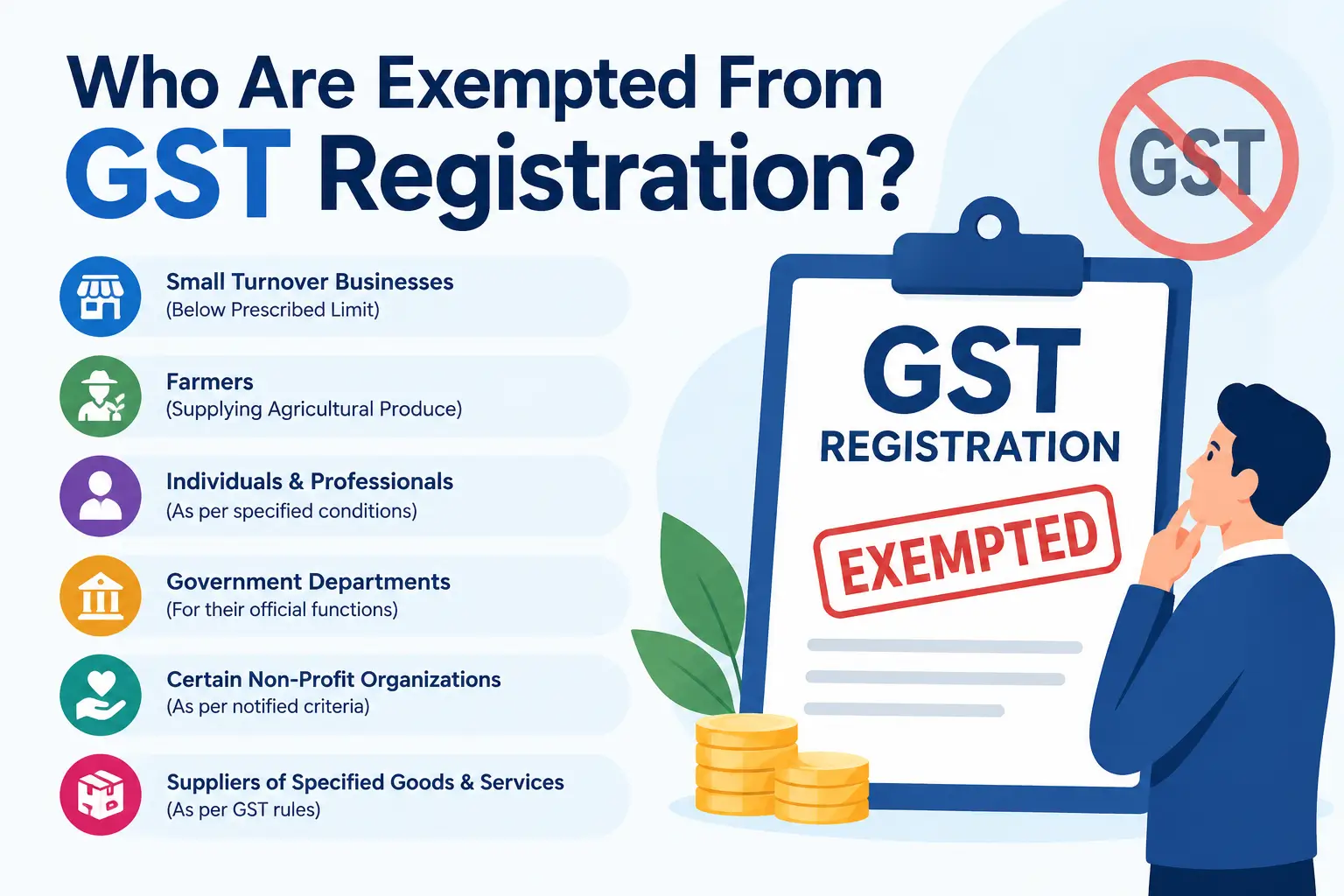
Quick answer: Four main groups are exempt from GST registration: (1) businesses whose annual turnover is below the threshold (₹40 lakh for goods and ₹20 lakh for services in most states, or ₹20 lakh and ₹10 lakh in special category states), (2) persons supplying only exempt, nil-rated or non-GST goods and services, (3) agriculturists selling produce from their own cultivation, and (4) persons whose supplies are taxed entirely under reverse charge. Some businesses must still register regardless of turnover, such as those making interstate supplies of goods or selling goods on e-commerce platforms.
Under Section 23 of the CGST Act, 2017, certain persons are not liable to take GST registration even though they carry on business. The law provides these exemptions in two ways: directly in the Act (for persons exclusively making exempt supplies and for agriculturists), and through government notifications (for example, the turnover threshold and reverse-charge cases).
It is important to separate two ideas that are often mixed up. An exempt supply is a product or service on which no GST is charged. Exemption from registration means the person does not need a GSTIN at all. A business can sell exempt goods and still need registration if it also makes taxable supplies or crosses the threshold on its taxable sales.
| Category | Condition | Common Example |
|---|---|---|
| Turnover below the threshold | Aggregate turnover under ₹40 lakh (goods) or ₹20 lakh (services); ₹20 lakh and ₹10 lakh in special category states | A small shop owner, a freelancer with modest annual billing |
| Exclusively exempt or nil-rated supplies | All supplies made are exempt from tax or not liable to tax, whatever the turnover | A seller of unbranded fresh vegetables, or an educational service provider |
| Agriculturist | Only to the extent of selling produce from cultivation of land | A farmer selling crops grown on his own land |
| Reverse-charge-only suppliers | Every supply made is one on which the recipient pays the tax under reverse charge | A supplier whose entire supply attracts reverse charge in the buyer's hands |
| Non-GST supplies | Supplies kept outside GST, such as alcohol for human consumption, crude petroleum, petrol, diesel, natural gas and aviation turbine fuel | A trader dealing only in such goods |
| Activities that are neither supply of goods nor services | Listed in Schedule III of the CGST Act | Services by an employee to an employer in the course of employment, funeral services |
Thresholds and notified exemptions can be revised by the GST Council and the government. Confirm the current position for your state and business before relying on an exemption.
The most common reason a small business does not need GST registration is its turnover. If your aggregate annual turnover stays under the limit, you can run without a GSTIN.
Even a tiny business can be required to register, because the threshold exemption does not apply to certain categories of people.
| Category | Why Registration Is Needed |
|---|---|
| Interstate supply of goods | Selling goods to another state generally requires registration, with limited exceptions such as certain handicraft goods |
| Sellers of goods on e-commerce platforms | Selling goods through Amazon, Flipkart, Meesho and similar operators requires registration regardless of turnover |
| Casual taxable persons | People who supply occasionally from a temporary place, such as a trade fair stall, must register before supplying |
| Non-resident taxable persons | Foreign suppliers making taxable supplies in India must register |
| Persons liable to pay tax under reverse charge | Recipients who must pay tax on behalf of the supplier generally need registration, subject to notified exceptions |
| TDS / TCS deductors and Input Service Distributors | These roles carry registration requirements irrespective of turnover |
| Agriculturists with non-farm supplies | The exemption covers only own-cultivation produce; other supplies are tested against the threshold |
Being exempt means you are not forced to register, but voluntary registration can still make business sense:
The trade-off is compliance: once registered, you must file returns on time even if your turnover stays small. Our packages below include return filing options so you are not left managing it alone.
Write down every product and service you sell, and mark whether each one is taxable, exempt, nil-rated or outside GST.
If every supply you make is exempt, nil-rated or non-GST, you are not liable to register, whatever your turnover.
Add up the turnover of all your businesses under the same PAN in the state, including taxable and exempt sales, for the financial year.
Use ₹40 lakh for goods or ₹20 lakh for services in most states, or ₹20 lakh and ₹10 lakh in special category states.
Check whether you make interstate supplies of goods, sell on e-commerce platforms, supply as a casual or non-resident taxable person, or pay tax under reverse charge. Any of these can require registration even below the threshold.
If you are not exempt, or you choose voluntary registration, pick a package below and our team will file your application end to end.
Found out you need to register, or want to register voluntarily? Transparent, fixed pricing with no hidden charges.
Just the GST registration — fast and affordable.
GST Registration + 6 months of returns.
GST Registration + 12 Month GST Return.
Businesses with turnover below the threshold, persons supplying only exempt, nil-rated or non-GST goods and services, agriculturists selling their own farm produce, and persons whose supplies are taxed entirely under reverse charge are exempt from GST registration.
In most states the limit is ₹40 lakh for goods and ₹20 lakh for services. In special category states it is ₹20 lakh for goods and ₹10 lakh for services.
Yes, an agriculturist is exempt to the extent of supplying produce from cultivation of land. If the farmer also makes other supplies, such as processed or traded goods, those are tested against the normal threshold.
No, a person who exclusively supplies goods or services that are wholly exempt or not liable to tax is not required to register, even if turnover exceeds the threshold. If you also sell any taxable item, this exemption no longer applies in full.
For goods, no. Sellers of goods through e-commerce operators must register regardless of turnover, so the turnover threshold exemption does not help marketplace sellers.
Interstate supply of goods generally requires registration even when turnover is below the threshold, with limited exceptions such as certain handicraft goods. Small service providers making interstate supplies can remain exempt below the services threshold.
No. The Composition Scheme is for registered businesses that pay a flat, low tax rate and file simpler returns. An exempt person does not register at all, whereas a composition dealer is registered but follows a simplified tax method.
Choose the Silver Package if you only need the GSTIN. Choose the Gold Package if you also want 6 months of return filing handled for you. Choose the Premium Package if you want a full year of GST return filing covered along with faster 24-hour delivery.
Join 50,000+ businesses who trusted us with their compliance. Talk to our experts, or register in as fast as 24 hours.