💳 Pay Now |
✍️ Learning Center

A complete, ready-reference chart of TDS on rent for FY 2026-27 covering Section 194I and Section 194IB — applicable rates, threshold limits, who must deduct, due dates, forms, and penalties for non-compliance.
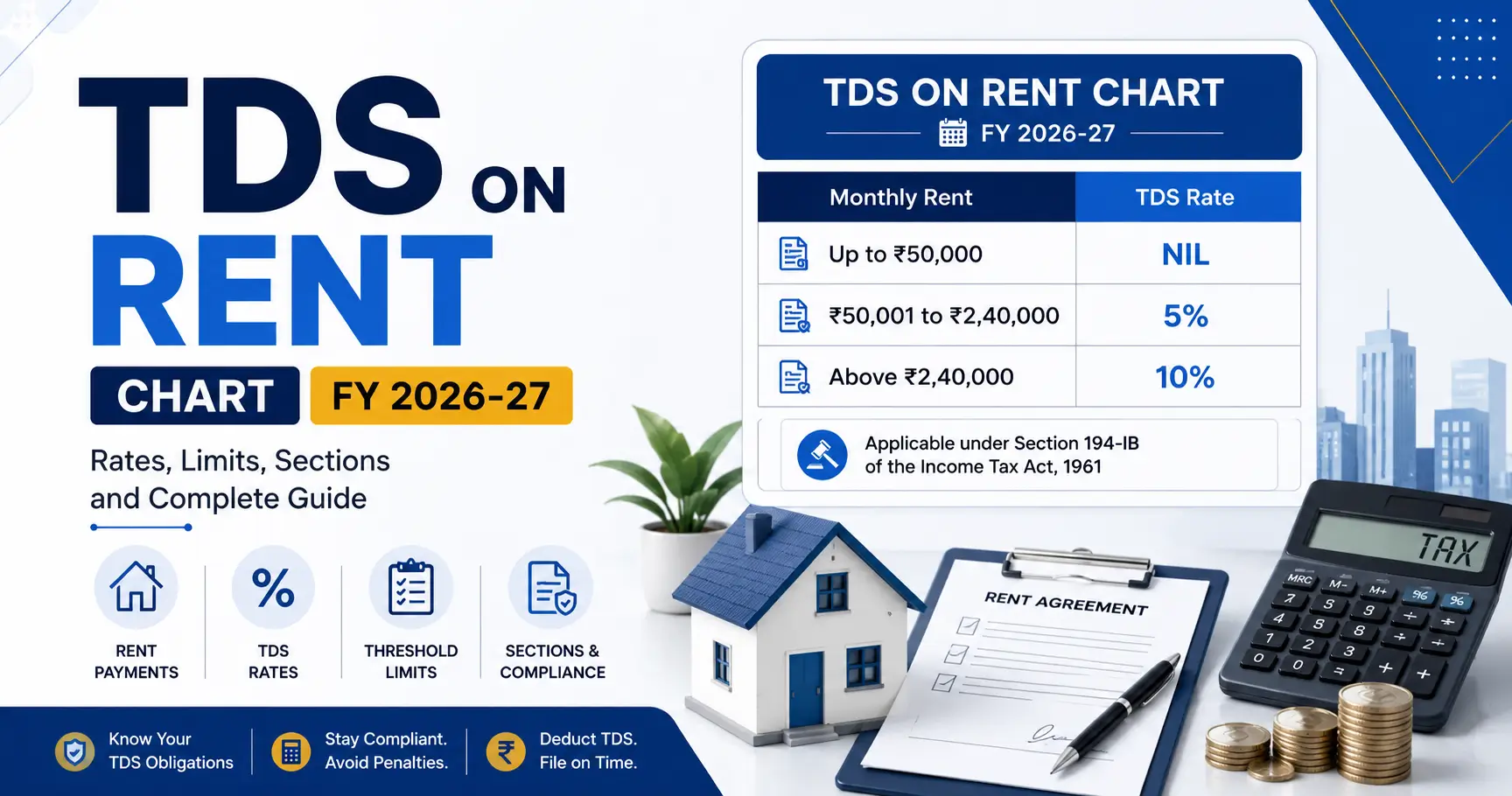
TDS (Tax Deducted at Source) on rent means the tenant deducts a percentage of the rent payable to the landlord and deposits it directly with the Income Tax Department, before paying the balance rent. It ensures the government collects tax on rental income upfront and helps track high-value rent transactions.
Two separate provisions govern TDS on rent in India: Section 194I, which applies to businesses, companies, and individuals/HUFs liable to tax audit, and Section 194IB, which applies to individuals and HUFs not liable to tax audit who pay high monthly rent for residential or commercial property.
Note: The rates and thresholds below apply for FY 2026-27 and remain unchanged from FY 2025-26, per the enhanced threshold retained in Budget 2026.
| Section | Applicable To | Nature of Payment | Threshold Limit | TDS Rate |
|---|---|---|---|---|
| 194I | Companies, firms, businesses under tax audit | Rent of land, building, furniture, fittings | ₹50,000/month (₹6,00,000/year) | 10% |
| 194I | Companies, firms, businesses under tax audit | Rent of plant & machinery / equipment | ₹50,000/month (₹6,00,000/year) | 2% |
| 194IB | Individuals/HUF not liable to tax audit | Rent of land or building (residential/commercial) | >₹50,000/month | 2% |
| 195 | Any tenant, resident or non-resident landlord | Rent paid to non-resident landlord | No threshold | Rates in force (as per DTAA/slab) |
| 206AA | Any payer, if landlord's PAN not furnished | Any rent payment above threshold | Same as above thresholds | 20% |
Section 194I applies to any person, other than an individual or HUF, and to individuals or HUFs whose books of account were required to be audited in the preceding financial year, paying rent to a resident landlord.
Section 194IB covers individuals and HUFs who are not liable to tax audit but pay monthly rent exceeding ₹50,000 for a residential or commercial property — a common situation for salaried tenants renting a house in a metro city.
When rent is paid to a non-resident landlord, Sections 194I and 194IB do not apply. Instead, TDS is governed by Section 195, deducted at the rates in force, which may include applicable surcharge and cess, and can be reduced under a Double Taxation Avoidance Agreement (DTAA) or a lower/nil deduction certificate obtained by the landlord under Section 197. The tenant must obtain a TAN and file quarterly returns in Form 27Q for such payments.
Determine whether Section 194I (business/tax-audit cases) or Section 194IB (individuals/HUF) applies based on tenant status and monthly rent.
Confirm the rent exceeds ₹50,000 per month before any TDS obligation arises under either section.
Obtain the landlord's PAN to apply the correct rate; without PAN, TDS rises to 20%.
Deduct 10% or 2% under Section 194I, or 2% under Section 194IB, from the rent payable.
Deposit TDS monthly (194I) using Form 26Q reporting, or as a single annual deposit (194IB) using Form 26QC, within the prescribed due dates.
Provide Form 16A (194I, quarterly) or Form 16C (194IB, after Form 26QC filing) to the landlord as proof of TDS deducted and deposited.
| Form | Purpose | Applicable Section |
|---|---|---|
| Form 26Q | Quarterly TDS return for resident payments (other than salary) | 194I |
| Form 26QC | Challan-cum-statement for TDS on rent by individuals/HUF | 194IB |
| Form 27Q | Quarterly TDS return for payments to non-residents | 195 |
| Form 16A | TDS certificate issued quarterly to the landlord | 194I |
| Form 16C | TDS certificate issued after Form 26QC filing | 194IB |
Under Section 194I, TDS is 10% on rent for land, building, furniture, and fittings, and 2% on rent for plant and machinery. Under Section 194IB, TDS is 2% for individuals and HUFs paying monthly rent above ₹50,000.
Under Section 194I, TDS applies once rent exceeds ₹50,000 per month (₹6,00,000 per year) to a single landlord. Under Section 194IB, TDS applies when monthly rent exceeds ₹50,000, regardless of the annual total.
Individuals and HUFs who are not liable to tax audit and who pay rent exceeding ₹50,000 per month for residential or commercial property must deduct TDS under Section 194IB.
If the landlord does not furnish their PAN, the TDS rate increases to 20% under Section 206AA, regardless of the rate that would otherwise apply.
Only once — in the last month of the tenancy or the last month of the financial year, whichever is earlier — unlike Section 194I, which requires monthly deduction and deposit.
No. TDS under Section 194IB can be deducted, deposited, and reported using only the tenant's and landlord's PAN through Form 26QC, without obtaining a TAN.
No. TDS applies only to periodic rent payments. A refundable security deposit that does not form part of rent is not subject to TDS.
TDS on rent paid to a non-resident landlord is governed by Section 195, and the tenant must obtain a TAN and file a quarterly return in Form 27Q.
Our tax experts help 50,000+ taxpayers and businesses deduct, deposit, and file TDS correctly and avoid interest or penalty notices.
This article is for general informational purposes only and does not constitute tax or legal advice. TDS rates, thresholds, and forms are subject to change through future Finance Acts, CBDT notifications, and the new Income-tax Act, 2025. Please consult a qualified tax professional for advice specific to your situation.