💳 Pay Now |
✍️ Learning Center
Understand when Reverse Charge Mechanism applies under GST, who is liable to pay tax, which goods and services are covered, and how to stay compliant. Guided by Chartered Accountants with 15+ years of GST advisory expertise.
RCM & GST Compliance Support
Reviewed by Practicing Chartered Accountants
Query resolution and filing support within 24-48 hours
Email: help@setupfiling.inUnder normal GST rules, the supplier of goods or services collects GST from the buyer and deposits it with the government. The Reverse Charge Mechanism (RCM) under GST flips this rule around for certain notified transactions, making the recipient of goods or services responsible for paying GST directly to the government instead of the supplier. Many businesses miss RCM liabilities simply because they assume GST is always the supplier's responsibility, which leads to interest, penalties, and blocked input tax credit during audits.
Setupfiling.in is an online professional business services platform founded by experienced Chartered Accountants, Company Secretaries, and Trademark Attorneys with 15+ years of combined expertise. We have helped 50,000+ entrepreneurs and businesses across India with GST registration, return filing, and compliance advisory, including correctly identifying and reporting Reverse Charge Mechanism liabilities.
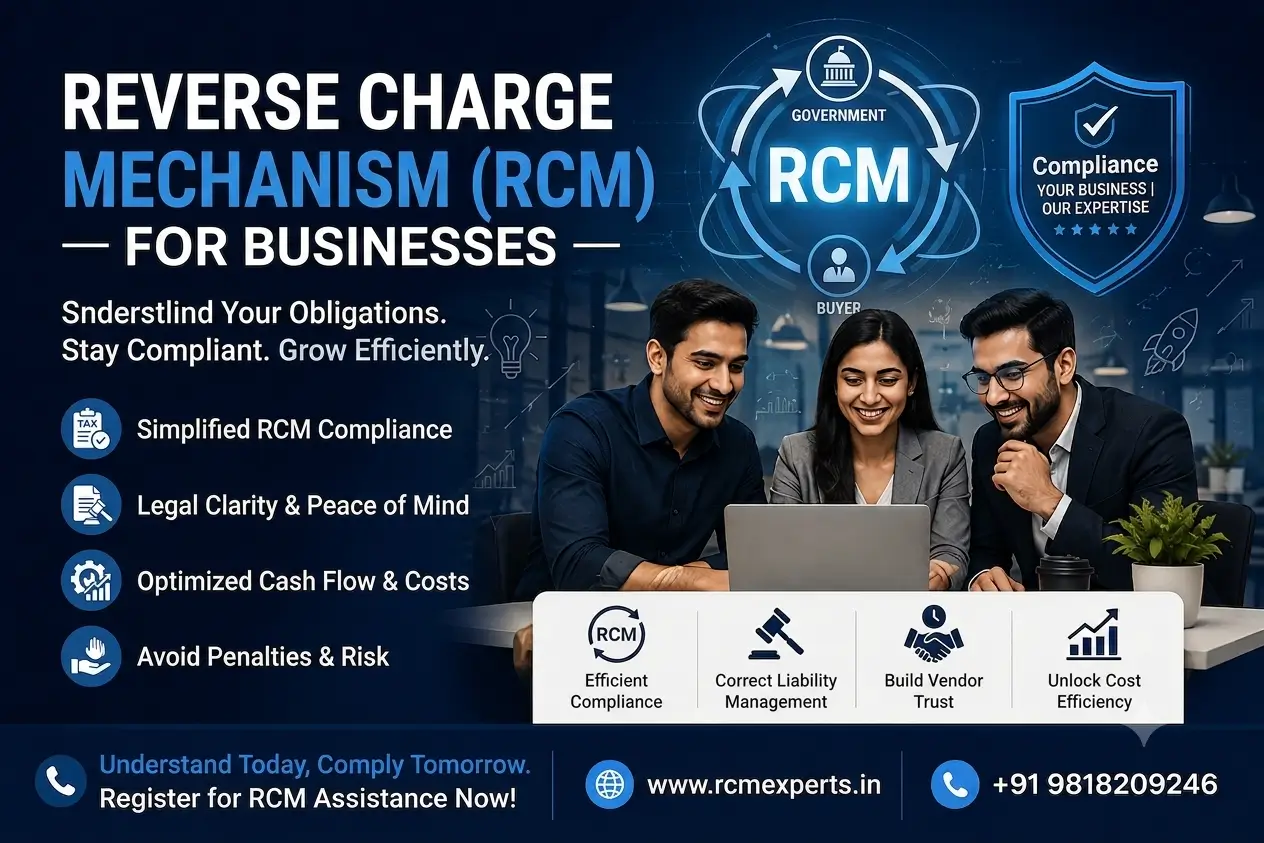
This guide explains what RCM means, how it differs from normal forward charge, which goods and services it commonly applies to, how input tax credit works under RCM, and how our team can help you stay fully compliant.
Reverse Charge Mechanism is a provision under the GST law, primarily governed by Section 9(3) and Section 9(4) of the CGST Act, where the liability to pay GST shifts from the supplier to the recipient of the goods or services. Instead of the seller charging GST on the invoice and depositing it, the buyer calculates the applicable GST themselves, pays it directly to the government, and can typically claim Input Tax Credit on that amount, subject to normal ITC conditions.
RCM applies in two broad situations: first, when the government specifically notifies certain categories of goods or services as subject to reverse charge regardless of the supplier's registration status, and second, in limited notified cases involving supplies from unregistered persons to registered persons.
| Aspect | Forward Charge | Reverse Charge (RCM) |
|---|---|---|
| Who pays GST to the government | The supplier of goods or services | The recipient of goods or services |
| Who raises the tax invoice | The supplier, showing GST charged | The recipient, through a self-invoice in most notified cases |
| Payment mode | Can be paid using input tax credit | Must be paid in cash through the electronic cash ledger |
| Input tax credit | Available to the buyer on eligible purchases | Available to the recipient after paying RCM in cash, subject to eligibility |
The government periodically notifies specific categories of services and goods under RCM. Some of the most common and long-standing categories businesses encounter include the following.
Freight charges paid to a GTA for transport of goods by road, where the GTA has not opted to pay tax under forward charge.
Services provided by an individual advocate or a firm of advocates to a business entity.
Services supplied by a director of a company to the company, such as sitting fees or remuneration not treated as salary.
Any service received from a supplier located outside India, where the recipient in India is liable to pay GST under reverse charge.
Sponsorship services provided to a body corporate or partnership firm located in India.
Security personnel services supplied by any person other than a body corporate to a registered business entity.
Renting of motor vehicles for passenger transport by a non-body-corporate supplier to a body corporate, under specified conditions.
Certain services supplied by the Central or State Government to a business entity, excluding specifically exempted categories.
Certain goods are also notified under reverse charge, including cashew nuts (not shelled or peeled) sold by an agriculturist, bidi wrapper leaves (tendu leaves), tobacco leaves, silk yarn, raw cotton supplied by an agriculturist, and used vehicles, seized goods, or old and used goods sold by government departments to registered persons.
Because notified lists are updated by the GST Council from time to time, businesses should always verify the current applicability for their specific transaction rather than relying solely on past notifications. Our GST advisory team keeps track of these updates and can confirm applicability for your specific purchases.
A common misconception is that RCM is simply an extra cost. In most cases, once you pay RCM in cash, you can claim it as input tax credit in the same return period, provided the goods or services are used for business purposes and all other standard ITC conditions are met. The key compliance points to remember are outlined below.
When RCM applies to a purchase from an unregistered supplier, the recipient is required to issue a self-invoice, since the unregistered supplier cannot issue a GST-compliant tax invoice.
RCM liability must be discharged in cash through the electronic cash ledger. Input tax credit balances cannot be used to pay RCM tax.
RCM liability and the corresponding input tax credit must be correctly reported in GSTR-3B and reconciled with GSTR-2B for the relevant period.
Review every purchase of goods or services against the current RCM notifications to determine whether reverse charge applies to that specific transaction.
Where the supplier is unregistered or otherwise unable to issue a GST invoice, prepare a self-invoice recording the value of supply and applicable GST rate.
Compute the GST payable under reverse charge and deposit it through the electronic cash ledger, since RCM cannot be settled using available input tax credit.
Declare the RCM liability under the relevant table in GSTR-3B for the tax period in which the liability arose.
Once the RCM amount is paid, claim input tax credit on it in the same or a subsequent return, provided the goods or services qualify for ITC under normal rules.
Freight, legal fees, and director sitting fees are often booked as regular expenses without checking whether RCM applies, resulting in unreported tax liability.
Some businesses mistakenly try to offset RCM liability against available input tax credit, which is not permitted and can lead to demand notices with interest.
Failing to raise a self-invoice for RCM purchases from unregistered suppliers creates documentation gaps that surface during GST audits and assessments.
Keep the following details ready before you reach out. This helps our Chartered Accountants review your RCM applicability and filing accurately.
Message us on WhatsApp or email us with details of the transaction or expense you want reviewed for RCM applicability.
Send your invoices and GST details to help@setupfiling.in or via WhatsApp at +91 98182 09246.
Our Chartered Accountants confirm RCM applicability, help with self-invoicing, and support accurate GSTR-3B reporting within 24-48 hours.
Setupfiling.in is built by Chartered Accountants, Company Secretaries, and Trademark Attorneys who track GST notifications closely and help businesses avoid interest, penalties, and blocked credit from missed reverse charge liabilities.
RCM compliance is one part of overall GST management. Explore other services our clients commonly need:
RCM is a provision where the liability to pay GST shifts from the supplier to the recipient of goods or services, applicable to specific notified categories under Section 9(3) and 9(4) of the CGST Act.
The recipient of the goods or services is liable to pay GST directly to the government under reverse charge, instead of the supplier collecting and depositing it.
No. RCM liability must be paid in cash through the electronic cash ledger. Available input tax credit balances cannot be used to discharge RCM tax.
Yes, in most cases, once the RCM amount is paid in cash, it can be claimed as input tax credit in the same or a later return period, provided the goods or services are used for business purposes and normal ITC conditions are met.
Yes, freight paid to a Goods Transport Agency for road transport of goods is one of the most common services covered under RCM, where the GTA has not opted to pay tax under forward charge.
Yes, legal services received from an individual advocate or a firm of advocates by a business entity are notified under reverse charge.
Yes, import of services attracts reverse charge, making the Indian recipient liable to pay GST on the value of services received from a foreign supplier.
A self-invoice is a document the recipient prepares when receiving notified goods or services from an unregistered supplier who cannot issue a GST-compliant tax invoice, capturing the value and applicable GST for RCM purposes.
RCM liability is reported under the relevant table in GSTR-3B for the period in which it arises, and the corresponding eligible input tax credit is claimed in the same return.
Missed RCM liability can lead to interest on the unpaid tax, penalties on assessment, and denial of the related input tax credit, so timely identification and payment is important.
Services supplied by a director to the company, other than remuneration treated as salary under employment, are generally covered under reverse charge, and businesses should review this classification carefully with their tax advisor.
Message us on WhatsApp at +91 98182 09246 or email help@setupfiling.in with your transaction details. Our Chartered Accountants review RCM applicability, assist with self-invoicing, and support accurate GST return filing within 24-48 hours.
GST advisory guided by Chartered Accountants — trusted by 50,000+ businesses across India.
Chat on WhatsApp: +91 98182 09246