💳 Pay Now |
✍️ Learning Center

"Logo registration" and "trademark registration" get used interchangeably, but they protect different things under different laws. Here's exactly what each one covers, and which one your brand actually needs.
Secure checkout via Razorpay · No hidden charges
"Logo registration" in India usually refers to copyright registration of the logo as an original artistic work, protected under the Copyright Act, 1957. Trademark registration protects the logo (or brand name) as a commercial identifier under the Trade Marks Act, 1999, giving you the exclusive right to use it for specific goods or services. In short: copyright protects the artwork itself, and trademark protects the brand's use of that artwork in the marketplace.
Most businesses actually need trademark registration, not copyright, because the real risk is a competitor using a similar name or logo to sell competing products — something only trademark law addresses. Copyright registration is useful too, but mainly for proving original authorship of the design, not for stopping brand confusion in the market.
You can register a logo as a trademark alone, a wordmark and logo together, or pursue both copyright and trademark protection for maximum coverage. Our team files under the device mark category explained in our trademark types guide if you want the logo itself protected as your brand identifier.
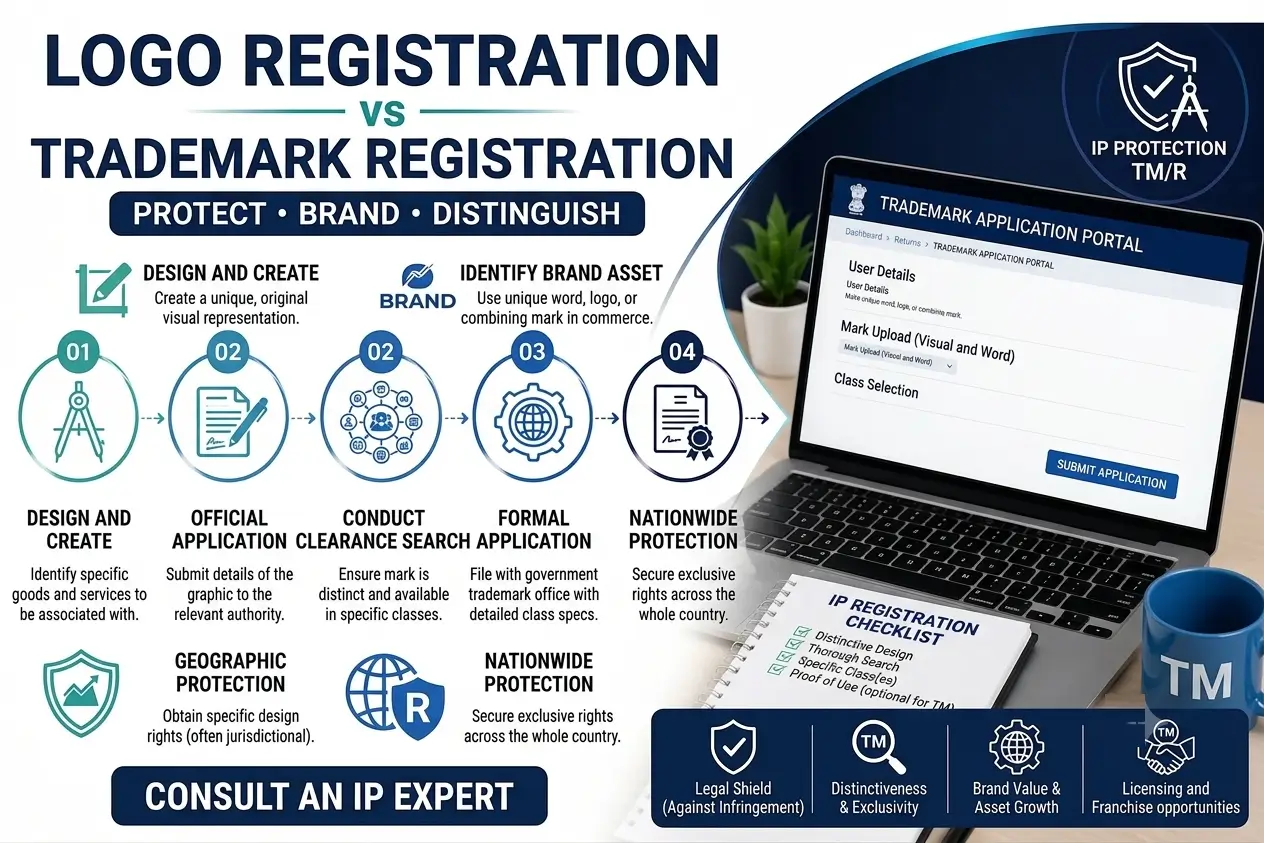
Filing the wrong type of protection — or assuming one covers what the other does — leaves real gaps in how your brand is defended.
Copyright alone can't stop a competitor from using a similar name or logo to sell competing goods or services.
Registering the logo's copyright creates strong evidence of who designed it and when, useful in design disputes.
Trademark rights apply to the class of goods/services you register under — not automatically to every industry.
Copyright in an artistic work lasts the author's lifetime plus 60 years, without needing renewal fees.
A trademark must be renewed every 10 years, but gives ongoing exclusive commercial rights while active.
Filing both gives you authorship proof over the design and exclusive commercial rights over its brand use.
Both protect intellectual property, but they answer completely different legal questions.
| Aspect | Logo Registration (Copyright) | Trademark Registration |
|---|---|---|
| Governing law | Copyright Act, 1957 | Trade Marks Act, 1999 |
| What it protects | The artistic design/graphic work itself | The logo/name as a commercial brand identifier |
| Registering authority | Copyright Office | Trade Marks Registry |
| Scope of protection | Applies to the artwork, regardless of industry | Applies only to the registered class of goods/services |
| Duration | Author's lifetime + 60 years | 10 years, renewable indefinitely |
| Symbol used | © (copyright) | ® (once registered), TM while pending |
| Stops brand confusion? | Not directly — protects copying of the artwork | Yes — this is its core purpose |
| Typical use case | Proving original design authorship | Preventing others from trading under a similar mark |
Want copyright protection for your logo artwork as well? See our copyright registration service alongside trademark filing.
Most businesses need trademark registration first. Copyright is a useful addition, not a substitute.
You need trademark registration. This is the only protection that lets you legally stop another business from trading under a similar name or logo.
Copyright Registration helps here — it creates a dated public record of your original artistic work.
File both. Trademark protects your commercial use of the logo; copyright protects the design itself from being copied outright.
Keep the following details ready — our team uses this to prepare and file your trademark application within 24-48 hours.
A simple 3-step process from order to filed application — no office visits, no paperwork courier.
Choose the Trademark Registration Plan and complete secure payment via the Apply Now button above.
Email your details to help@setupfiling.in or WhatsApp them to +91 98182 09246.
Our team files your trademark application and shares the filed documents within 24-48 hours.
Filing is just the start. Here's the typical journey your application takes at the Trade Marks Registry.
Your application is filed online and you receive an application number for tracking.
The Registrar checks for conflicts with existing marks and either accepts the mark or raises an objection.
The mark is published in the Trade Marks Journal for public viewing, opening a 4-month opposition window.
Third parties may oppose the mark. If no opposition is filed, the application proceeds to registration.
Once cleared, the Registry issues the registration certificate and the ® symbol can be legally used.
Everything a business needs to protect its name, logo and creative work, in one place.
No, they are different. "Logo Registration" generally refers to copyright registration of the artistic design, while trademark registration protects the logo as a commercial brand identifier under a specific class.
It's not mandatory, but it's common for serious brands to file both — trademark to stop brand confusion in the market, and copyright to prove original authorship of the design.
Trademark registration is the stronger tool for this, since it directly addresses use of a similar mark in commerce for competing goods or services.
The total cost is ₹1,999 as the professional filing fee plus ₹4,500 as the government fee for one class, making the effective cost ₹6,499 for a startup or individual applicant.
Copyright in an artistic work lasts for the author's lifetime plus 60 years and does not require renewal. Trademark registration lasts 10 years and must be renewed to stay active.
No, the ® symbol can only be used after trademark registration is complete. Copyright registration uses the © symbol instead.
Yes, a logo can be registered on its own as a device mark, separately from or alongside the wordmark (brand name).
No, you can use a logo without registering it, but you get no exclusive legal protection against copycats until it is registered as a trademark.
You need the applicant's name, father's name and address, company name (if any), MSME certificate (if any), the logo in JPEG format, product/service list, trademark class, and a valid email and mobile number.
Yes, being the designer gives you authorship, but registration — whether copyright or trademark — is what gives you an enforceable legal record and stronger protection.
Join 50,000+ customers who trust SetupFiling.in for fast, transparent trademark filing.