💳 Pay Now |
✍️ Learning Center

Not always. If your turnover is below the threshold, the law lets you export services without registering. But without a GSTIN you cannot file a Letter of Undertaking or claim refunds, and above the limit registration is compulsory. We help you register and set up your export billing correctly.
One-time payment. Once your GSTIN is issued, ask us on WhatsApp about filing your annual LUT for zero-tax export invoices.
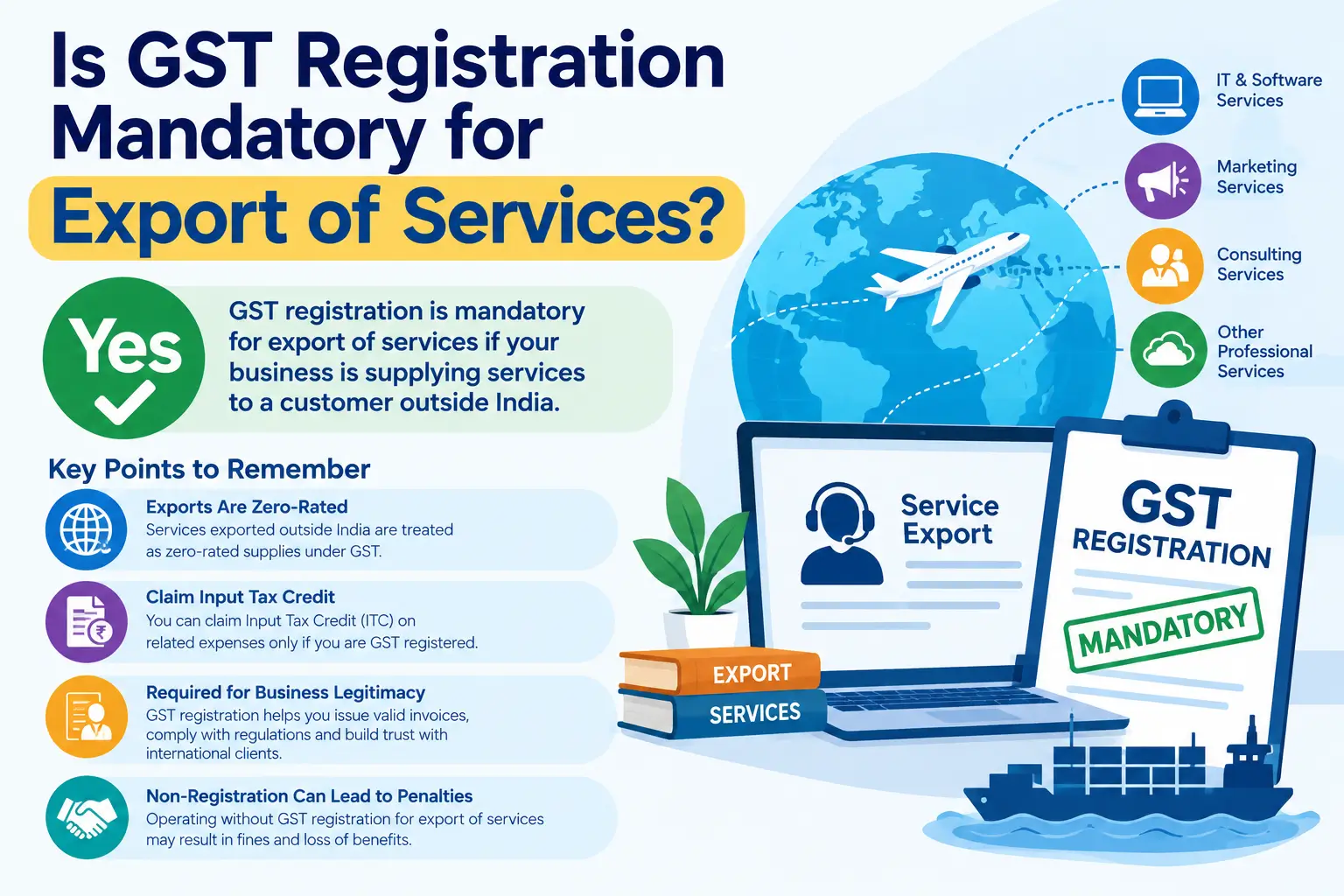
Short answer: it depends on your turnover. Export of services counts as an inter-State supply, and a notification exempts service providers making inter-State supplies from registration while their aggregate turnover stays within ₹20 lakh in a financial year (₹10 lakh in some special category states). Once you cross that limit, registration is mandatory, even if every rupee comes from exports. Registration is also needed if you want to file an LUT or claim a refund.
Export of services is a zero-rated supply under the IGST Act, which means GST is charged at zero rate, not that GST does not apply. Because it is still a supply under GST, the usual registration rules decide whether you need a GSTIN. The table below shows how it works in practice.
| Your situation | Is registration mandatory? |
|---|---|
| Only exporting services, aggregate turnover within ₹20 lakh | Not mandatory under the inter-State exemption. Registration is optional. |
| Aggregate turnover above ₹20 lakh, even if 100% exports | Mandatory. |
| Special category states, turnover above ₹10 lakh | Mandatory above the lower limit applicable to your state. |
| You want to export under LUT without paying IGST | Needs a GSTIN, because the LUT is filed on the GST portal. |
| You want a refund of unutilised input tax credit or IGST paid | Needs a GSTIN, because refunds are claimed on the GST portal. |
| You also make taxable domestic supplies or are liable under reverse charge | Check the rules for those supplies, since registration may be needed irrespective of the export exemption. |
Interpretation note: the exemption notification speaks of inter-State supplies of services and does not mention exports by name. It is widely read to cover service exporters, but some professionals prefer to register anyway to avoid any dispute. If you want certainty, registering is the safer route.
Aggregate turnover includes your export receipts, so exports count towards the ₹20 lakh limit. If you are unsure where you stand, our guide on GST for small and growing businesses explains how turnover is calculated.
A supply qualifies as export of services only if all five conditions are met:
| Condition | What it means |
|---|---|
| 1. Supplier in India | The service provider is located in India. |
| 2. Recipient outside India | The client is located outside India. |
| 3. Place of supply outside India | The place of supply, as per the IGST rules, is outside India. |
| 4. Payment in convertible foreign exchange | Payment is received in convertible foreign exchange, or in Indian rupees where the RBI permits it. |
| 5. Not merely a distinct person | The supplier and recipient are not merely establishments of the same legal entity. |
If any condition fails, the supply may be treated as a domestic taxable supply, with 18% GST on most professional services.
Registered exporters receive a GST registration certificate that they can show to clients and banks.
| Route | How it works |
|---|---|
| Export under LUT | You file an annual Letter of Undertaking on the GST portal and raise invoices without charging IGST. Any unutilised input tax credit can be claimed as a refund. |
| Export with payment of IGST | You charge IGST on the export invoice, pay it, and then claim the IGST back as a refund. This ties up cash, so most exporters choose the LUT route. |
Whichever route you use, report the export invoices in your returns and keep proof of foreign exchange receipt, such as bank advice or FIRC. We can handle this through our monthly GSTR-1 and GSTR-3B filing service.
For the full list by business type, see our GST registration documents checklist. Sole owners can start with GST registration for an individual, and agencies run by partners can read GST registration for a partnership firm.
Add up your annual turnover including exports and confirm that your supplies meet the five export conditions.
Apply on the GST portal with PAN, Aadhaar, address proof and bank details, and note the ARN generated.
Once the GSTIN is active, furnish the Letter of Undertaking on the portal for the financial year.
Issue invoices stating export under LUT without payment of IGST, and receive payment in foreign exchange.
Report exports in your monthly returns, keep payment proof, and apply for refund of unutilised input tax credit if you have any.
More than 50,000 customers have used us for GST registration and compliance, including freelancers and agencies billing clients abroad. We check that your SAC code, address proof and business details are consistent before filing, so your registration is less likely to be queried. You can follow your application through our page on tracking GST status by ARN, and compare charges in our GST registration cost guide.
Need a GSTIN before a client contract starts? Ask about 1-day GST registration, or message us on WhatsApp at +91 98182 09246. If you run your export business through a company, read about GST registration for a newly formed company.
Not if your aggregate turnover stays within ₹20 lakh (₹10 lakh in some special category states), because service providers making inter-State supplies are exempt from registration up to that limit. Above the limit, registration is mandatory even if all your income is from exports.
Yes, if your turnover is within the threshold and you do not need an LUT or refund. You cannot file an LUT, claim a refund of input tax credit, or issue a GST tax invoice without a GSTIN.
Yes. Export receipts are part of your aggregate turnover, so they count towards the ₹20 lakh limit that decides whether registration is mandatory.
A Letter of Undertaking is an annual declaration on the GST portal that lets a registered exporter issue invoices without paying IGST. It is optional, but without it you must pay IGST on exports and then claim a refund.
Yes, a registered exporter can claim a refund of unutilised input tax credit on exports made under LUT, or a refund of IGST paid on exports. The refund application is filed on the GST portal, so a GSTIN is required.
The supplier must be in India, the recipient outside India, the place of supply outside India, payment must be received in convertible foreign exchange or in rupees where RBI permits, and the supplier and recipient must not be merely establishments of the same person.
You should apply within 30 days of becoming liable to register. Delay can lead to notices, tax liability for the period, and penalties, so register as soon as you expect to cross the limit.
Join 50,000+ businesses already served by Setupfiling.in. Pick a package or message us on WhatsApp to get your GSTIN and LUT sorted.