💳 Pay Now |
✍️ Learning Center

Confused whether to register your business name as a word mark or your logo as a device mark? Understand the difference in protection scope and choose the right filing, guided by Trademark Attorneys with 15+ years of expertise.
Pricing Summary
₹1999+ Govt. Fee ₹4500
Filing starts within 24-48 hours of document submission
Chat on WhatsApp: +91 98182 09246One of the first decisions you'll face when filing a trademark application is what type of mark to register. Two of the most common options are a word mark and a device mark, and understanding the difference between word mark and device mark trademark filings determines exactly what part of your brand identity gets legal protection. Filing the wrong type, or only one when you needed both, can leave a real gap in how well your brand is protected.
Setupfiling.in is an online professional business services platform founded by experienced Chartered Accountants, Company Secretaries, and Trademark Attorneys with 15+ years of combined expertise. We have helped 50,000+ entrepreneurs and businesses across India register word marks, device marks, and combination marks correctly based on what actually needs protecting.
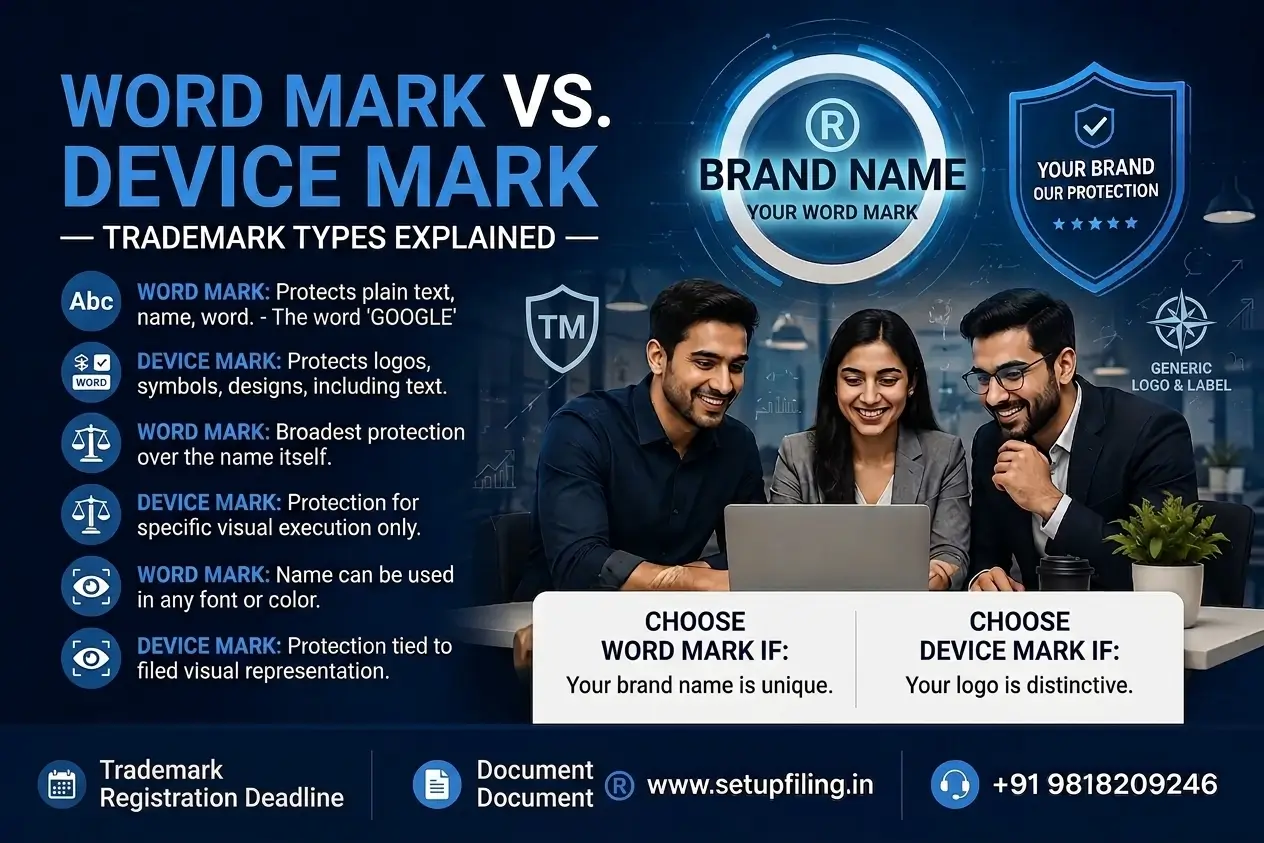
This guide explains what each type of mark protects, a detailed comparison, whether you should register both, the registration process, and how to place your order with Setupfiling.in.
A word mark, also called a wordmark or standard character mark, protects the text of your brand name itself, independent of any specific font, color, size, or stylisation. Registering a word mark gives you the broadest possible protection for the name, since it covers the words no matter how they are later displayed, whether in plain text, a different font, all capitals, or any typographic style.
A device mark protects a specific logo, symbol, design, or the particular stylised presentation of a name, including its unique font, colour combination, and graphic elements. A device mark protects the visual appearance exactly as filed, not the underlying words in a generic sense, so protection is narrower and tied closely to that specific visual design.
| Parameter | Word Mark | Device Mark |
|---|---|---|
| What Is Protected | The brand name or text itself, regardless of font or styling | The specific logo, symbol, or stylised graphic presentation |
| Scope of Protection | Broader, covers the words in any font, size, or colour | Narrower, limited to the exact visual design as filed |
| Best Suited For | Protecting the business or product name across all future branding changes | Protecting a specific logo, mascot, or unique visual identity |
| Filing Requirement | Simple text entry of the mark, no logo image needed | A clear image of the logo or design must be submitted with the application |
| Similarity Examination | Compared primarily on phonetic and structural similarity to existing word marks | Compared primarily on visual similarity to existing device marks and logos |
| Impact of Rebranding | Protection continues even if the logo design changes, since only the name matters | A significant redesign of the logo may require filing a fresh device mark application |
For complete brand protection, many businesses register both. The word mark locks down the name itself so no competitor can use it in any form, while a separate device mark protects the specific logo design that customers visually recognise. Registering only a device mark, for example, would not necessarily stop a competitor from using your brand name in plain text with a different logo, since the device mark's protection is tied closely to the visual design filed.
Suitable if your logo design changes frequently or you have not finalised a permanent visual identity yet, and the name itself is your primary brand asset.
Suitable only if your business name itself is generic or descriptive and cannot be registered as a word mark on its own, making the distinctive logo your main protectable asset.
Recommended for most growing brands that want to protect both the name and the visual logo independently, covering all the ways competitors might try to copy the brand.
A search is conducted to check whether an identical or deceptively similar word mark or device mark already exists in the relevant class.
The application is filed specifying whether it is a word mark, a device mark with the logo image attached, or a combination mark including both elements.
A Trademark Examiner reviews the application for distinctiveness and similarity to existing marks, and may raise an objection if issues are found.
Once accepted, the mark is published in the Trademark Journal for four months, during which any third party can file an opposition.
If no opposition is filed, or any opposition is successfully resolved, the Registry issues the trademark registration certificate.
Keep the following details ready before you place your order. This helps us file your word mark or device mark application without delay.
Click "Order Now" and complete payment of ₹1999 plus the applicable government fee through our secure Razorpay checkout.
Email your details to help@setupfiling.in or send them on WhatsApp at +91 98182 09246, along with your logo if filing a device mark.
Our team runs the availability search, prepares the correct application type, and files your trademark within 24-48 hours.
Setupfiling.in is built by Chartered Accountants, Company Secretaries, and Trademark Attorneys who help you decide between a word mark, device mark, or both, based on what genuinely needs protecting in your brand, rather than a one-size-fits-all filing.
Choosing the right mark type is one part of the trademark journey. Explore other related services our clients commonly need:
A word mark protects the brand name itself regardless of font or styling, while a device mark protects a specific logo, symbol, or stylised visual design exactly as filed.
A word mark generally gives broader protection since it covers the name in any font, size, or colour, while a device mark's protection is narrower and tied to the specific visual design submitted.
Yes, and it is recommended for most growing brands, since a word mark protects the name and a separate device mark protects the specific logo, together covering more ways a competitor might try to copy the brand.
No. A word mark application only requires the text of the mark and does not need a logo image, unlike a device mark application which requires a clear image of the design.
A significant redesign of the logo may fall outside the protection of the originally registered device mark, and a fresh application may be needed to protect the new design.
Yes, in some cases a name that is too generic or descriptive to register as a word mark on its own can still be protected as part of a distinctive device mark, since the overall stylised presentation may be considered distinctive.
Word marks are compared primarily on phonetic and structural similarity to existing registered names, while device marks are compared primarily on visual similarity to existing logos and designs.
A combination mark includes both the word and a specific visual design filed together as a single mark, offering protection for that exact combined presentation, though it is generally advisable to also file the word and device elements separately for stronger, independent protection.
No. A word mark only protects the text of the name and does not extend protection to a specific logo design, which requires a separate device mark application.
Most startups are advised to register the word mark first to lock down the business name, and add a device mark once the logo design is finalised and unlikely to change significantly.
The ₹1999 professional fee covers a trademark availability search and registration filing under one class, whether for a word mark or a device mark. The government fee of ₹4500 is paid separately to the Trademark Registry.
Click the "Order Now" button, complete payment, then send your details, and your logo if filing a device mark, to help@setupfiling.in or WhatsApp +91 98182 09246. Our team files your application within 24-48 hours.
Filed by Chartered Accountants, Company Secretaries & Trademark Attorneys — trusted by 50,000+ businesses across India.
Order Now