💳 Pay Now |
✍️ Learning Center

Confused between registering a Private Limited Company or an LLP? Compare liability, compliance, taxation, and funding differences to choose the right structure, guided by Chartered Accountants and Company Secretaries with 15+ years of expertise.
Business Registration Assistance
Free Guidance on Choosing the Right Structure
Get registered within 24-48 hours of document submission
Email: help@setupfiling.inChoosing between a Private Limited Company and a Limited Liability Partnership (LLP) is one of the first and most consequential decisions any founder makes in India. Both structures offer limited liability protection, but they differ significantly in ownership, compliance burden, taxation, and the ability to raise outside funding. Getting the difference between Private Limited and LLP in India right before you register can save you the cost and hassle of converting structures later.
Setupfiling.in is an online professional business services platform founded by experienced Chartered Accountants, Company Secretaries, and Trademark Attorneys with 15+ years of combined expertise. We have helped 50,000+ entrepreneurs and businesses across India register both Private Limited Companies and LLPs, and guide founders on which structure genuinely fits their business plans.
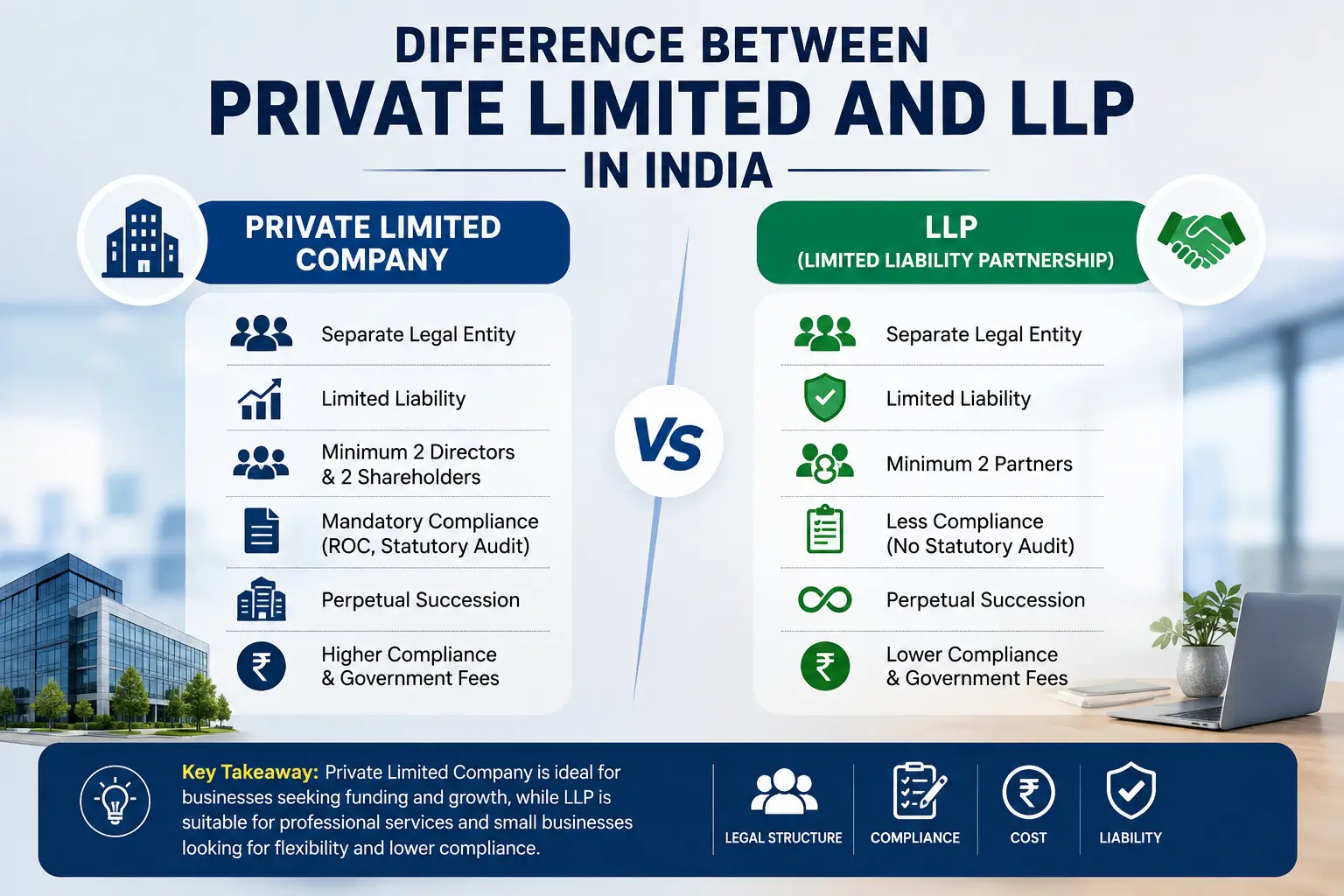
This guide covers what each structure means, a detailed side-by-side comparison, which businesses typically suit each option, and how to get registered with Setupfiling.in once you've decided.
A Private Limited Company is a business entity registered under the Companies Act, 2013, owned by shareholders and managed by directors. It is a separate legal entity from its owners, offers limited liability protection, and is the preferred structure for startups planning to raise equity funding from investors, since shares can be issued and transferred relatively easily.
An LLP is a hybrid business structure registered under the Limited Liability Partnership Act, 2008, combining the operational flexibility of a traditional partnership with the limited liability protection of a company. Partners in an LLP are not personally liable for the LLP's debts beyond their agreed contribution, and the LLP itself is a separate legal entity that can own assets and enter contracts in its own name.
| Parameter | Private Limited Company | LLP |
|---|---|---|
| Governing Law | Companies Act, 2013 | Limited Liability Partnership Act, 2008 |
| Ownership Structure | Owned by shareholders, managed by directors | Owned and managed directly by partners |
| Minimum Members | 2 shareholders and 2 directors (can be the same individuals) | 2 designated partners |
| Liability Protection | Limited to the value of shares held by each shareholder | Limited to the agreed contribution of each partner |
| Statutory Audit | Mandatory every year, regardless of turnover | Mandatory only if turnover or contribution exceeds prescribed limits |
| Compliance Burden | Higher, including board meetings, annual filings, and statutory registers | Lower, with fewer mandatory filings and simpler annual compliance |
| Ability to Raise Equity Funding | Well-suited for raising funds from investors, venture capital, and angel investors | Not well-suited for equity funding, since LLPs cannot issue shares |
| Employee Stock Options (ESOPs) | Can be issued to employees as an incentive structure | Not available under the LLP structure |
| Transfer of Ownership | Relatively easier through transfer of shares | Requires amendment to the LLP agreement and partner consent |
| Taxation | Taxed as a company, with potential dividend distribution considerations | Taxed as a partnership firm, with profit distribution to partners generally not taxed again |
| Foreign Direct Investment (FDI) | Permitted under the automatic route in most sectors | Permitted under the automatic route only in sectors where 100% FDI is allowed without conditions |
| Credibility with Banks & Clients | Generally perceived as more credible for large contracts, tenders, and institutional lending | Well accepted for professional services and small to mid-sized businesses |
A Private Limited Company is strongly preferred by venture capital and angel investors, since equity shares and ESOPs are only possible under this structure.
Consultants, agencies, and small professional practices often prefer an LLP for its lower compliance burden and straightforward partner-based management.
An LLP can suit family or close-partner businesses that want liability protection without the higher compliance cost of a company.
A Private Limited Company structure is generally easier to scale, bring in new investors, and eventually list or get acquired.
If you plan to raise venture capital or angel investment, or issue ESOPs to employees, a Private Limited Company is generally the necessary structure.
Consider whether your business can handle the higher annual compliance and audit requirements of a company, or whether the lighter LLP compliance load suits you better.
Both structures offer limited liability, but review how each treats personal asset protection for your specific business activity and risk profile.
Compare how company taxation versus partnership-style LLP taxation would apply to your expected profit levels and distribution plans.
Speak with a Chartered Accountant or Company Secretary to confirm the right structure for your specific business plan before filing incorporation documents.
Keep the following details ready before you place your order, whichever structure you choose.
Setupfiling.in is built by Chartered Accountants, Company Secretaries, and Trademark Attorneys who help founders choose the right structure based on their actual business plans, not a one-size-fits-all recommendation, and handle the complete registration process end to end.
Choosing your structure is just the first step. Explore other services our clients commonly need after registration:
A Private Limited Company is governed by the Companies Act and is owned by shareholders with shares that can be issued to investors, while an LLP is governed by the LLP Act and is owned and managed directly by partners without the concept of shares.
A Private Limited Company is better suited for raising equity funding, since investors typically require shares and ESOPs, both of which are not available under the LLP structure.
Yes, an LLP offers limited liability protection to its partners, limiting their personal liability to the extent of their agreed contribution, similar in principle to shareholder liability in a company.
No, Statutory Audit is only mandatory for an LLP if its turnover or partner contribution exceeds prescribed limits, whereas a Private Limited Company must undergo statutory audit every year regardless of turnover.
An LLP generally has lower ongoing compliance requirements compared to a Private Limited Company, which must hold board meetings, maintain statutory registers, and file more extensive annual returns.
Yes, an LLP can be converted into a Private Limited Company at a later stage if the business needs to raise equity funding or scale, subject to the conversion process and compliance requirements under applicable law.
A Private Limited Company is taxed as a company, while an LLP is taxed similarly to a partnership firm, with profit distribution to partners generally not attracting further tax at the partner level, unlike company dividends in certain cases.
Foreign Direct Investment is permitted under the automatic route in a Private Limited Company across most sectors, while FDI in an LLP is allowed under the automatic route only in sectors where 100% FDI is permitted without conditions.
A Private Limited Company allows relatively easier transfer of ownership through transfer of shares, while an LLP requires an amendment to the LLP agreement and consent of existing partners to change ownership.
There is no mandatory minimum capital requirement to register either a Private Limited Company or an LLP in India, though a nominal share capital or partner contribution is typically declared at the time of incorporation.
An LLP is often preferred by small consulting and professional services businesses due to its lower compliance burden and flexible partner-based management, unless the business specifically plans to raise external equity funding.
Message us on WhatsApp at +91 98182 09246 or email help@setupfiling.in with your business plan. Our team will help you choose between Private Limited and LLP and complete your registration within 24-48 hours.
Private Limited & LLP registration guided by Chartered Accountants & Company Secretaries — trusted by 50,000+ businesses across India.
Chat on WhatsApp: +91 98182 09246