How to Start a Business From Home in India (2026 Step-by-Step Guide)
Register your home-based business the right way — sole proprietorship, OPC, LLP or Private Limited — with GST, MSME (Udyam) and all mandatory licenses handled by SetupFiling.In in-house experts.
Home Business Registration Plans
All-inclusive pricing. Government fee + professional fee.
Sole Proprietorship + Udyam
Best for freelancers & small home sellers
Private Limited Company
Best for scaling & raising funds
One Person Company (OPC)
Full liability protection, solo owner
LLP Registration
Best for 2+ partners working from home
GST Registration (Add-on)
Required for online selling & invoicing
Quick answer: To start a business from home in India, pick a legal structure (sole proprietorship, OPC, LLP or Private Limited), register it with the MCA/Udyam portal, obtain a GST number if you sell online or cross ₹20–40 lakh turnover, open a current bank account, and apply for a Shop & Establishment or local trade license if your state requires one for home-based operations. Most home businesses complete this in 5–10 working days when handled by a registration expert.
On this page
Why Start a Business From Home in India
Home-based businesses have become one of the fastest-growing categories of Indian MSMEs. Low overheads, GST input benefits, access to government schemes like Startup India registration, and marketplaces such as Amazon, Flipkart, Meesho and Etsy have made it possible to run a fully compliant, revenue-generating company without renting office space.
But "working from home" and "running a registered business from home" are different things. A registered entity lets you open a current account, issue GST-compliant invoices, apply for MSME/Udyam benefits, bid for government tenders on GeM, and build a brand that buyers and banks trust.
Which Legal Structure Fits a Home Business
The right structure depends on your team size, funding plans and liability comfort. Here's how the common options compare for a home-run business:
| Structure | Best For | Liability | Compliance Load | Approx. Cost |
|---|---|---|---|---|
| Sole Proprietorship | Freelancers, single-owner home sellers | Unlimited | Low | ₹1,999 onwards |
| One Person Company (OPC) | Solo founders wanting limited liability | Limited | Moderate | ₹7,999 onwards |
| LLP | 2+ partners running the business together | Limited | Moderate | ₹6,999 onwards |
| Private Limited Company | Businesses planning to raise funds or scale fast | Limited | Higher | ₹7,999 onwards |
Do you need GST for a home business?
You must register for GST if your annual turnover crosses ₹40 lakh (₹20 lakh for services), if you sell through e-commerce marketplaces, or if you sell across state lines — regardless of turnover. Many home sellers register voluntarily early on because most marketplaces require a GSTIN before onboarding.
Do you need Udyam/MSME registration?
Yes — Udyam (MSME) registration is free on the government portal, takes minutes, and unlocks collateral-free loans, subsidies, delayed-payment protection under the MSME Act, and eligibility for government tenders. It is one of the easiest wins for any home business.
Not sure which structure to pick?
Message us your business idea — we'll recommend the right structure in minutes.
Step-by-Step Process to Start a Business From Home in India
Follow this sequence to go from idea to a fully compliant, invoice-ready home business.
Finalise your business idea and structure
Decide what you'll sell or offer, then choose a legal structure — sole proprietorship for a quick solo start, or Private Limited if you plan to raise investment later.
Reserve and check your business name
Search the MCA name portal (for companies/LLP) or simply confirm your trade name is unique locally. If branding matters long-term, plan for a trademark registration once the name is finalised.
Get a Digital Signature Certificate (DSC)
Required if you're registering an OPC, LLP or Private Limited Company. This lets you digitally sign incorporation forms filed with the MCA.
Register your entity with the MCA or Udyam portal
File incorporation documents for OPC/LLP/Pvt Ltd with the Ministry of Corporate Affairs, or complete free Udyam registration for a sole proprietorship using your Aadhaar and PAN.
Apply for GST registration (if applicable)
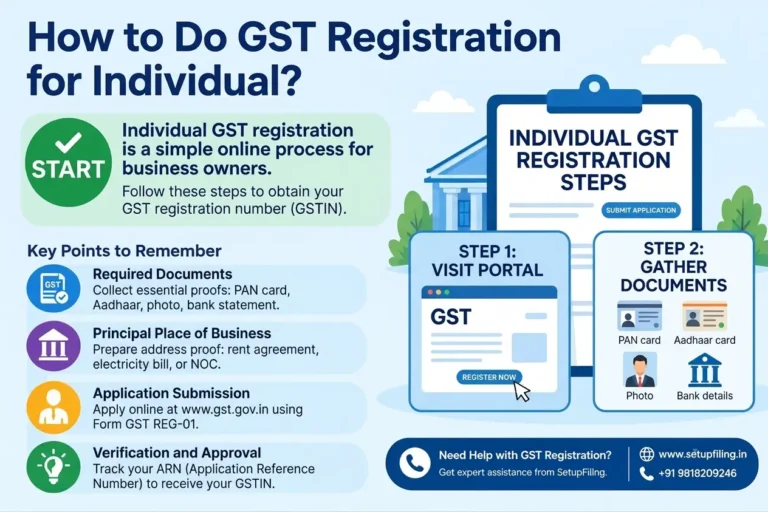
Complete GST registration if you cross the threshold, sell on marketplaces, or sell inter-state. Your home address can be used as the principal place of business with a rent/utility proof and NOC.
Open a current bank account
Use your incorporation certificate/Udyam certificate and GST Certificate to open a business current account, keeping personal and business finances separate.
Get local licenses if required
Depending on your state and activity, you may need a Shop & Establishment registration or a local Trade License — even for home-based operations in some municipalities.
Start invoicing and stay compliant
Issue GST-compliant invoices, file periodic GST and Income Tax Returns, and consider Startup India recognition for tax holidays and easier funding access as you grow.
Home business launch checklist
- Aadhaar, PAN and passport-size photo ready
- Business name and structure finalised
- Address proof of your home (electricity bill / rent agreement + NOC)
- Bank account details for the current account
- GSTIN applied for (if selling online or inter-state)
Documents Required to Register a Home-Based Business
| Document | Purpose |
|---|---|
| PAN Card | Identity proof for owner/directors/partners |
| Aadhaar Card | Identity & address verification, Udyam registration |
| Passport-size photograph | Incorporation and GST forms |
| Home address proof | Electricity bill, property tax receipt or rent agreement + owner's NOC |
| Bank account details | Current account opening and GST registration |
| Business activity description | Selecting the correct registration and GST/HSN codes |
Common Mistakes to Avoid
- Skipping registration entirely — operating without any registration blocks you from opening a current account, using payment gateways, or selling on most marketplaces.
- Choosing the wrong structure — a sole proprietorship without limited liability can be risky once order volumes and vendor liabilities grow.
- Ignoring GST thresholds — many home sellers unknowingly cross the ₹20–40 lakh limit and face late registration penalties.
- Not checking local municipal rules — some states require a Shop & Establishment or trade license even for home-run activity.
- Delaying trademark protection — a strong brand name left unregistered can be copied or blocked by a competitor filing first.
Why Register Your Home Business With SetupFiling.In
SetupFiling.In has helped over 50,000 Indian entrepreneurs register and grow their businesses — from first-time home sellers to funded startups. Our team handles the paperwork, government portals and follow-ups end-to-end, so you can focus on running your business.
- Dedicated compliance manager for your application
- Transparent, all-inclusive pricing — no hidden government fee surprises
- Support for GST, Udyam, trademark and ongoing annual compliance in one place
- Average registration turnaround of 5–10 working days
Ready to register your home business?
Talk to our experts on WhatsApp or place your order directly from the pricing table above.
Frequently Asked Questions
Can I legally run a business from my home address in India?
Which registration is best for a small home-based business?
Do I need GST registration to sell products from home?
How long does it take to register a home business in India?
How much does it cost to start a business from home in India?
Can I get a current bank account for a home-registered business?
What is Udyam registration and is it mandatory?
Should I trademark my home business brand name?
Start Your Home Business the Right Way, Today
Join 50,000+ entrepreneurs who registered their business with SetupFiling.In.