💳 Pay Now |
✍️ Learning Center

You do not have to register for GST until you cross the threshold, but many businesses choose to anyway. Here is who can register voluntarily, what you gain, what you take on, and the one-year catch most people miss.
Transparent, one-time pricing — no hidden charges. Pick the plan that fits how much of the journey you want handled for you.
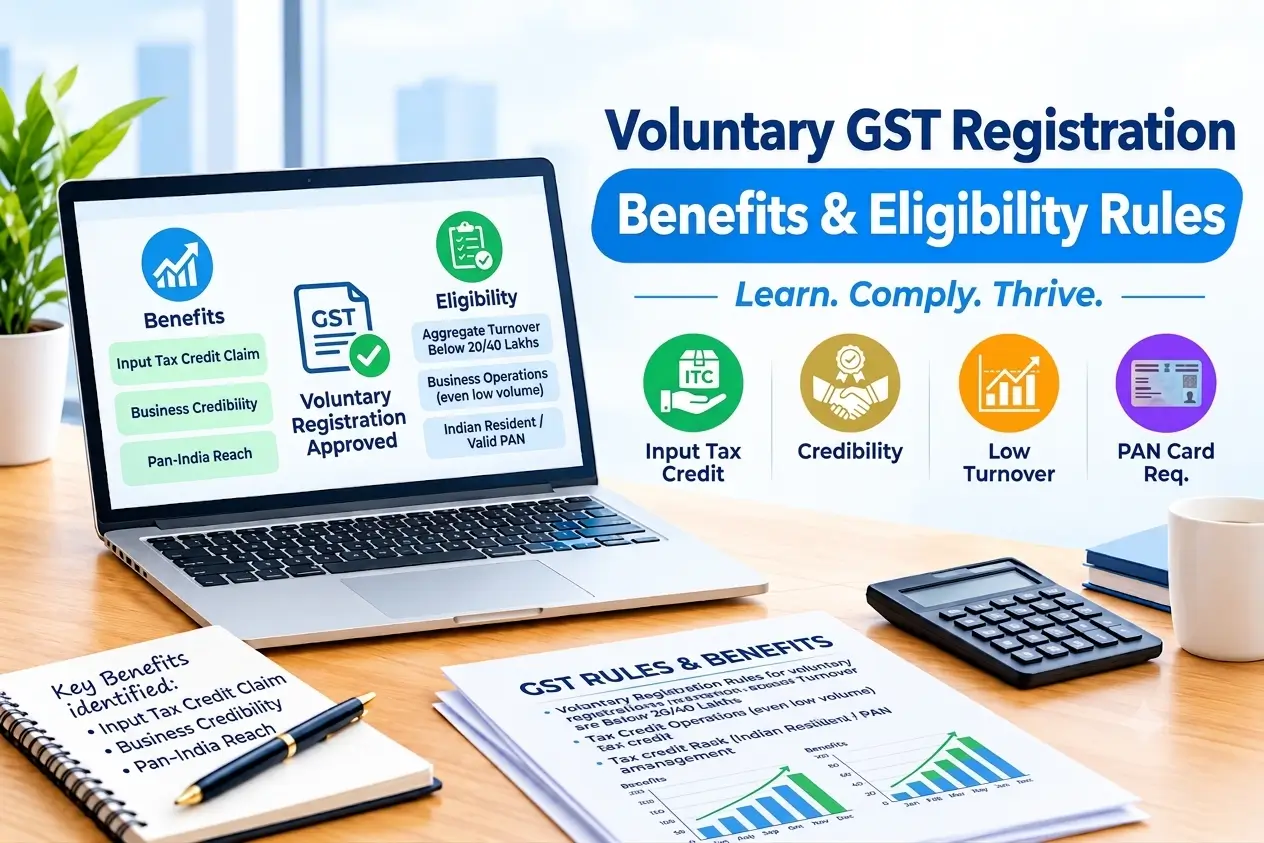
Quick Answer: Voluntary GST registration lets a business that is not legally required to register, for example because it is below the turnover threshold, take a GSTIN anyway. You gain the right to charge GST, claim input tax credit and sell to business customers, but you take on regular return filing and generally cannot cancel for about a year. It makes sense when your customers or purchases make GST credit valuable.
The GST law lets a person who is not liable to register choose to register anyway. The provision is in Section 25(3) of the CGST Act. Once you are registered, though, the law treats you just like any other registered person. That means tax invoices, GST charged on supplies, returns on schedule and all the usual penalties for default. The only thing "voluntary" about it is the decision to start.
This is different from GST registration services across India that are mandatory because you crossed the limit. Mandatory registration is about obligation. Voluntary registration is about advantage, and whether that advantage outweighs the work.
| Basis | Mandatory registration | Voluntary registration |
|---|---|---|
| Why you register | The law requires it, because of turnover or a trigger | You choose it, even though you are not liable |
| Tax from which date | From the date you became liable | From the date of registration |
| Compliance | Full GST compliance | Full GST compliance, identical |
| Cancellation | Possible when conditions are met | Generally not allowed for about a year |
| Penalty for not registering | Yes, if you delay | None, because you were not required to |
| Typical reason | Turnover above the limit or inter-state goods | Input credit, business customers, credibility |
*Rules can be amended. Confirm the current conditions before applying.
There is no turnover floor for voluntary registration. What matters is that you can meet the compliance obligations once registered.
GST you pay on business purchases can be set off against GST you collect, which can lower your real tax cost.
Eligible stock held on the day before registration may qualify for credit, subject to conditions such as the age of the invoice.
Registered buyers need your GSTIN on an invoice to claim credit, so many prefer or demand a registered supplier.
Online platforms and larger buyers often ask for a GSTIN at onboarding.
A GSTIN signals a formal business to banks, lenders and clients, which helps with loans and contracts.
You can sell across states and scale up without scrambling to register at the last minute.
| If this describes you | Voluntary registration is usually |
|---|---|
| You sell mostly to registered businesses | Worth considering |
| You pay significant GST on purchases or stock | Worth considering |
| You plan to sell on marketplaces or tender for contracts | Worth considering |
| You sell only to consumers and have little input GST | Often not worth it yet |
| You want the option to stop easily | Think twice, because of the minimum period |
| You are close to the threshold and growing | Often sensible to register early |
Compare your turnover and any triggers against the threshold. If you are liable, registration is mandatory, not voluntary.
Think about customers who need credit, input GST you pay and the cost of regular filing.
Choose Silver, Gold or Premium above and pay securely through Razorpay.
Send PAN, Aadhaar, photo, address proof and bank details on WhatsApp.
Our CA team files the application, completes Aadhaar authentication with you and tracks the ARN.
Once the GSTIN is issued, charge GST on tax invoices and file returns on time.
The decision to register early is a business decision first and a paperwork task second. Our team of Chartered Accountants and Company Secretaries helps you weigh the benefits, files your application and sets up return filing. If you later want to simplify, we also cover the GST Composition Scheme and the GST cancellation process once you are eligible.
Businesses registering voluntarily often need these as well:
What is voluntary GST registration?
It is registration taken by a business that is not legally required to register, for example because its turnover is below the threshold. Once registered, it must follow all GST rules like any other registered taxpayer.
Who is eligible for voluntary GST registration?
Generally any person who is not liable to register can apply, including small traders, freelancers, startups and service providers below the threshold. Check your category, as some special cases have their own rules.
What are the benefits of voluntary GST registration?
You can issue tax invoices, charge GST, claim Input Tax Credit, sell to business customers who need credit, onboard on marketplaces and build credibility with banks and buyers.
Are there any disadvantages of registering voluntarily?
Yes. You must file returns on schedule, even for months with no sales, charge GST on supplies, and generally stay registered for a minimum period before you can apply to cancel.
Can I cancel a voluntary registration anytime?
Not immediately. A voluntary registrant generally cannot apply for cancellation until about a year after the effective date of registration. Confirm the current rule before you decide.
Can I claim input tax credit on stock I already hold?
In many cases credit can be claimed on eligible stock held on the day before registration, subject to conditions such as the age of the invoice. Confirm eligibility and time limits.
Does voluntary registration mean I must file returns monthly?
Registered taxpayers file GSTR-1 and GSTR-3B monthly, or quarterly under the QRMP scheme if eligible. A NIL return is still needed in months without sales.
Can a voluntarily registered business use the composition scheme?
Possibly, if it meets the composition scheme conditions on turnover and type of supply. Composition has its own limits, such as no input tax credit, so compare before choosing.
Is voluntary registration good for a freelancer?
It can be, especially if you serve business clients or foreign customers. If you sell only to consumers or have little input GST, waiting until you cross the threshold may be simpler.
How much does GST Registration Cost with SetupFiling.in?
The Silver plan is ₹999, the Gold plan ₹1,999 and the Premium plan ₹3,699. Gold and Premium also include 6 and 12 months of GST return filing.
Join 50,000+ customers who trust SetupFiling.in for CA-assisted GST registration.