💳 Pay Now |
✍️ Learning Center

Expanding into more than one state used to mean filling in the same business details again and again. The GST portal's new Multistate Registration facility lets you enter them once. Here is exactly how it works, what it does not change, and how to avoid the mistakes.
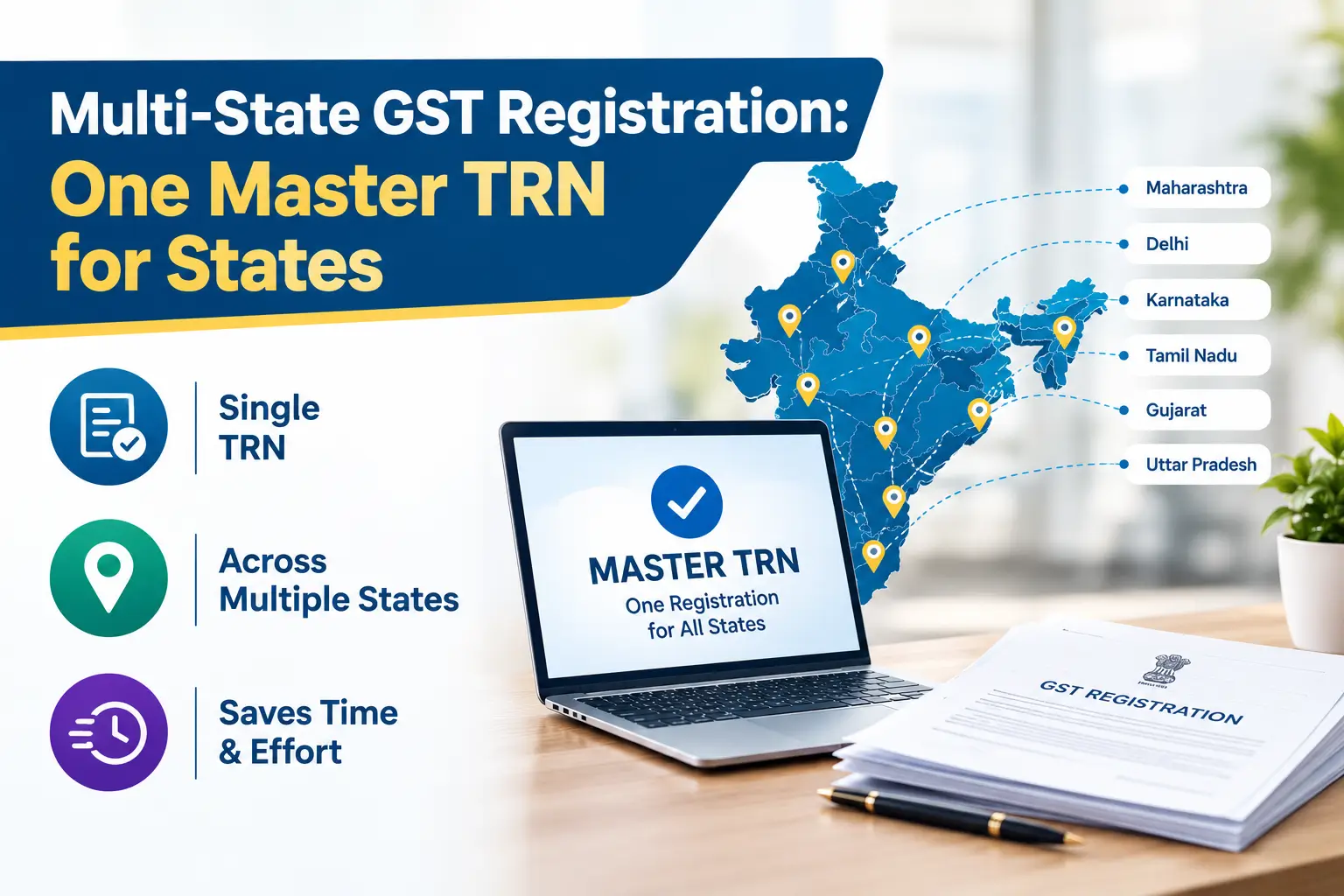
Quick Answer: The GST portal's Multistate Registration facility lets a normal taxpayer applying in two or more States or UTs under the same PAN generate one Master TRN, submit the common business details once within 15 days, and then complete a separate application for each state. Every state still gets its own ARN and its own GSTIN. It saves data entry, not compliance: there is no single all-India GSTIN and no shared input credit pool.
Until recently, a business that needed registration in Maharashtra, Karnataka and Delhi filed three completely separate applications. Each one started with its own TRN and asked for the same partner details, the same signatory, the same list of goods and services. A single typing error could end up in three places, and updating them meant three edits.
The new facility, available on the GST Common Portal under Multistate Registration, changes the front end of that process. You select your states, verify your PAN-linked credentials and get one Master TRN. You fill the common details once, and the portal creates a state-level TRN for each State or UT, pre-filled with what you entered. From there each application is completed and approved separately. If you are new to the basics, our GST registration services across India page explains the single-state process.
| Basis | Earlier process | With the Master TRN facility |
|---|---|---|
| Applications | Separate application started from scratch in every state | One Master TRN starts all state applications together |
| Common details | Typed again for each state | Entered once and auto-filled in every state TRN |
| State details | Entered in each application | Still entered state by state |
| ARN and GSTIN | One ARN and one GSTIN per state | Unchanged: one ARN and one GSTIN per state |
| Verification | Each state verifies its own application | Unchanged: each state verifies its own application |
Based on the facility as described in GSTN's advisory and commentary on it. Procedures can be refined, so confirm the current screens on the GST portal.
| Entered once (common registration information) | Entered in every state (state-specific) |
|---|---|
| Business details | Principal place of business, with ownership or rent proof |
| Promoter or partner details | Additional places of business such as warehouses and branches |
| Authorised signatory | State-specific registrations, such as professional tax |
| Authorised representative, such as a CA or GST practitioner | Aadhaar authentication |
| Goods and services (HSN and SAC codes) | Final submission by DSC or EVC, which generates the state ARN |
Common details are carried into each state application and remain editable there, so a signatory or HSN list can still differ by state where needed.
The left column shows who the facility is meant for; the right column shows categories the portal does not currently cover. If you are in an excluded category, you apply state by state as before. And note that one Master TRN gives one registration per state; a second registration in the same state is a separate matter.
A Master TRN is a reference number for the application process. It cannot be used on invoices or to file returns.
Each state has its own registration. Returns, tax payments, e-invoicing and e-way bills are managed per GSTIN.
Credit sits with the state GSTIN where it arose. Moving it between states needs a proper mechanism, such as input service distribution where applicable.
Registration is still governed by the CGST Act. Selling to customers in a state does not automatically mean you need a registration there.
Each state officer processes its own ARN. A query in one state is not expected to hold up the others.
Rent agreements, ownership proof and utility bills are still needed for every state you register in.
List every state where you have an office, warehouse, factory or other registration trigger. Registering in a state you do not need creates return filing work for nothing.
Choose the Multistate Registration option, select the States or UTs and verify PAN-linked business credentials to generate the Master TRN.
Enter business, promoter, signatory, representative and goods and services details once. The portal then creates a TRN for each state.
Add the principal and additional places of business, upload premises documents, complete Aadhaar authentication and submit with DSC or EVC to receive a state-wise ARN.
Each state processes its own ARN. Respond to any query quickly and download each GSTIN once granted.
Furnish bank details on time, plan inter-state invoicing, and file returns separately for each GSTIN.
The easiest way to waste money is to register everywhere "just in case". Each GSTIN carries its own monthly or quarterly returns, even in a quiet month. Whether you need a state registration depends on facts such as where you have a place of business, where goods are stored, and what you supply. Typical triggers include:
Not sure? Our CAs will map your business to the states you need before any application is filed.
The 15-day window for submitting the common details starts when the Master TRN is generated. That makes preparation the real work. Gather these first:
Bank account details for each New GSTIN are expected within a prescribed period after registration or before filing certain returns. Missing it can lead to suspension. Confirm the current deadline.
Registrations in different states are distinct persons under the CGST Act. Stock transfers and shared services between them can attract GST.
Each GSTIN files its own GSTR-1 and GSTR-3B. A missed return in one state does not get covered by another.
Input credit stays with the GSTIN where it was earned. Shared costs such as head-office services may need an ISD or similar approach.
Thresholds and obligations are applied per registration, so each state can have its own set of requirements.
New warehouses or changed signatories need an amendment. See our page on updating your GST registration details.
The portal change makes data entry lighter, but the decisions around it are the hard part: which states, which documents, how to structure invoicing between states. Our team of Chartered Accountants and Company Secretaries plans the state list, prepares the common details, completes every state application and chases each ARN. If you later wind a state down, we also handle the GST cancellation process for that registration.
Businesses expanding across states often need a few more services along the way:
What is a Master TRN in GST?
A Master TRN is a temporary reference number generated on the GST portal when a taxpayer starts a Multistate Registration. It lets the common details be entered once for several States or UTs, and then creates a separate TRN for each selected State or UT.
Does one Master TRN give me one GSTIN for all states?
No. There is no single all-India GSTIN. Each State or UT gets its own application, its own ARN and its own GSTIN. The Master TRN only centralises data entry.
Who can use the Multistate Registration facility?
It is meant for normal taxpayers who need registration in two or more States or UTs under the same PAN. Composition taxpayers, input service distributors, TDS and TCS registrations and non-resident taxable persons are not currently covered.
How long do I have to submit the common registration details?
The common registration information must be submitted within 15 days of generating the Master TRN. Keep premises documents for each state ready before you start.
What details are common and what is state-specific?
Business details, promoter or partner details, the authorised signatory, the authorised representative and goods and services are entered once. The principal place of business, additional places, state-specific details, Aadhaar authentication and final submission are done state by state.
Can I register twice in the same state through the Master TRN?
No. One Master TRN supports one registration per State or UT. Additional registrations in the same state are a separate process.
If one state raises a query, are my other registrations delayed?
Each state application goes to that state's officer and is processed independently, so a query in one state should not hold up the others. Timelines still depend on each state's processing.
Do I need a GST registration in every state where I have customers?
Not simply because you sell there. Registration is generally tied to supplies, places of business and the rules under the CGST Act. Check your specific facts, as the answer differs for goods, services, e-commerce and warehouses.
Are stock transfers between my state registrations taxable?
Separate state registrations are treated as distinct persons under the CGST Act, so supplies between them can attract GST. Plan invoicing and credit flow before moving stock.
Can SetupFiling.in handle multi-state registration for me?
Yes. Our CA team plans which states you need, prepares the common details, completes each state application and tracks every ARN until the GSTINs are issued. Message us on WhatsApp at +91 98182 09246 to get started.
Join 50,000+ customers who trust SetupFiling.in for CA-assisted GST registration and compliance.