💳 Pay Now |
✍️ Learning Center

Learn the exact steps to legally start a dropshipping business in India, including business registration, GST, trademark protection, and supplier tie-ups. Guided by Chartered Accountants, Company Secretaries, and Trademark Attorneys with 15+ years of expertise.
Dropshipping Setup Assistance
Everything you need to legally launch
Get your dropshipping business registered within 24-48 hours
Email: help@setupfiling.inDropshipping has become one of the most popular ways for Indian entrepreneurs to start an online business without holding inventory, managing a warehouse, or investing heavily upfront. You list products on your own website or a marketplace, and when a customer places an order, your supplier ships the product directly to them while you keep the margin. It sounds simple, but most people searching for how to start a dropshipping business in India skip the legal and compliance groundwork that determines whether the business survives past its first few months.
Setupfiling.in is an online professional business services platform founded by experienced Chartered Accountants, Company Secretaries, and Trademark Attorneys with 15+ years of combined expertise. We have helped 50,000+ entrepreneurs and businesses across India register their companies, obtain GST numbers, and protect their brand names, including a growing number of dropshipping and e-commerce sellers.
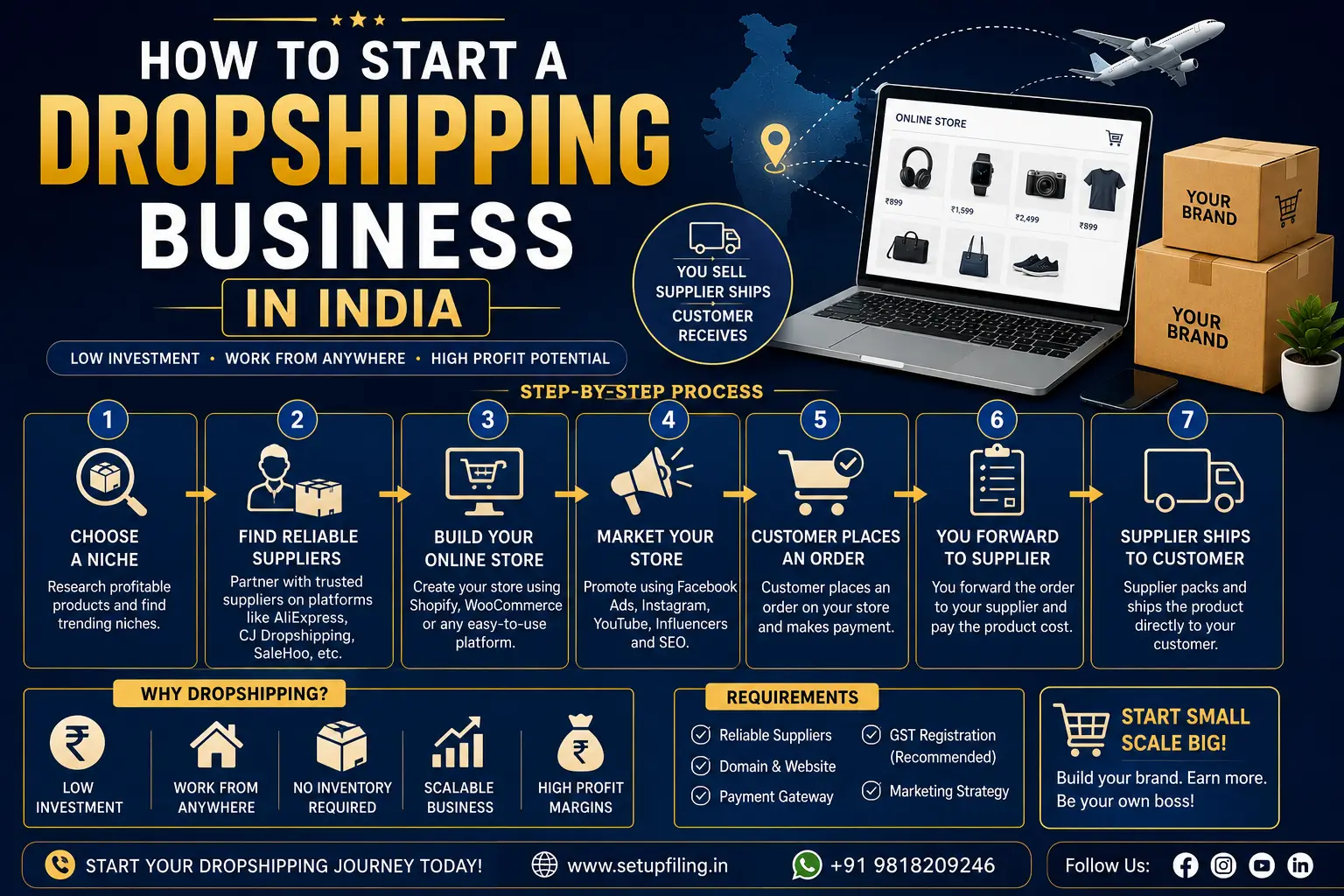
This guide covers what dropshipping actually involves, whether it is legal in India, the exact step-by-step process to launch one correctly, the registrations you will need, and how to get expert help from Setupfiling.in to set everything up properly from day one.
Dropshipping is a retail fulfilment model where the seller does not keep the products they sell in stock. Instead, when a sale is made, the seller purchases the item from a third-party supplier or manufacturer, who then ships it directly to the customer. The seller never physically handles the inventory, and profit comes from the difference between the supplier's price and the retail price charged to the customer.
Dropshipping itself is completely legal in India. There is no law that prohibits the business model. However, like any business, it becomes non-compliant if you operate without the required registrations, fail to charge or remit GST correctly, import products without following customs rules, or sell using a brand name that infringes on someone else's registered trademark.
There is no dropshipping-specific license in India. The registrations required are the same ones any online retail business needs to operate legally.
Most dropshippers selling online, especially through marketplaces or their own website with pan-India shipping, are required to Register for GST regardless of turnover.
If you source products from suppliers outside India, customs duty, iec code, and import compliance rules apply to your business.
Pick a product category with steady demand and manageable competition. Validate the idea using marketplace trends, social media interest, and competitor pricing before committing.
Decide whether to operate as a sole proprietorship, partnership, LLP, or private limited company. Most dropshippers start as a sole proprietorship or private limited company depending on funding and liability preferences.
Register for GST so you can legally invoice customers, claim Input Tax Credit on supplier purchases, and sell through e-commerce marketplaces that require a GSTIN before onboarding sellers.
Register your store or brand name as a trademark early, before you invest in marketing and build customer recognition around it, to prevent competitors from copying your identity later.
Shortlist domestic or international suppliers based on product quality, shipping timelines, return policy, and pricing. Order samples before listing any product for sale.
Build a website using an e-commerce platform, or set up seller accounts on marketplaces, ensuring your business name, GSTIN, and contact details are correctly listed.
Integrate a payment gateway to accept online payments. Most payment gateway providers require a registered business entity, GST number, and bank account in the business name.
Clarify shipping timelines, tracking, and return or refund handling with your supplier upfront, since delivery experience directly affects customer trust in a dropshipping model.
Start driving traffic through social media, paid ads, or SEO content, and track which products and channels convert best before scaling your ad spend.
Many first-time dropshippers try to run their store informally, using a personal bank account and no formal registration, assuming they can formalise things "once the business grows." This approach creates real problems: marketplaces and payment gateways increasingly demand GST and business registration details before approving a seller account, banks flag unregistered businesses during payment settlement checks, and any brand name success can be legally challenged or copied if it was never trademarked.
Waiting until a marketplace rejects the seller application, instead of registering for GST before launch, causes weeks of lost selling time.
Building a recognisable brand name without registering it, only to find a competitor has copied the name once it starts performing well.
Operating without any formal entity, which limits access to business bank accounts, payment gateways, and credibility with suppliers.
Keep the following details ready before you place your order. This helps us register your business entity, GST, and brand trademark without delay.
Message us on WhatsApp or email us to discuss whether you need a sole proprietorship, LLP, or private limited company, along with GST and trademark requirements.
Email your details to help@setupfiling.in or send them on WhatsApp at +91 98182 09246.
Our team prepares and files your business registration, gst application, and trademark filing, delivering your documents within 24-48 hours.
Setupfiling.in is built by Chartered Accountants, Company Secretaries, and Trademark Attorneys who understand the specific registration needs of online sellers, from marketplace GST requirements to protecting a brand name before it gets copied.
Starting a dropshipping business involves several registrations working together. Explore the services our clients commonly need:
Yes, dropshipping is completely legal in India. There is no specific law against the business model, but you must comply with GST, business registration, and import rules like any other retail business.
In most cases, yes. Online sellers, including dropshippers, are generally required to register for GST regardless of turnover, especially if selling through marketplaces or shipping across multiple states.
Many dropshippers start as a sole proprietorship for simplicity and lower cost, then move to a private limited company or LLP once the business scales and needs formal funding, limited liability, or investor participation.
Trademark registration is not legally mandatory to start selling, but it is strongly recommended. Without it, a competitor can legally use or copy your brand name once it becomes recognisable.
Yes, but importing products from international suppliers means customs duty, import compliance, and potentially an Import Export Code (IEC) apply, along with longer shipping times that can affect customer experience.
Dropshipping requires lower upfront capital than traditional retail since there is no inventory investment, but you should budget for business registration, GST compliance, website or marketplace fees, and marketing.
You can technically start selling informally, but most marketplaces and payment gateways now require GST and business registration details before approving a seller account, so registration is practically unavoidable for scaling.
The applicable class depends on the products sold under your brand name. Retail and online sales services generally fall under Class 35, while the products themselves may fall under other classes depending on their category.
Yes, it is strongly recommended. A current account in your registered business name makes it easier to integrate payment gateways, manage GST compliance, and keep personal and business finances separate.
Business entity registration, GST registration, and trademark filing can typically be completed within 24-48 hours of submitting your documents to Setupfiling.in, though GST approval timelines depend on the department's processing.
Message us on WhatsApp at +91 98182 09246 or email help@setupfiling.in with your requirement. Our team will guide you on the right business structure, GST, and trademark filing, and complete your registrations within 24-48 hours.
Business registration, GST & trademark filing guided by Chartered Accountants, Company Secretaries & Trademark Attorneys — trusted by 50,000+ businesses across India.
Chat on WhatsApp: +91 98182 09246