💳 Pay Now |
✍️ Learning Center

Two numbers, one question: do you have to register? The answer depends on whether you sell goods or services, which state you operate from and where your customers are. Here is the clear version, plus how to register the moment you need to.
Transparent, one-time pricing. Choose registration only, or add months of return filing so you stay compliant from the day you register.
| RECOMMENDED | |||
|---|---|---|---|
| Compare plansOne-time fee, no hidden charges | SilverRegistration only₹999one-time | GoldRegistration + 6 months returns₹3999₹1999one-time | PremiumRegistration + 12 months returns₹7398₹3,699one-time |
| GST registration certificate | |||
| GST portal user ID and password | |||
| ARN tracking until approval | |||
| CA review of documents | |||
| GST return filing | 6 months | 12 months | |
| Application turnaround | 48–72 hours | 24 hours | 24 hours |
| WhatsApp support | |||
| Place Your Order | Place Your Order | Place Your Order |
Swipe sideways to compare all three plans.
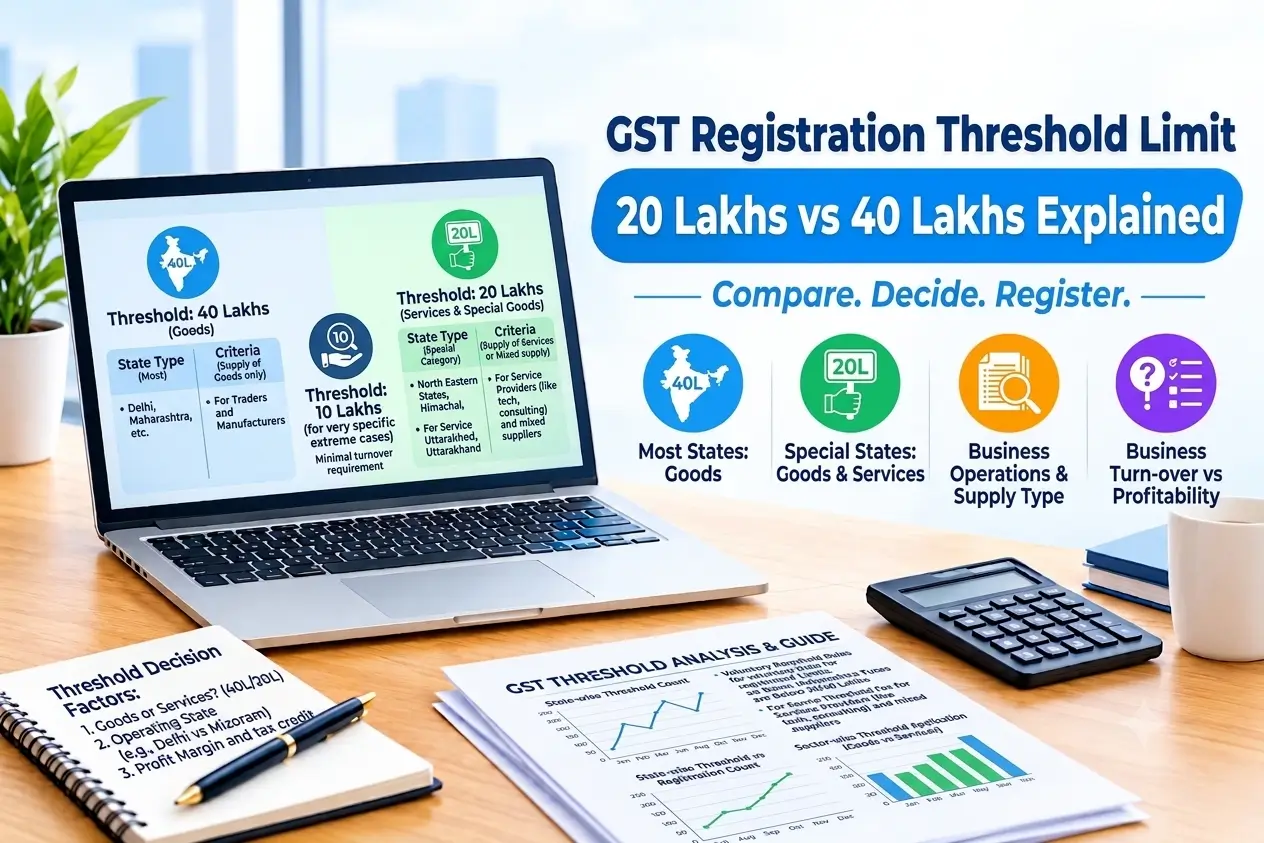
Quick Answer: The GST registration threshold is ₹40 lakh of annual aggregate turnover for businesses supplying only goods, and ₹20 lakh for service providers and generally for those supplying both goods and services. Some states have lower limits, and inter-state supply of goods, e-commerce selling and a few other situations require registration whatever your turnover. Below the limit you can still register voluntarily.
People often ask whether the limit is 20 lakh or 40 lakh, as if only one could be right. Both are correct; they apply to different kinds of business. What decides it is what you supply and where you operate. If you are building the picture from scratch, our GST registration services across India page covers registration itself; this page is about when you need it.
| Type of supplier | Usual threshold | Notes |
|---|---|---|
| Only goods (trader, manufacturer, retailer) | ₹40 lakh | Lower in certain states notified by the government |
| Only services (consultant, agency, freelancer) | ₹20 lakh | Lower for special category states |
| Goods and services both | Generally ₹20 lakh | Confirm with a CA, as the treatment depends on the mix |
| Special category states | Lower limits for goods and services | Check the notification for your state |
| Inter-state supply of goods | No threshold | Registration generally needed from the first sale |
| E-commerce sellers | Generally no threshold | Registration usually required, with narrow exceptions |
*Limits are set by the GST Council and state notifications and can change. Confirm the current position for your state and activity.
The test is applied for the whole PAN across India, not state by state, and over the financial year. Two small businesses under one PAN are added together.
| Business | Annual turnover | Likely position |
|---|---|---|
| Kirana trader selling only goods within one state | ₹35 lakh | Below the usual goods limit; registration not mandatory |
| Same trader after growth | ₹45 lakh | Above the goods limit; registration required |
| Freelance designer with only services | ₹25 lakh | Above the services limit; registration required |
| Online seller on a marketplace | ₹8 lakh | Registration generally required through the platform |
| Garment trader selling to another state | ₹10 lakh | Inter-state goods supply; registration generally needed |
| Consultant serving foreign clients | ₹22 lakh | Exports count toward turnover; registration required once over the limit |
Illustrative examples only. Your specific facts and state rules decide the actual position.
Selling goods across state lines generally requires registration from the first sale, whatever your turnover.
Most sellers on e-commerce platforms need registration regardless of turnover.
Where you must pay tax under reverse charge, registration can be required.
These categories need registration before they start supplying.
Specific roles carry their own registration requirements.
You may register below the limit to issue tax invoices, claim input credit and win business customers.
Include taxable, exempt, export and inter-state supplies across every business under your PAN for the financial year.
Use ₹40 lakh for goods-only suppliers and ₹20 lakh for services or mixed supply, then check your state for a lower limit.
Inter-state goods, e-commerce selling and reverse-charge liability can require registration whatever your turnover.
If you cross the limit or a trigger applies, register. Below it, choose voluntary registration if customers or credit make it worthwhile.
Order a plan above and we file your application promptly so liability does not run on.
Review turnover regularly so you never cross the limit unnoticed.
| Reason to register early | Reason to wait |
|---|---|
| Business customers want invoices they can claim credit on | You sell only to consumers who do not need GST invoices |
| You pay GST on purchases and want input credit | Your input GST is small |
| You plan to sell on marketplaces or across states | You operate locally with low turnover |
| A GSTIN adds credibility with banks and buyers | You prefer to avoid regular return filing |
Crossing the threshold quietly is one of the most common reasons for GST notices. Our team of Chartered Accountants and Company Secretaries reviews your turnover, tells you whether you must register and files your application promptly. Later we also help with updating your GST registration details and, for small taxpayers, the GST Composition Scheme.
Businesses near the threshold often need these as well:
What is the GST registration threshold limit?
It is the annual aggregate turnover above which a business must Register for GST. The common limits are ₹40 lakh for businesses supplying only goods and ₹20 lakh for service providers and mixed suppliers, with lower limits in some states.
Why are there two limits, 20 lakh and 40 lakh?
The ₹40 lakh limit applies to suppliers dealing only in goods, while the ₹20 lakh limit applies to service providers and generally to businesses supplying both goods and services. Special category states have lower limits.
Does the threshold apply if I sell goods to another state?
No. Inter-state supply of goods generally requires registration regardless of turnover. Inter-state supply of services can use the threshold exemption in many cases, subject to exceptions.
What counts as aggregate turnover for the threshold?
Aggregate turnover includes taxable supplies, exempt supplies, exports and inter-state supplies across all your registrations under one PAN. It excludes GST itself and inward supplies on which you pay tax under reverse charge.
Is the threshold counted per state or for the whole PAN?
For the whole PAN across India, not state by state. If you run two businesses under one PAN, their turnover is added together.
When must I register after crossing the limit?
You become liable once turnover crosses the threshold, and should apply for registration within the time the law allows, commonly 30 days. Tax is payable from the date you became liable, so do not delay.
Do e-commerce sellers need to register below the limit?
Generally yes. Selling through an e-commerce operator usually requires registration regardless of turnover, with some narrow exceptions. Check your own situation.
Can I register voluntarily below the threshold?
Yes. Voluntary registration lets you issue tax invoices, claim input credit and serve business customers, but it brings return filing obligations from the date of registration.
What if I supply both goods and services?
Mixed suppliers generally follow the lower ₹20 lakh limit. The exact treatment depends on the nature of your supplies, so confirm it with a CA.
How much does GST Registration Cost with SetupFiling.in?
The Silver plan is ₹999, the Gold plan ₹1,999 and the Premium plan ₹3,699. Gold and Premium also include 6 and 12 months of GST return filing.
Join 50,000+ customers who trust SetupFiling.in for CA-assisted GST registration.