
First Steps after obtaining GST Registration
Wondering What to do after GST Registration? Follow the First Steps after obtaining GST Registration to stay compliant, set up invoicing, file returns correctly, and avoid penalties. Take the right steps today and grow your business smoothly and confidently.
Get Free Expert Consultation
42806 +
Happy Clients
3500+
Expert Advisors
4.8+
Customer Rating
What to do after GST Registration: First Steps after obtaining GST Registration
Getting your GST registration is an important milestone for any business. But many business owners feel confused about what to do after GST Registration. Completing the registration is just the beginning. To run your business smoothly and avoid penalties, you must follow the correct steps immediately.
In this article, we will explain in simple language the First Steps after obtaining GST Registration so you can stay compliant and confident.
Why it is important to know What to do after GST Registration
Many new business owners think that once GST registration is done, their job is complete. This is not true. If you do not follow the rules after registration, you may face fines, penalties, or even cancellation of your GST number.
Understanding What to do after GST Registration helps you:
- Avoid legal issues
- Maintain proper records
- Build trust with customers
- Grow your business without stress
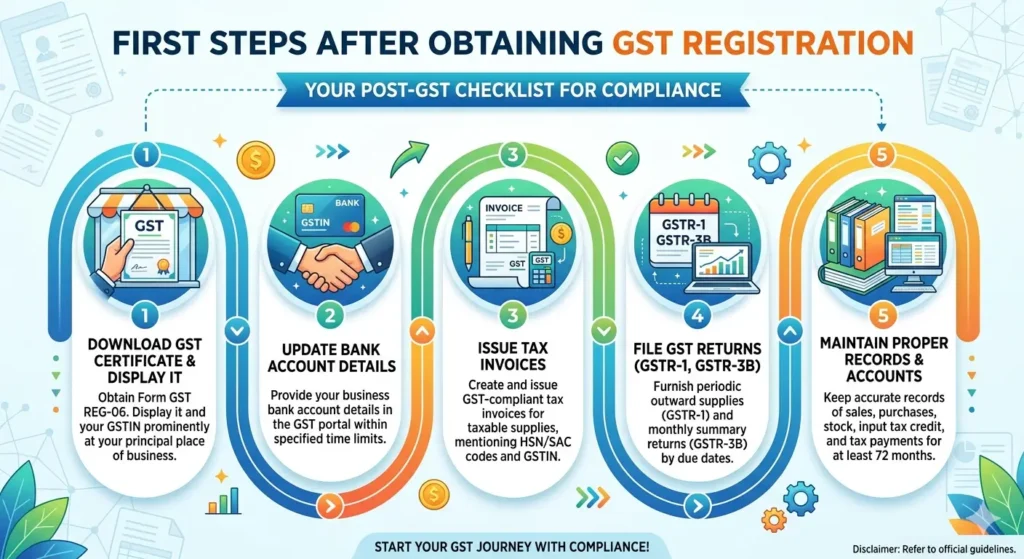
First Steps after obtaining GST Registration
1. Display your GSTIN properly
After registration, you receive a GST Identification Number (GSTIN). This number must be displayed:
- At your place of business
- On your website (if you have one)
- On invoices and bills
This is one of the most basic yet important First Steps after obtaining GST Registration.
2. Understand GST rates for your products or services
You must know the correct GST rate applicable to your goods or services. GST rates can be 0%, 5%, 12%, 18%, or 28%.
Charging the wrong GST rate can lead to penalties. So, one of the key actions in What to do after GST Registration is to classify your products correctly.
3. Start issuing GST-compliant invoices
Once registered, you must issue proper GST invoices for every sale. A GST invoice should include:
- Business name and GSTIN
- Invoice number and date
- Customer details
- Description of goods/services
- Tax amount (CGST, SGST, or IGST)
This step is essential in the First Steps after obtaining GST Registration because incorrect invoicing can create problems during filing.
4. Open a separate business bank account
Although not mandatory for all, it is highly recommended to open a separate bank account for your business transactions.
This helps you:
- Track income and expenses
- Maintain clear records
- Simplify GST filing
It is a smart move when planning What to do after GST Registration.
5. Maintain proper records
You must keep records of:
- Sales
- Purchases
- Input tax credit
- Stock
Good record-keeping is one of the most important First Steps after obtaining GST Registration. It helps during audits and return filing.
6. Learn about Input Tax Credit (ITC)
Input Tax Credit allows you to reduce the tax you pay by claiming credit for GST paid on purchases.
For example:
If you paid GST on raw materials, you can reduce that amount from your total tax liability.
Understanding ITC is a key part of What to do after GST Registration because it saves money.
7. File GST returns on time
Filing GST returns is mandatory even if you have no sales.
Common returns include:
- GSTR-1 (sales details)
- GSTR-3B (summary return)
Late filing leads to penalties and interest. So, one of the most critical First Steps after obtaining GST Registration is to follow a proper filing schedule.
READ ABOUT OUR GST RETURN FILING PACKAGES>>
8. Use accounting software
Managing GST manually can be difficult. Using accounting software helps you:
- Generate invoices
- Track GST automatically
- File returns easily
This simplifies What to do after GST Registration, especially for small businesses.
9. Check compliance regularly
GST rules may change from time to time. Stay updated with:
- New notifications
- Changes in tax rates
- Filing rules
Regular checks are an important part of the First Steps after obtaining GST Registration to avoid mistakes.
10. Train your staff
If you have employees handling billing or accounts, make sure they understand GST basics.
Proper training ensures:
- Correct invoicing
- Accurate data entry
- Smooth compliance
This is often overlooked when thinking about What to do after GST Registration.
11. Reconcile your data
You should match your purchase data with supplier filings. This ensures that your Input Tax Credit is correct.
Reconciliation helps:
- Avoid mismatches
- Prevent notices from authorities
It is a crucial step in the First Steps after obtaining GST Registration.
12. Understand e-invoicing (if applicable)
If your business crosses a certain turnover limit, you must generate e-invoices.
E-invoicing ensures:
- Real-time reporting
- Better transparency
Knowing whether it applies to you is part of What to do after GST Registration.
13. Know about GST payments
You must pay GST collected from customers to the government within the due date.
Always:
- Keep funds ready
- Avoid using GST money for other expenses
This is a responsible step in the First Steps after obtaining GST Registration.
14. Avoid common mistakes
Many businesses make errors after registration, such as:
- Missing return deadlines
- Incorrect GST rates
- Not issuing invoices
Avoiding these mistakes is key when learning What to do after GST Registration.
15. Seek professional help if needed
If GST seems complicated, you can consult:
- Chartered accountants
- Tax consultants
Professional guidance ensures you follow all the First Steps after obtaining GST Registration correctly.
Benefits of following the right steps
When you clearly understand What to do after GST Registration, you gain several benefits:
- Smooth business operations
- Better financial management
- No penalties or legal issues
- Improved credibility
Following the First Steps after obtaining GST Registration sets a strong foundation for growth.
Start Your GST Compliance Today
Learn What to do after GST Registration and follow First Steps after obtaining GST Registration to grow your business smoothly today.