FSSAI License for Spice & Masala Manufacturing

Grinding, blending, or packaging spices and masala powders for sale is a food manufacturing activity that legally requires an FSSAI license. SetupFiling.in prepares your documents, files your FoSCoS application, and follows up with the department until your manufacturing license is in hand — so your unit stays fully compliant from day one.
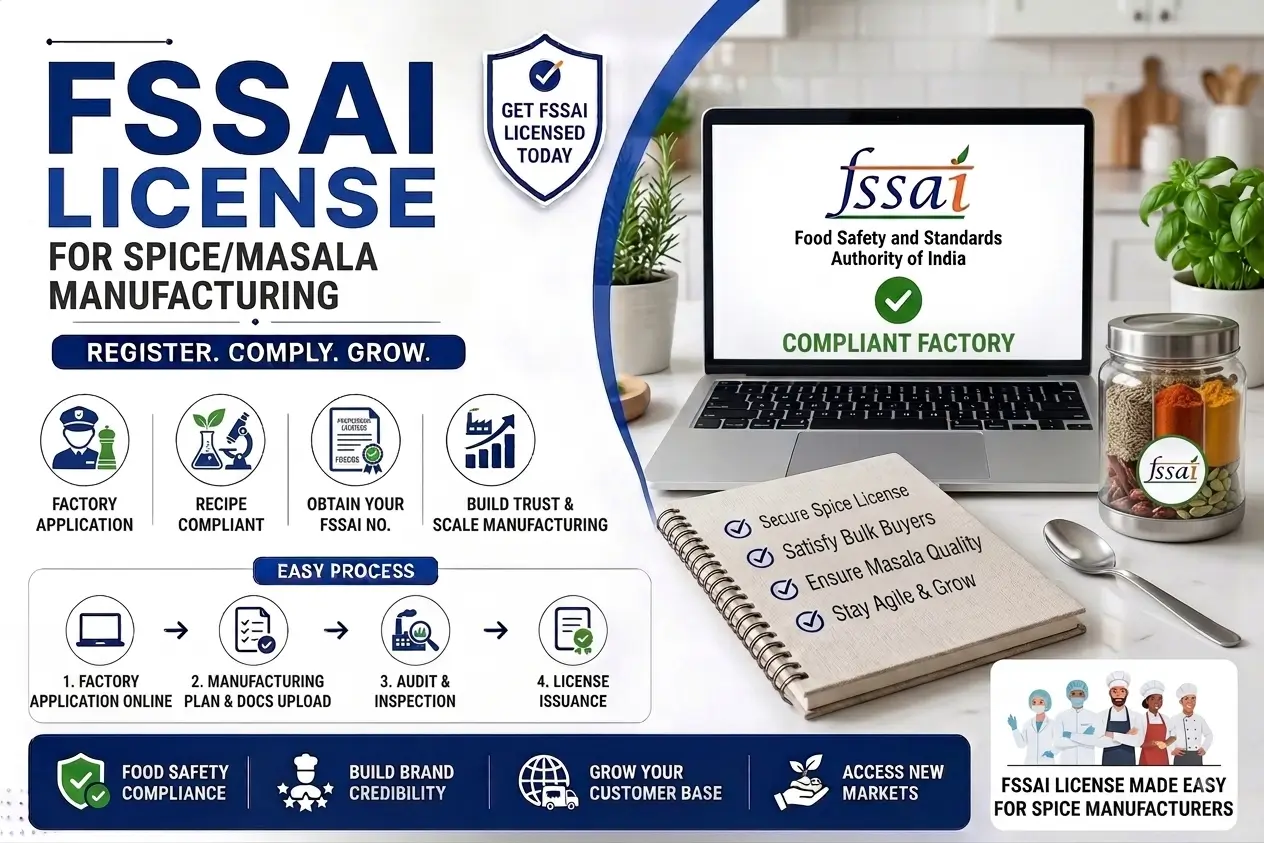
  • Correct license identified for your manufacturing turnover and scale
  • End-to-end FoSCoS filing handled by CA/CS professionals
  • Perpetual validity under the 2026 rules — no repeated renewals
  • Trusted by 50,000+ Indian entrepreneurs and food manufacturers
50,000+ Businesses Served 15+ Years CA/CS Expertise FoSCoS Filing Specialists Pan-India Service
FSSAI License for Spice and Masala Manufacturing
Updated for FSSAI's 2026 Reforms

What Changed in FSSAI Rules — Effective 1 April 2026

FSSAI notified major reforms on 13 March 2026, effective 1 April 2026, that directly affect spice and masala manufacturing units. Here's what's new:

Basic Registration limit raised from ₹12 lakh to ₹1.5 crore annual turnover
State License now applies above ₹1.5 crore up to ₹50 crore turnover
Central License now applies above ₹50 crore turnover, or for importers, exporters and certain multi-state operators regardless of turnover
Perpetual (lifetime) validity — registrations and licenses no longer expire on a fixed 1–5 year cycle
Automatic category upgrade if turnover crosses your slab, free of cost, keeping your existing license number
Risk-based inspections — fewer routine checks for compliant, well-documented manufacturing units
FSSAI Basics

What Is an FSSAI License for Spice & Masala Manufacturing?

An FSSAI license is a mandatory food safety approval issued by the Food Safety and Standards Authority of India that permits a unit to manufacture, process, pack, and sell food products. Spice and masala manufacturing — grinding raw spices, blending masala mixes, or packaging powders under your own brand — is classified as food processing, so it requires an FSSAI license before you can legally sell to retailers, wholesalers, or consumers, whether you run a small home-based grinding unit or a larger processing facility.

Who Needs FSSAI License for Spice or Masala Manufacturing?

Businesses That Must Register

Spice grinding and powdering units, masala blending and packaging businesses, home-based spice brands, contract manufacturers producing masala for other labels, and units exporting spices or masala mixes all require an FSSAI license before they can manufacture or sell.

Why It Matters

Retailers, distributors, and e-commerce marketplaces require a valid FSSAI license and number printed on your packaging before listing your masala brand. Manufacturing without one can attract penalties under the Food Safety and Standards Act and block export or bulk-supply opportunities.

Which FSSAI License Applies to Your Spice/Masala Unit? (Updated 2026 Limits)

For manufacturers, the correct license depends on annual turnover and production capacity, not just turnover alone — larger grinding or blending capacity can require a State or Central license even at moderate turnover.

License TypeAnnual Turnover (2026 Limits)Typically Used By
FSSAI Basic RegistrationUp to ₹1.5 croreHome-based spice units, small masala grinding businesses
FSSAI State LicenseAbove ₹1.5 crore – ₹50 croreBranded masala manufacturers, mid-size processing units
FSSAI Central LicenseAbove ₹50 crore, exporters, or multi-state manufacturingLarge spice processors, exporters, multi-state brands

Documents Required for FSSAI License for Spice/Masala Manufacturing

1

Identity ProofAadhaar Card, PAN Card, or Voter ID of the applicant

2

Manufacturing Unit Address ProofRent agreement, electricity bill, or property document for the unit

3

Unit Layout PlanBlueprint showing processing, packaging, and storage areas

4

List of MachineryGrinding, blending, sieving, and packaging equipment installed

5

Product List & Recipe DetailsSpice blends, masala mixes, and any additives used

6

Water Test ReportPortability certificate for water used in processing (if applicable)

7

Bank Account DetailsCancelled cheque or bank statement (for State/Central license)

8

Food Safety Management PlanHygiene and quality-control declaration (we prepare this for you)

How to Apply for FSSAI License for Spice/Masala Manufacturing

Check Eligibility

We assess your turnover and manufacturing capacity against the revised 2026 slabs to confirm whether Basic, State, or Central license applies.

Share Documents

Send your ID proof, unit address proof, layout plan, and machinery list to our team over WhatsApp or our secure online form.

Application Filed on FoSCoS

Our CA/CS professionals prepare and file your manufacturing license application on the FoSCoS portal accurately, the first time.

Query Handling

If the FSSAI department raises any clarification on your unit or process, we respond directly so you're never stuck on a portal.

Follow-Up Till Approval

We track your application status and follow up proactively until it's approved.

Certificate Delivered

Your FSSAI license certificate is delivered to you digitally, with perpetual validity under the 2026 rules.

Pricing

Choose the Best Package That Suits You

Transparent, all-inclusive professional fees — no hidden charges. Pick the license that matches your manufacturing unit's turnover and scale.

FSSAI State License

For branded masala manufacturers, above ₹1.5 crore–₹50 crore turnover
₹4,999/-
+ Govt fee: ₹2,000 – ₹5,000/year depending on business type
  • Document preparation & review
  • Online application filing (FoSCoS)
  • Query & clarification handling
  • Follow-up till license issued
Apply Now for State License

FSSAI Central License

For large processors, above ₹50 crore turnover, or export businesses
₹6,500/-
+ Govt fee: ₹7,500/year
  • Document preparation & review
  • Online application filing (FoSCoS)
  • Query & clarification handling
  • Follow-up till license issued
Apply Now for Central License

Why 50,000+ Entrepreneurs Trust SetupFiling.in

50,000+

Businesses served across India

15+ Yrs

Combined CA, CS & Trademark Attorney expertise

100%

Online process, zero office visits

Pan-India

Support for every state's FoSCoS filing

Frequently Asked Questions

Is FSSAI license mandatory for spice or masala manufacturing?

Yes. Grinding, blending, or packaging spices and masala for sale is classified as food manufacturing, so any unit — home-based or commercial — must hold an FSSAI license under the Food Safety and Standards Act before selling to the public.

Which FSSAI license applies to a spice/masala unit in 2026?

Under the turnover limits revised effective 1 April 2026, small and home-based spice units qualify for fssai basic registration up to ₹1.5 crore turnover. Branded manufacturers above that threshold, up to ₹50 crore, need a State License, and exporters or units above ₹50 crore need a Central License.

Do I need FSSAI license to sell homemade masala online?

Yes. Selling homemade or small-batch masala through Instagram, WhatsApp, or e-commerce marketplaces still qualifies as a food business, and platforms typically require your FSSAI number before listing your product.

What documents are required for an FSSAI license for spice manufacturing?

You need identity proof, address proof of the manufacturing unit, a layout plan of the processing area, a list of machinery used for grinding or blending, and details of the spice products you manufacture. State and Central licenses may also require a food safety management plan and water test report.

How long does it take to get an FSSAI license for a masala manufacturing unit?

FSSAI Basic Registration is typically issued within 7 to 10 working days of filing a complete application. State and Central manufacturing licenses can take 15 to 45 working days, since the department may require a site inspection of the processing unit.

Do I still need to renew my FSSAI license every year?

Not under the current rules. FSSAI registrations and licenses granted under the 2026 reforms carry perpetual (lifetime) validity and no longer expire on a fixed 1–5 year cycle, though you must continue meeting hygiene and food safety compliance. Licenses issued before the reform under the older 1–5 year cycle still follow their original renewal timeline until migrated.

What happens if I manufacture spices or masala without FSSAI license?

Manufacturing food products without FSSAI license can attract penalties of up to ₹5 lakh or more depending on the violation, along with the risk of seizure of stock and closure of the manufacturing unit by food safety authorities.

Ready to Get Your FSSAI License?

Join 50,000+ entrepreneurs who trusted SetupFiling.in to handle their food business compliance — start to finish, without a single office visit.