💳 Pay Now |
✍️ Learning Center
Yes, if your business operates in a state that levies professional tax. A proprietor must enrol for the owner's own liability (PTEC), and must also register as an employer (PTRC) once staff earn above the state threshold. In states that don't levy it, there is nothing to register.
Government fee varies by state. No hidden professional charges.
Secure payment via Razorpay · Instant confirmation
Yes, in states that levy professional tax. A sole proprietor earning from a business or profession must hold a Professional Tax Enrolment Certificate (PTEC), even with no employees. If the firm also employs people above the state's salary threshold, it needs a Professional Tax Registration Certificate (PTRC) too.
Professional tax is a state levy, not a central one, so the answer depends on where your business operates. A proprietorship has no separate legal identity from its owner, which is why the owner's own income from the business is what attracts the tax.
The tax itself is small, capped by the Constitution at ₹2,500 per year per person. The real risk is not the amount but the compliance: unregistered proprietors in a levying state can face penalties, late-filing charges, and difficulty with bank loans and tenders.
Get My PT Certificate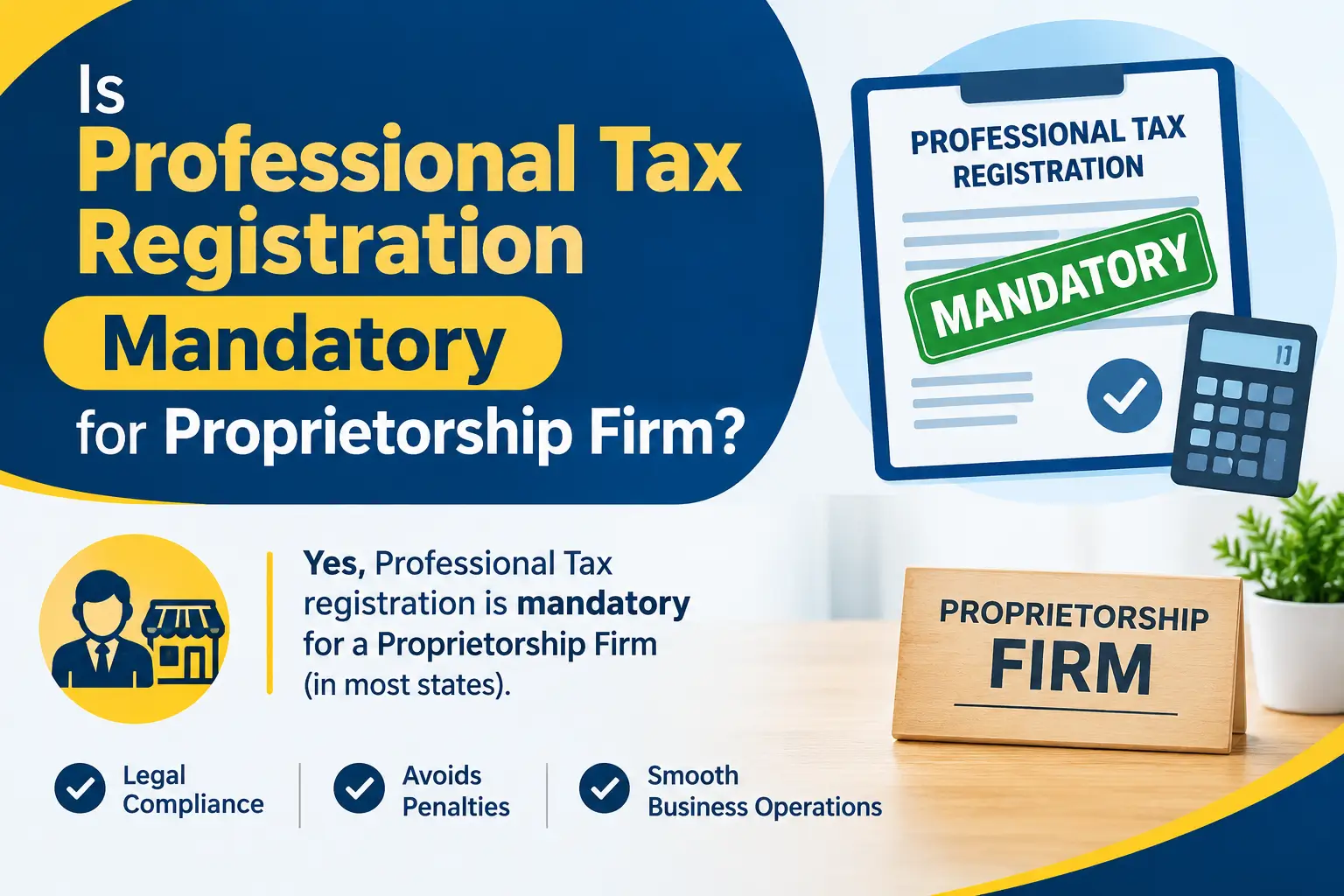
Most founders miss this distinction. A proprietor can need one registration, or both, depending on whether the firm has employees.
| Point | PTEC (Enrolment Certificate) | PTRC (Registration Certificate) |
|---|---|---|
| Who it is for | The proprietor, as a self-employed person earning from business or profession | The firm, as an employer with staff above the salary threshold |
| What it covers | Professional tax on the owner's own income | Deducting professional tax from employees' salaries and paying it to the state |
| Needed with no employees? | Yes, in states that levy the tax | No |
| Returns | Usually annual, varies by state | Monthly or quarterly, depending on liability and state |
A proprietorship with employees typically needs both: PTEC for the owner and PTRC for the staff. Due dates and slabs can differ between the two within the same state.
Professional tax is not a pan-India tax. About 20 states and one union territory levy it as of FY 2026-27, so mandatory registration depends entirely on your business location.
These include the following, among others. A proprietor in any of them should check PTEC applicability.
These states do not levy it, so a proprietor there has nothing to register.
State rules and rates change. Confirm the current position with your state's professional tax department, or let us check it for you before you file.
You run the business alone and have no employees. You still need a PTEC to pay professional tax on your own income from the business.
You employ staff earning above the state threshold. Register for PTEC for yourself and PTRC to deduct and deposit tax from their salaries.
Your business and all your staff are in a state such as Delhi, Haryana, Uttar Pradesh, or Rajasthan. Professional tax does not apply.
If you have staff working remotely in a levying state, you generally need to register as an employer there and deduct tax at that state's slab.
The amount is modest and capped, but it varies by state, so there is no single national figure.
Our professional fee of ₹1,499 covers the filing work. The state's own registration or enrolment fee is separate and is paid at actual cost.
We first check whether your state levies professional tax and which certificate applies to you: PTEC, PTRC, or both.
We prepare your PAN, Aadhaar, address proof, and business proof in the format your state portal expects.
We file the enrolment or registration application on your state's professional tax portal on your behalf.
The applicable government fee is paid at actual cost, which varies by state, and the application is submitted for approval.
The state department verifies your details. If it raises a query, we respond to it so your application does not stall.
You receive your Professional Tax certificate with its registration number, ready for annual payment and return filing.
The proprietor's PAN, since the proprietorship is registered under the owner's identity.
Identity and address proof of the proprietor for the application.
Rent agreement, electricity bill, or property paper for the place of business.
Proof that the business exists, such as a GST Certificate, Udyam certificate, or Shop and Establishment licence.
A cancelled cheque or statement for the business or proprietor's account.
Names and salaries of staff, needed only when applying for PTRC as an employer.
Not true in levying states. Employer registration (PTRC) needs employees, but the owner's own enrolment (PTEC) does not.
GST is a central tax and professional tax is a state tax. Having a GSTIN does not enrol you under any state's professional tax law.
The tax is small, but late or missed filings can attract state penalties, and many tenders and lenders ask for the certificate.
One flat professional fee. The state's own fee is paid at actual cost.
Professional Fee
The government fee depends on your state and on whether you need PTEC, PTRC, or both. We confirm it before you pay.
Apply Now →Yes, in states that levy professional tax. The proprietor must enrol for PTEC on their own income, and the firm must also register for PTRC if it employs people above the state's salary threshold. In states that do not levy the tax, registration is not required.
You do not need PTRC, which is for employers. But in a levying state you still need PTEC, because the proprietor earns income from a trade or profession and is personally liable for the tax.
PTEC is the enrolment certificate for the proprietor's own liability. PTRC is the registration certificate for an employer who deducts professional tax from employees' salaries. A proprietorship with staff usually needs both.
The amount is set by each state and is capped at ₹2,500 per person per year under the Constitution. Many states charge a flat annual amount for self-employed persons, so check your state's current slab.
States such as Delhi, Haryana, Uttar Pradesh, and Rajasthan do not levy professional tax, along with several others. Rules can change, so confirm the current position for your state.
Yes. For a self-employed proprietor, professional tax paid is generally allowed as a business expense under Section 37(1) of the Income Tax Act.
In a levying state, states can impose penalties for non-registration and for late payment or filing, and continued non-compliance can lead to further action. The certificate is also often asked for in tenders and loan applications.
Our professional fee is ₹1,499 plus the government fee, which varies by state. The fee covers document preparation, application filing, and issuance of the professional tax certificate.
Join 50,000+ businesses who trust SetupFiling.in for their registrations and compliance.