💳 Pay Now |
✍️ Learning Center

Confused between MSME Registration and Udyam Registration? They are not two separate schemes — Udyam is the current, official online system that replaced the old MSME (Udyog Aadhaar) process. Get your Udyam/MSME Certificate issued quickly, with complete document preparation and application filing handled for you.
All-inclusive package, no hidden charges
₹999/- only
Secure payment via Razorpay · Filing starts same day
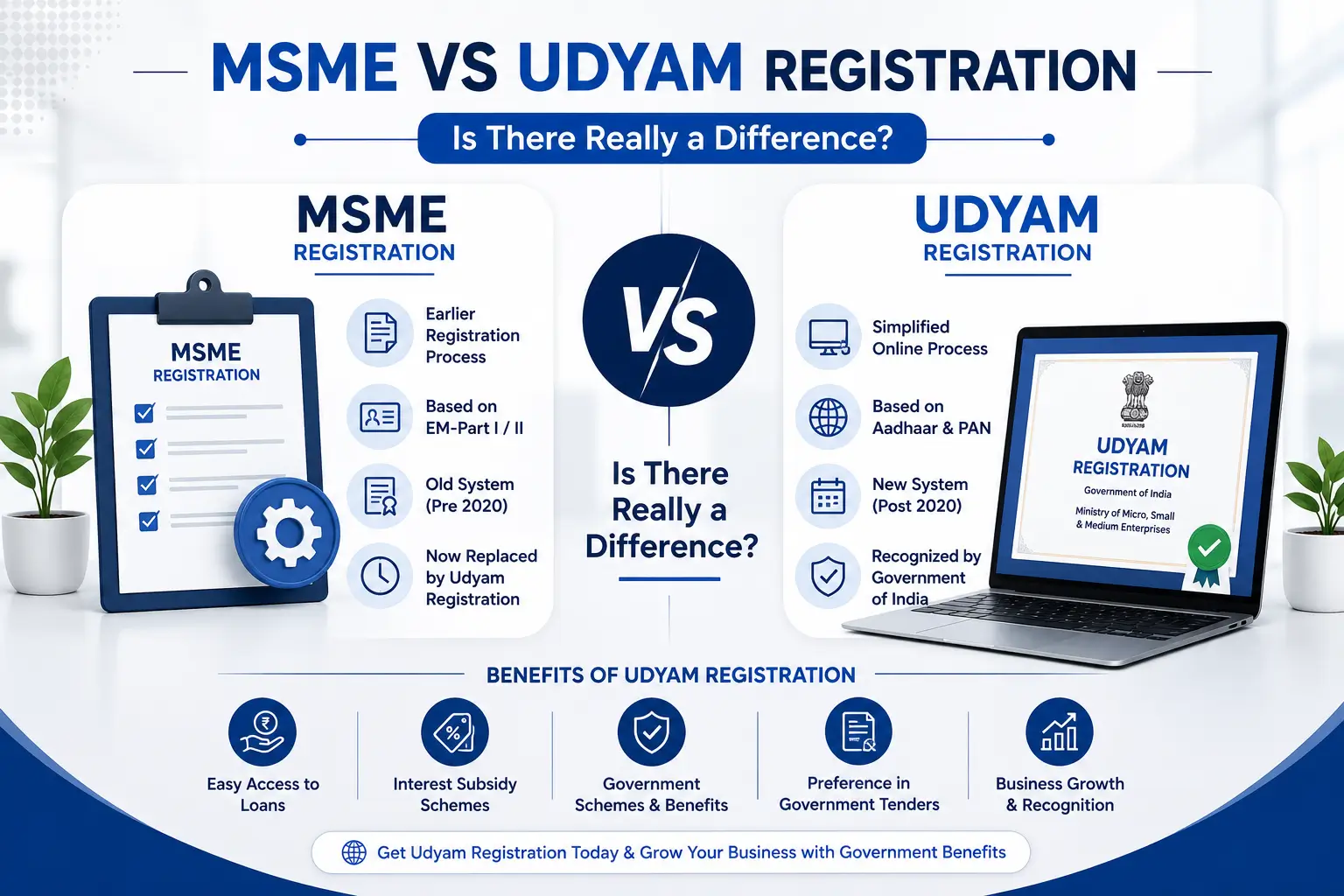
MSME Registration vs Udyam Registration — how the two terms relate and which one your business actually needs.
MSME Registration is the broad term for registering as a Micro, Small, or Medium Enterprise in India. Udyam Registration is the specific, government-mandated online system (launched 1 July 2020 by the Ministry of MSME) through which this registration is now done. In simple words — every Udyam Registration is an MSME Registration, but you can no longer get "MSME Registration" through the old Udyog Aadhaar or EM-II routes; Udyam is the only valid process today.
The table below breaks down how the old MSME registration system compares with the current Udyam Registration framework, so you know exactly what applies to your business in 2026.
| Parameter | MSME Registration (Old / General Term) | Udyam Registration (Current System) |
|---|---|---|
| What it is | Generic term for registering a Micro, Small or Medium Enterprise | Official online portal-based registration process for MSMEs |
| Governing body | Ministry of MSME (earlier via EM-I/EM-II, Udyog Aadhaar) | Ministry of MSME, Government of India |
| Effective since | Discontinued after 30 June 2020 | Applicable from 1 July 2020 onward |
| Application basis | Self-declaration, multiple documents | Aadhaar & PAN-linked, auto-fetches data from Income Tax and GST records |
| Classification criteria | Based only on investment in plant & machinery/equipment | Based on both investment AND annual turnover |
| Certificate issued | Udyog Aadhaar Memorandum (UAM) — no longer issued | Udyam Registration Certificate with a unique Udyam Registration Number (URN) |
| Validity today | Not valid for new applications | Permanent, lifetime validity (self-updation required) |
| Where to apply | Not applicable anymore | udyamregistration.gov.in or through an authorised filing partner |
MSME stands for Micro, Small and Medium Enterprises. "MSME Registration" is the umbrella term Indian business owners use when they want official recognition of their business under the MSME Development Act, 2006. This recognition unlocks priority-sector lending, subsidies, tax benefits, and protection against delayed payments from buyers.
Udyam Registration is the digital, paperless system introduced by the government to grant this exact MSME status. It replaced Udyog Aadhaar Memorandum (UAM) and the earlier EM-I/EM-II filings. Once registered, your business receives a permanent Udyam Registration Number (URN) and an official Udyam Certificate that acts as proof of your MSME status.
Under the revised composite criteria, a business is classified as Micro, Small, or Medium based on both investment and turnover:
| Enterprise Type | Investment in Plant & Machinery/Equipment | Annual Turnover |
|---|---|---|
| Micro Enterprise | Up to ₹1 crore | Up to ₹5 crore |
| Small Enterprise | Up to ₹10 crore | Up to ₹50 crore |
| Medium Enterprise | Up to ₹50 crore | Up to ₹250 crore |
Sole proprietorships, partnership firms, LLPs, private limited companies, HUFs, and co-operative societies engaged in manufacturing or services can apply. Wondering whether MSME registration is mandatory if you run a sole proprietorship? It isn't legally compulsory for every business, but it is highly recommended for the loan, tax and tender benefits it unlocks.
Aadhaar number of the proprietor/partner/director, PAN of the business and owner, mobile number linked to Aadhaar, and bank account details.
Nature of business activity (manufacturing/service), investment figures, GST number (if applicable), and previous year's turnover as per ITR/gst returns.
No physical documents need to be uploaded — the Udyam portal fetches PAN and GST data automatically once you enter your basic details, which is what makes the GST registration for a sole proprietorship and Udyam process much faster than the older MSME filing method.
Here is the step-by-step process our team follows to get your Udyam Registration Certificate issued without errors or rejections.
Send us your Aadhaar number, PAN, mobile number, and a short description of your business activity via WhatsApp or the application form.
Our team verifies your PAN, GST, and turnover figures and prepares the exact data set required by the Udyam portal.
We file your application on the official Udyam Registration portal, selecting the correct enterprise category (Micro/Small/Medium) and activity type.
An OTP is sent to the Aadhaar-linked mobile number for identity verification and final submission of the application.
Once approved, your Udyam Registration Certificate with a unique URN is generated and shared with you by email — ready to use for loans, tenders, and subsidies.
Already registered and need your certificate again? Here's how to download your Udyam certificate using just your mobile number.
Start My Udyam Registration – ₹999/-Access priority-sector lending and collateral-free loans under schemes like CGTMSE, useful when you also prepare a project report for an MSME loan or a Mudra loan project report.
Buyers must pay registered MSMEs within 45 days, with interest applicable on delayed payments under the MSMED Act.
Eligibility for capital investment subsidies, ISO certification reimbursement, and schemes such as the PMEGP loan scheme.
Government tenders often reserve a quota exclusively for registered MSMEs, along with EMD exemptions.
Easier compliance under GST and income tax, plus concessions on certain statutory fees and patent/trademark filing costs.
An official business registration certificate strengthens your profile with banks, vendors, and marketplaces.
If you run a manufacturing unit, a service business, a trading firm, or even a home-based venture, Udyam Registration applies to you as long as you fall within the investment and turnover limits above. It's especially useful for businesses that have completed the complete process of registering a sole proprietorship, food businesses holding an FSSAI license, exporters, e-commerce sellers, and manufacturing SMEs planning to protect their brand through trademark registration in India.
Yes, in practice. Udyam Registration is simply the current, official process for obtaining MSME status. There is no separate "MSME Registration" application anymore — Udyam Registration is how MSME status is granted since 1 July 2020.
Udyam Registration is not legally mandatory for every business, but it is required if you want to claim MSME benefits such as collateral-free loans, delayed payment protection, subsidies, and tender preferences.
No. Udyog Aadhaar and the old EM-I/EM-II filing methods have been discontinued. All new and re-registrations must be done through the Udyam Registration portal.
Micro enterprises: investment up to ₹1 crore and turnover up to ₹5 crore. Small enterprises: investment up to ₹10 crore and turnover up to ₹50 crore. Medium enterprises: investment up to ₹50 crore and turnover up to ₹250 crore.
You mainly need the Aadhaar number of the business owner, PAN of the business, a linked mobile number, bank details, and GST number if applicable. No physical document upload is required.
Once documents and details are verified, the application is typically filed the same day, and the Udyam Certificate with your unique URN is issued shortly after successful verification.
Our end-to-end Udyam/MSME Registration service, covering document preparation, application filing, and certificate issuance, is priced at ₹999/- only.
Yes. Sole proprietors, freelancers offering services, partnership firms, LLPs, and companies are all eligible to apply for Udyam Registration as long as they meet the investment and turnover criteria.
Join 50,000+ customers who trust us for fast, error-free business registrations across India.